Review: With a new drummer and a tribute to Peart, a resurgent Rush gets back to work
Published in Entertainment News


CHICAGO — Rush’s first direct tribute to late drummer Neil Peart arrived before the second song on Thursday night at a packed United Center, where the band is playing a series of four concerts through this Wednesday.
Peart was the Canadian group’s drummer until his death from cancer in early 2020, and from a self-effacing pre-concert introduction video to a comedic post-encore outro, the entire 155-minute concert functioned as a cozy bear hug of an homage to the former bandmate. His lyrics, spirit and sound informed virtually every aspect of Rush’s impressive opening night in Chicago.
Making the third U.S. residency stop on its unexpected “Fifty Something” tour, Rush displayed few signs of decay. There’s no need to expect much more at this juncture from the ensemble, coming off a decade-plus-long layoff and adapting to a new face on the drum stool. Backing tracks were thankfully absent here, despite a couple of slip-ups from guitarist Alex Lifeson.
The big question in nearly everyone’s mind — could Anika Nilles, who accepted the unenviable job of subbing for Peart, respond to the technical challenges and mesh with bassist-singer Geddy Lee and Lifeson — was quickly answered in the affirmative.
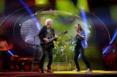
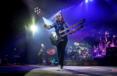
Declaring it meant business, with Lifeson wrestling with the heft of a double-neck guitar and Lee navigating the contours of a double-neck bass, Rush opened with all the subtlety of a triple exclamation mark. One of the most demanding prog-rock tunes in the group’s catalog, “Xanadu” issued an instant status report on Rush’s agility and strength. The epic also provided Nilles an immediate chance to quiet concerns. Suffice it to say she’ll probably never worry about fielding calls from major artists seeking her out once her current engagement ends.
Nilles gave a clinic in the art of stability, control, power, timing and organization. Rather than attempt to replicate the intricacies of Peart’s style or mimic his jazz-inspired flair, the 43-year-old German native leaned on her own traits — unflappable calm, steadfast focus, forcefulness you felt in your chest, a touch of youthful zest — in shoring up foundations, sailing through dynamic passages and furnishing her mates invaluable dependability. Along with plenty of reasons to smile.
No band can replace the chemistry shaped with another individual over a lifetime. Especially if that musician helped map the course of songs and penned almost all the narratives. Nilles operated as if she, too, was paying respect to Peart and the music he left behind. She played with a preparedness, joyfulness and enthusiasm the fallen drummer would’ve admired. Nilles’ persistent visual communication with Lee, who stood in front of her kit and faced her on multiple occasions, further suggested respect and appreciation.
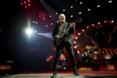
Prancing, sprinting, skipping, kicking up a leg, executing a wobbly pirouette: Lee shared in Nilles’ fervor. Wearing vintage-looking glasses, slicked-back shoulder-length hair and a gray soul patch, the fit-and-trim singer clearly has missed the stage. He throttled an array of gorgeous Fender and Rickenbacker basses with similar intensity. Lee’s left-hand fingers sprawled, darted, pounced and pushed their way up and down fretboards. His methodical movements evoked those of a spider hell-bent on spinning a web; the rhythmic lines he produced exploded with discernible texture and tonal punch.
Lee’s fluid, famously high-pitched voice reached most of the intended upper frequencies. His range lowered and deepened by the impact of aging, he adjusted his timbre on a few songs (“2112 Part II: The Temples of Syrinx,” “Red Barchetta”) and received subtle boosts via echo and projection on certain choruses. Intelligibility suffered only when he climbed too high on the ladder, his words liquifying into a soup.
Expanded beyond a trio for the duration of every show for the first time on a tour, Rush used auxiliary keyboardist Loren Gold to take some responsibilities off Lee’s plate even as the bassist simultaneously juggled singing, bass and Moog synthesizers with regularity. Gold’s nuanced contributions rounded out and accented arrangements, stirring pigment into colorful blends of rock, pop, blues, classical, reggae, metal, funk and folk that seemingly speak to a larger audience than ever.
Indeed, the initial itinerary for Rush’s first outing since 2015 called for only 12 shows in seven North American locations. After tickets promptly sold out, extra nights and cities were added. Factoring in subsequent expansion to South America and Europe in 2027, the “Fifty Something” tour now encompasses upwards of 80 concerts — more than double the scope of Rush’s preceding “R40 Tour.”
Local demand for the band has arguably never been greater. A late-winter 1981 run at International Amphitheatre signaled the last time Rush played a run of four dates in Chicago. Though Lee and company have been a strong draw for decades, they began to fail to consistently fill area venues in the 2000s.
Rush addressed each of its four distinctive eras over the course of the program, which skewed slightly toward the synth-based material of the early ’80s and acknowledged the band’s heavy roots in the encore. In a classy turn, the collective nodded to co-founding original drummer John Rutsey by flashing his name and rendering his comic-illustrated likeness amid the visual complements to “Working Man.”
But the man of the hour was Peart, heard talking and seen in his element in a handful of concise, well-produced interludes. Lee served as the proud master of ceremonies, praising Peart’s evolution as an observational songwriter and his outsized impact. The tender balladry and reflective essence of “The Garden” invoked Peart’s journeyman quality and probing soulfulness. Animated imagery of a riderless motorcycle (a Peart enthusiasm) exploring places unknown and the drummer poring over words in a peaceful cottage reflected the refined dignity and emotional warmth that made the event something far more than a nostalgic trip down memory lane.
Save for the compositions themselves, of course, Rush treated everything with a measure of restraint. Bursts of strategic albeit minimized pyrotechnics. High-definition backdrop graphics that imparted ideas by changing small details around a main, unshifting motif. Lighting and lasers that resisted excess. An uncluttered rooftop-like stage setting, ornamental props and creative doodads that expressed the band’s whimsical side.
All decisions that spotlighted the thrill-ride music. And drew attention to how Rush piloted its way through impossibly complex instrumental mazes via dizzying fusions of accessible melodies and memorable hooks; heady riffs and mystical notes; grand flourishes and streamlined attacks; winding fills and blistering wah-pedal solos.
Sure, “Limelight” unfolded at a slower clip. Lifeson, who lacked the effortlessness and mobility his fellow 72-year-old colleague Lee enjoyed, botched the crackling-electricity prelude to “The Spirit of Radio.” Minor flaws given the quartet handled lengthy, elaborate pieces such as the multi-part “La Villa Strangiato,” spry “YYZ,” cerebral “Natural Science” and three sections of the majestic “2112” with diligence, fun and conviction. And that the thematic calls — to resist conformity, embrace knowledge, maintain free will, escape alienation, heed the environment, dare to dream — resonated with stinging relevance and urgency.
“I can’t stop thinking big,” Lee repeatedly sang on “Caravan.” More than 50 years after three Ontario teenagers settled on creating what they deemed “Energized Rock” on their original T-shirts, that base inclination continues to thrive.
Setlist from the United Center July 16:
Set One
“Xanadu”
“Limelight”
“Far Cry”
“Subdivisions”
“Free Will”
“Bravado”
“Caravan”
“La Villa Strangiato”
“Vital Signs”
“The Spirit of Radio”
Set Two
“2112 Part I: Overture”
“2112 Part II: The Temples of Syrinx”
“2112 Part VII: The Grand Finale”
“Distant Early Warning”
“Red Barchetta”
“Dreamline”
“Natural Science”
“Time Stand Still”
“Red Sector A”
“YYZ”
“The Garden”
“Tom Sawyer”
Encore
“By-Tor and the Snow Dog”
“Working Man”
———
©2026 Chicago Tribune. Visit at chicagotribune.com. Distributed by Tribune Content Agency, LLC.








Comments