Howard Jones, back on tour, reflects on hippie ideals: 'There was a lot of good about it'
Published in Entertainment News
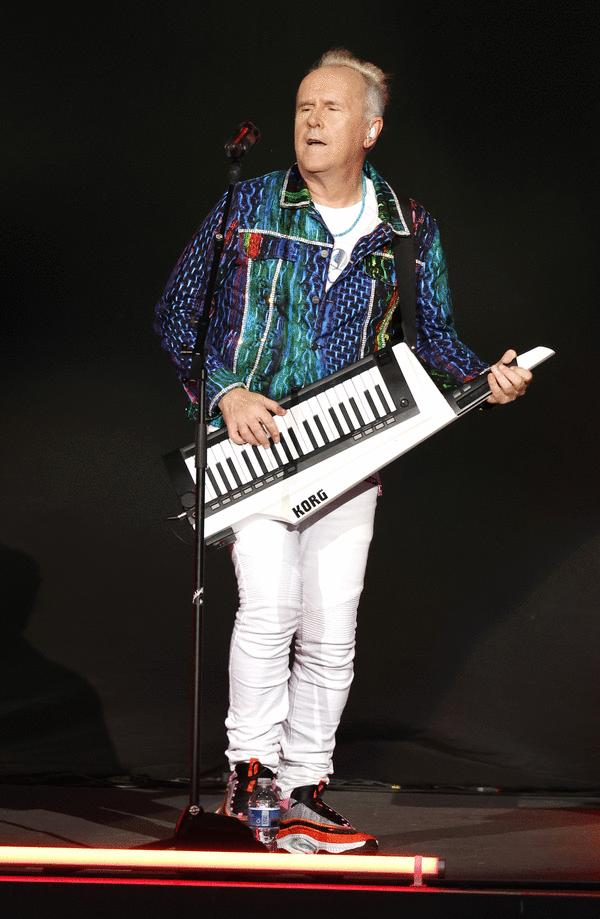
SAN DIEGO — Was Howard Jones once a hippie? It’s not a far-fetched notion, especially considering this pioneering 1980s synth-pop maverick had an epiphany at 15 when he saw the 1970 film documentary “Woodstock” and still raves about watching Jimi Hendrix perform at the Isle of Wight festival in England later that same year.
“I had very long hair when I went to music college, so I guess that’s a bit hippie-ish,” said Jones, who brings his “Things Can Only Get Better” tour to SDSU’s Cal Coast Credit Union Open Air Theatre next Friday, July 24.
“But I don’t know if hippies practiced piano nine hour a day, playing all the classical repertoire. And as soon as I left college, I had my hair cut really short and started to think very differently. But I don’t think anybody could have avoided the hippie philosophy of the time, because there are a lot of great things about it.”
Perhaps not coincidentally, Jones next album — due out in 2027 — is entitled “Global Citizen.” Its first single, “Stand Up,” was released July 9. The song’s lyrics encourage listeners to better the world by nonviolently opposing authoritarianism.
To underscore his commitment to peaceful change, Jones is featuring “Stand Up” as the opening number on his “Things Can Only Get Better” tour, which he curated and which features the bands Wang Chung, English Beat and Modern English.
“If we’re not going to slide into a completely authoritarian world, then each one of us must stand up for the direction that we want society to go in,” he said. “If we don’t do that, as individuals, then we’ll just be passengers to authoritarianism. And I don’t think anybody is going to enjoy that, because it hasn’t worked in the past and it’s not going to work now.”
Jones, 71, cites the Rev. Jesse Jackson’s 1972 poem “Stand Up, Black Man” as a major inspiration for “Stand Up.” The famed civil rights leader died in February at the age of 84.
“It’s a very straightforward poem that is so brilliant,” Jones said. “I hadn’t heard it before he passed away, and I thought: ‘I want to take inspiration from it’ because so many of the big problems in the world are caused because people think other people are different from them — ‘They don’t think or dress the way I do’ — so they’re scared of them, and this is the cause of conflict.
“But we should always be looking for the things that unite us, our humanity. So, stand up and be counted. It doesn’t mean you have to be aggressive or confrontational, but to challenge behavior around you that is disrespectful. That’s the message of the song: For people to have confidence in their beliefs and their good nature.”
Those attributes have helped Jones sustain a career that is now in its fifth decade. His first single, “New Song,” was released in 1983. It was followed by his 1984 debut album, “Human’s Lib.”
The album topped the charts in his native England, where he scored six Top 10 singles between 1983 and 1986. One of them “No One Is to Blame,” rose to the No. 4 spot in the U.S. on the national Billboard charts. The song also inspired an unusual tradition in San Diego, where Jones first performed in 1984 as the opening act for Joe Jackson at the SDSU Open Air Theatre. His “band” at the time consisted of Jones on vocals and synthesizers with silent accompaniment from a mime, Jed Hoile.
Airborne puzzle pieces
“There’s this particular thing that San Diego audiences do that no one does anywhere else,” Jones said in a 1996 Union-Tribune interview.
“When I get to the song ‘No One is to Blame,’ I (sing): ‘This is the last piece of the puzzle and I just can’t make it fit.’ As soon as I say that line, a rain of jigsaw-puzzle pieces hits the stage and has done so ever since I’ve been performing that song in ’85. It’s this incredible tradition. It’s become so bad that I can hardly sing the song.”
Jones was 30 in 1985. Speaking by phone last week from his home in Somerset, England, he laughed uproariously when asked if he’d ever worn protective headgear at any of his San Diego concerts.
“Are you talking about the puzzle pieces?” he asked, laughing again.
“The only place that ever happened was in San Diego. It was a bit of a shock the first time, and then it continued each time I performed there. The trouble with puzzle pieces is they get caught in my keyboards. They slot in between the keys, so it’s actually a bit annoying when that happens because I can’t play the song properly.”
Will Jones be disappointed if at least one puzzle piece doesn’t come flying up on stage during his San Diego concert next week?
He laughed again. “No, I probably won’t. I mean, I think that that was great when it happened, but that era now is over. We move on!”
He dissolved into an even bigger burst of laughter when asked if a puzzle company had ever approached him to do a corporate endorsement.
“No, no, no!”
Jones recently chatted with the San Diego Union-Tribune for 40 minutes. The interview has been edited for clarity and length.
Q: You made your San Diego concert debut 42 years ago as the opening for Joe Jackson, at the same venue where you are performing next week. Had anyone told you then that you’d be back playing the same venue in 2026 — and curating the lineup of bands for the concert here and an entire U.S. tour — would that have seemed remotely possible? Or would you have thought they were out of their mind?
A: I would have thought they’re out of their mind! I was only trying to make sure that my second album did well enough for me to keep going a bit longer, and I never would have thought I could keep going this long, but I did it. I did know one thing, though: This is the only thing I want to do.
Q: And if you were no longer touring or recording?
A: I would be playing in a pub somewhere, or a bar, doing my own music. I would still be doing this because this is what I’m supposed to do. I love it, and it’s what I can contribute. But I didn’t think it would be possible to keep it going for 40 years because, you know, pop music doesn’t allow you to do that very often. But it has; it’s been kind to me. People still want to come hear me. And I’m still making new music and I’m loving it. I’m still trying to get better at what I do.
It’s a process of evolution of the person and their skills. So, every day I’m in the studio, working on something new. And it’s got to be passionate like that. Because otherwise, if you go out on stage and you don’t have that passion, people know, they feel it, that you’re just going through the motions or just doing it for the money. That’s why I’m always trying to work on something new, playing new things in the set, finding new ways of playing the songs, singing better, playing better. Evolution!
Q: How does that correspond to the fact that, on a tour like this — with four artists who scored their biggest hits in the 1980s — a lot of concertgoers will be coming with a very deep sense of nostalgia and a desire to relive the music of their youth?
A: Well, I’ll be playing my brand new “Stand Up” as the first song in my set. I’ve also composed a completely new intro section, and I’ve got a new drummer with me now who’s playing entirely electronic drums. So, it’s always new and different. That said, you’re very right: There is an element of nostalgia in there.
But I also want to show people that you can be moving forward as well, not just living in the past like you’re some sort of museum exhibit. I think my fans know that I’m going to be changing things up, and that doing so keeps it interesting for me, and hopefully for them, too. But, yeah, I think a lot about what you’re saying. It’s very important to move forward.
Q: We last spoke a few years ago when I was writing an article about the legacy of the 1969 Woodstock festival. You recalled how seeing the “Woodstock” movie inspired you to attend your first festival, saying: “I saw (Jimi) Hendrix, The Who, Joni Mitchell and The Doors at England’s Isle of Wight festival in 1970, and the reason I went to it was because I’d seen the ‘Woodstock’ film. And that made me decide that that’s what I wanted to do in my life. It was mind-blowing!” If I recall correctly, Emerson, Lake & Palmer also played at the same Isle of Wight festival. Was that an epiphany for you?
A: Oh, absolutely. It was their second gig — they did a small warmup date before the Isle of Wight — and Keith Emerson had this big modular Moog synthesizer on stage. Nobody done that before, especially in that musical context. It was mind-blowing! I was such a fan of Keith, before ELP, when he was in the Nice. I saw them many times, and I got to meet Keith as well. He came to interview me for Contemporary Keyboard magazine. It was a big, big deal for me seeing him with ELP.
Q: In 2001, you performed alongside Greg Lake of ELP as a member of Ringo Starr’s All-Starr Band on a Ringo tour that included a concert at the same San Diego venue you are playing at here next week. How big of a full circle moment was it for you to get to play ELP’s “Karn Evil 9” onstage with Greg on bass and vocals and Sheila E on drums?
A: It was absolutely wonderful because I’m such a big ELP fan. And to actually be playing with Greg was a major moment for me. It was an extremely difficult piece to learn. I set aside a couple of months to nail it, but I relished the challenge as a keyboard player. And I was classically trained, like Keith, so I certainly should have the chops to do it. It was a wonderful thing, yeah, absolutely brilliant.
Q: As you may recall, in 1986 Greg Lake and Keith Emerson did a tour without Carl Palmer. They had Cozy Powell on drums instead, which enabled them to still be billed as “ELP.” If at some point, Greg and Carl had wanted to tour and the now-deceased Keith had not been available, was there ever talk of a Jones, Lake & Palmer tour?
A: I got to know Greg on the Ringo tour quite well, and he sort of hinted at doing something with me because he realized that I could play the (keyboard) parts. But it never came to pass, because — later on — he became quite ill and wasn’t able to tour. It would have been tempting to do it. But I’ve got my own work, so it would have been difficult to do, although I never had to make that choice.
Q: And “JLP” would have been a difficult acronym to pronounce.
A: (Laughs) Yeah!
Q: Speaking of prog-rock, in the late 1960s Elton John auditioned for the band that soon morphed into Gentle Giant. I’m curious: Did you audition for any bands?
A: I did. I auditioned for Billy Ocean’s band when I was still at Music College in Manchester. I got to meet him several times since and reminded him that I did audition for his band. It would have been tempting to do if I’d have been offered a job on the spot.
Q: What was a bigger “pinch-me” moment for you in 1985 — doing a solo version of your song “Hide and Seek” at Live Aid at London’s Wembley Stadium, or performing on the Grammy Awards telecast earlier that same year with Stevie Wonder, Herbie Hancock and Thomas Dolby?
A: It was just so cool to be on that stage with Herbie and to get together in the studio beforehand and hang out with them. I suppose I should have felt a bit intimidated to be there, but I didn’t. I’d grown up with Stevie’s music; he’s huge influence on me, not just songwriting-wise and with his philosophy and lyrics, but also because he was always the first person to have the newest keyboards and be doing cool things with them, in a very soulful way. So, that was a big influence on me.
And I thought it was great to have the legends, Stevie and Herbie, coming together with the new lads, Thomas and me. We were just having fun with all these new instruments, and it was such a cool thing they did to bring us together on the Grammys, because it suddenly made synthesizers okay with everyone. That was a pivotal moment.
Before that, people were saying things like: “No synthesizers were used on this record,” as if it was some sort of alien technology that would not very good for you! So, when I look back on that performance, I was like: “I can’t believe I’m here at the Grammys doing this with these guys.” But I thought that I should be there. I had the confidence to think that it was OK to be there.
Q: What about Live Aid?
A: Live Aid was just amazing. I mean, to be sharing the stage with lots of musicians that I was so familiar with was great. And I got to meet them and hang out with Paul and Linda McCartney, David Bowie, and the guys from Queen. It was brilliant! And also what I chose to do was to just play a song at the piano, which I don’t think people realized that I could do because they were used to seeing me as a one-man band who sang and played synthesizers.
The piano was my first instrument and is the one that I can convey the most emotion with. And the audience that day was so enthusiastic, so happy to be there, and they sang with me the whole chorus of the song. I still have a clear memory of every moment of that, and it’s just wonderful.
Q: I first saw you perform in San Diego in May 1984 when you opened for Joe Jackson at the same amphitheater at San Diego State University where you will perform later this month. In my review, I wrote: “Far more interesting was the concert’s opening performance by Howard Jones, who presented himself as a sort of one-man synth-pop band. Utilizing a bank of synthesizers and drum machines, as well as a mime and taped accompaniment, Jones’ set was both stirring and soulful.” Was it a goal of yours to bring warmth to an otherwise all-electronic musical setting? Or am I reading into it?
A: I think that’s a fair assessment. I’ve always thought that primarily I’ve been a songwriter wanting to get over lyrics, and to be melodic and heartfelt. But I loved synthesizers, because it was like having an orchestra to realize my musical ideas with and to do something new. And I liked that it would be a bit challenging for people. I hadn’t heard of anybody who’d ever done that before, performing live with synthesizers and no band, so it suited me really, really well.
The part that I loved most was that I had to engage with the audience., I could not be remote from them. Because there was just me and Jed (Hoile) on stage, and Jed was a mime and didn’t say anything! So, you had to involve the audience, and that was such a good thing for me to learn how to do.
Q: Were there many auditions to be the mime who toured with you? Or was Jed the first and only person you thought of for the job?
A: That was a completely organic thing. I was doing the one-man show very early in its prototype form, and Jed was a friend who used to come to those little tiny gigs I was doing. He’d be dancing in the in the audience and it was mesmerizing for me, watching him from the stage, and I thought he should be up here with me,
So, we together came up with all these different characters (for him) that would go with the songs. And then that evolved into costumes and videos and the whole visual element to the show, which was quite unique. I think it was more like performance art, really. And yeah, so it was a very natural thing. There were no auditions. It was just: ‘Oh, Jed, you should be up on stage. Let’s do that!” He’s still a very good friend of mine.
Q: Wrapping things up, have you ever met your namesake, Howard Jones, the former lead vocalist in the American metalcore band, Killswitch Engage?
A: No, I haven’t. But I’m certainly aware of him, because sometimes his music gets put up on my Spotify page by mistake!
©2026 The San Diego Union-Tribune. Visit sandiegouniontribune.com. Distributed by Tribune Content Agency, LLC.









Comments