Danny Glover reveals Alzheimer's diagnosis: 'Things are going to be different'
Published in Entertainment News
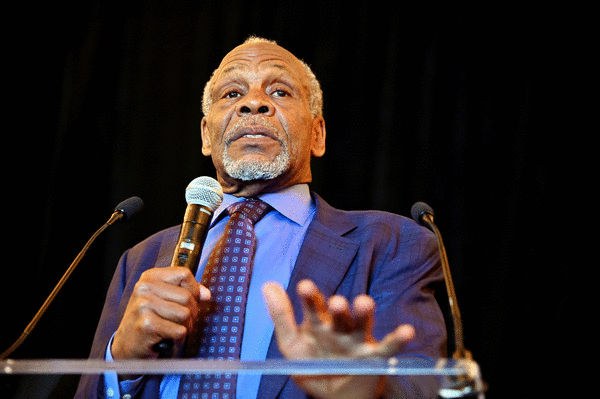
SAN JOSE, Calif. — Danny Glover, the lifelong San Francisco resident and global activist who rose to the height of Hollywood fame as the star of the “Lethal Weapon” film series, “The Color Purple” and “Places in the Heart,” revealed Wednesday that he has Alzheimer’s disease.
In an interview on the “Today” show that appeared to take place in his San Francisco home, the 79-year-old Glover said he had been living with the progressive neurodegenerative condition for several years.
“I can live with it, in a sense,” the four-time Emmy-nominated actor told “NBC Nightly News” anchor Lester Holt, adding, “I’m sure as it advances, things are going to be different and changing.”
With strong family support, Glover said he felt he could face what comes as the incurable brain disorder progresses. Since his diagnosis, his movements, memories and speech have slowed, as is common with the condition, according to the Alzheimer’s Association. More than 7 million Americans, 65 and older, are living with Alzheimer’s disease, while Black people are twice as likely as white people to develop the condition or another form of dementia.
However, Glover and his family said he tries to stay active, attending events and engaging with the community in and around San Francisco, “Today” reported.
For example, on a recent Reddit thread, someone posted a photo of himself with Glover at Ocean Beach, saying the actor had joined others in volunteering for a beach cleanup day. “Mr. Glover was super nice and I learned he worked for the city doing community development before he started acting,” the person wrote.
Glover’s activism, which has included work on behalf of the United Nations, artists in South Africa, people with AIDS and HIV and the Democratic Party, goes back to his San Francisco childhood. He grew up in the Haight-Ashbury neighborhood in the 1950s and 1960s, where his parents proudly worked for the U.S. Postal Service and were active themselves in the union and in the National Association for the Advancement of Colored People, as Glover shared in a 2019 essay and in his “Today” interview.
“The one thing about my parents was their activism,” Glover said. “A sense of being and belonging and making the contribution. When I saw the Montgomery Bus Boycott [in 1955-56], I knew I wanted to be like those people. I wanted to be in that moment and part of the role.”
Glover attended George Washington High School and studied economics at San Francisco State University, where he was a member of the Black Student Union and participated in the historic five-month strike in 1968 that resulted in the establishment of the school’s College of Ethnic Studies. He also became interested in community development issues, especially those involving urban renewal and gentrification in the city’s historically Black Western Addition neighborhood. But at SFSU, he also got his first taste of acting, where his talent was encouraged by famed playwright Amiri Baraka.
While Glover didn’t graduate from SFSU, he received a 1999 Presidential Medal for his “outstanding contributions to the university and the city,” as an SFSU press release said. He also received an honorary doctorate from the university in 2014.
Glover began working for the city in community development in the early 1970s before he decided to pursue acting professionally by training at the Jean Shelton Actors Lab in San Francisco and at the American Conservatory Theater. He soon sought out professional acting work in New York and in Los Angeles. He made his film debut in the 1979 Clint Eastwood-starring film “Escape From Alcatraz” and gained national acclaim for his Broadway debut in the play “Master Harold … and the Boys” in 1982.
Increasingly high-profile gigs in Hollywood followed, starting with his roles in “Places in the Heart” in 1984 and “Witness” and “The Color Purple” in 1985. Glover told Holt that he regards “Places in the Heart,” the 1930s-era farm drama starring Sally Field, as his most personal film because he learned he was getting the job while suffering a major personal loss.
“It’s for my mother,” Glover told Holt. “My mother, on the same day that I was told I was going to play the role, she had an automobile accident.”
Glover catapulted to Hollywood’s A-list when he was cast as Detective Roger Murtaugh alongside Mel Gibson’s Martin Riggs in “Lethal Weapon” in 1987. He starred in three “Lethal Weapon” sequels with Gibson in 1989, 1992 and 1998. Glover also began to receive accolades and Primetime Emmy nominations for his TV work, playing Nelson Mandela in a 1987 HBO television film and for his role in the CBS western miniseries “Lonesome Dove” in 1989.
Through his four-decade career, Glover amassed more than 170 acting credits across film and TV. He appeared in Hollywood studio films, including “Predator 2,” “Grand Canyon,” “Angels in the Outfield,” “Showgirls” and “2012,” and in independent projects, such as “To Sleep With Anger” and “The Royal Tenenbaums.” More recently, Glover appeared in two acclaimed Bay Area-based films, “Sorry to Bother You” in 2018 and “The Last Black Man in San Francisco” in 2019.
Glover managed to combine his screen work and activism by starting a production company to develop and fund socially conscious, politically relevant films from underserved communities, “Today” reported. He also served as a goodwill ambassador for the United Nations Development Program from 1998-2004, working on global campaigns against poverty, disease and combating HIV/AIDS across Africa, Latin America and the Caribbean.
Glover’s activism earned him the Jean Hersholt Humanitarian Award at the 2021 Academy Awards. As he revealed on “Today,” he learned about his Alzheimer’s diagnosis just before receiving the award. Part of living with his diagnosis is coming forward to talk about it as much as he can, in order to remove the stigma around the condition, his daughter, Mandisa, said.
“I think it’s really important for him to have control of his own narrative, of his own life story,” Mandisa said. “That’s really important. And the time is now. What better time but now for him to speak for himself?”
©2026 MediaNews Group, Inc. Visit at mercurynews.com. Distributed by Tribune Content Agency, LLC.








Comments