Commentary: What 'Widow's Bay' can -- and can't -- do for Apple TV
Published in Entertainment News
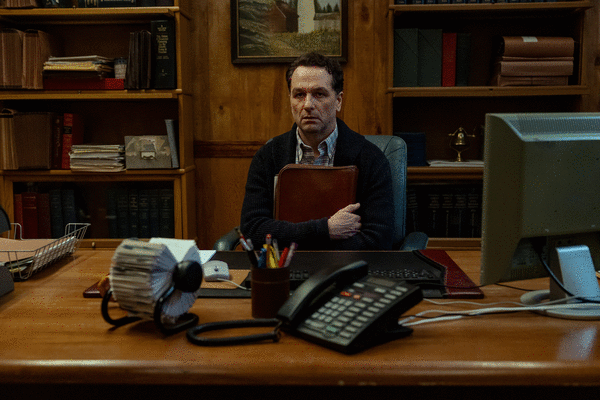
The island of "Widow’s Bay" may be cursed, but for Apple TV, the horror-comedy’s debut has only been a blessing. Since its premiere in April, the show has emerged as a genuine word-of-mouth hit, earning overwhelmingly positive reviews while averaging 20% audience growth with each week of release. This has become a familiar pattern for Apple TV, which drew similar buzz for the debuts of "Ted Lasso," "Severance" and "The Studio." In each of these cases, the shows went on to earn Emmy nominations, and "Widow’s Bay" is expected to join them.
In an industry flooded with content, Apple has established an HBO-like approach to its streaming service that emphasizes quality over quantity. But while Apple TV has solved the hardest problem in television — creating shows that consistently cut through the noise — it has failed to solve the more fundamental one: making the economics work without relying on its parent company’s deep pockets.
When Apple TV launched in 2019, it was part of a new wave of streaming services — Disney+, Peacock, Paramount+ — that was expected to compete with Netflix’s early dominance. For these streamers, the objective was to build out a library of original and licensed content that could lure subscribers at the expense of initially operating at a loss. Fast forward to 2026, and most streaming services have begun to turn a profit, while the ones that haven’t, such as Peacock, have reduced their losses.
Apple TV, however, has yet to follow that trajectory. According to a 2025 report from The Information, the streaming service loses more than $1 billion annually while having approximately 45 million subscribers. (Apple’s senior vice president of services, Eddy Cue, disputed that number in an October interview on "The Town" podcast, but he did not specify how many subscribers Apple TV has.) That reported subscriber base is roughly comparable to Peacock’s but only a fraction of Netflix’s, which exceeded 325 million by the end of 2025.
How long will Apple be able to subsidize a business without a clear return? Unlike entertainment companies that face investor pressure to make their streaming services profitable, Apple generates hundreds of billions of dollars in revenue and can afford to treat Apple TV as a long-term investment. But that advantage has its limits. The company reportedly began reining in spending on the service in 2024, a reflection of the industry’s broader shift toward financial discipline because streaming services are increasingly judged on whether audience engagement can translate into lasting retention and revenue.
Apple TV’s predicament here is an unfamiliar position for the company. In most of its businesses, Apple doesn’t just compete but sets the standard. The iPhone reimagined smartphones, the App Store reshaped mobile software, and the Apple Watch redefined the smartwatch market. Apple TV has earned similar acclaim for the quality of its programming, but unlike the company’s other products, it risks being an outlier instead of a blueprint in streaming — a blemish on a brand built on leading industries.
The irony is that Apple has already adopted some of the strategies its rivals are now pursuing. Netflix, which popularized the binge-release model, has embraced staggered releases for the latest seasons of some of its buzziest titles, including "Stranger Things," "Wednesday" and "Outer Banks." It has also invested in live programming as wide-ranging as wrestling ("WWE Raw"), celebrity roasts ("The Roast of Kevin Hart"), and late-night television ("Everybody’s Live with John Mulaney"), as the industry chases the kind of appointment viewing that once seemed antithetical to the streaming model.
But Apple TV’s success with appointment viewing has come with a ceiling. The challenge isn’t keeping existing subscribers engaged but generating the same level of awareness among everyone else. The platform’s biggest shows have historically grown through critical acclaim and audience enthusiasm rather than mass marketing campaigns. As entertainment journalists have noted, Apple TV doesn’t garner the same marketing push from its parent company as products like the iPhone.
Creatives in the industry have agreed. “Apple is all about the walled garden with their devices that are only compatible with each other, and they’re bringing that idea to television,” comedian and TV writer Ashley Ray said in a 2024 interview with Fast Company. “Their shows feel very closed off within Apple TV, and if you’re not about Apple and not about Apple TV, you’re not watching them, you don’t know about them, and you have to come inside the club to hear about any of it.” That insularity is a liability. While it may help Apple TV cultivate a devoted audience, it also limits the service’s reach.
"Widow’s Bay" can reinforce Apple TV’s reputation as television’s premier home for prestige programming. It can generate awards buzz, attract new viewers and remind audiences why the service has become synonymous with quality. What it can’t do, on its own, is solve Apple TV’s larger business problem. Until Apple finds a way to translate critical acclaim into broader awareness and sustained subscriber growth, even its biggest hits will remain evidence of a strategy that succeeds creatively more than commercially.
Prestige, in this case, is not a business model.
———
This column reflects the personal views of the author and does not necessarily reflect the opinion of the editorial board or Bloomberg LP and its owners.
Miles Surrey is a Brooklyn-based culture writer. His work has also appeared in The Ringer, Men’s Health, and Vox.
©2026 Bloomberg L.P. Visit bloomberg.com/opinion. Distributed by Tribune Content Agency, LLC.











Comments