Mary McNamara: 'Outlander' finale marks the end of a great show and an unprecedented age of TV
Published in Entertainment News
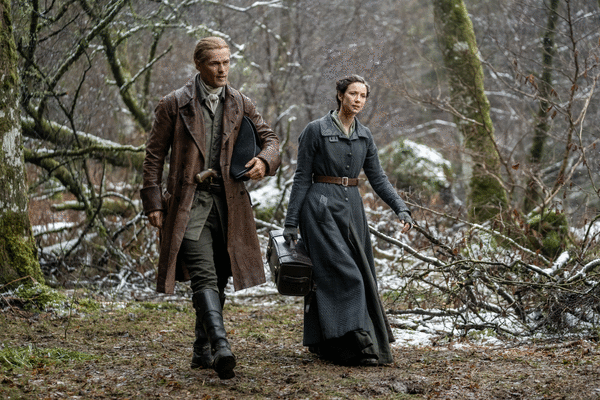
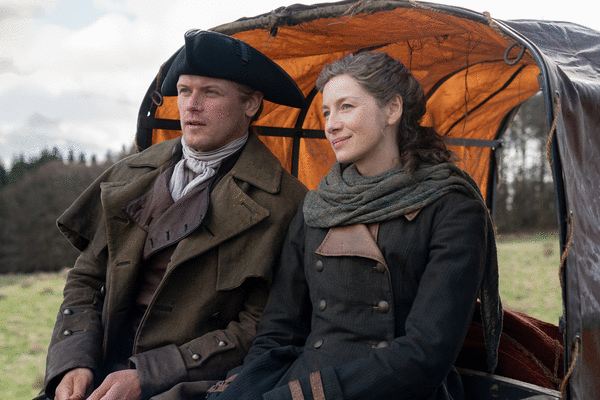

The final episode of the eight season Starz drama “Outlander” is upon us, and no matter what occurs— will the epic love story of Claire (Caitriona Balfe) and Jamie Fraser (Sam Heughan) end with, as many fear, one or both of their deaths? — there will be tears.
Not just for the loss of the show itself, which has been among Starz’s most popular series, but for a particular and powerful moment in entertainment history.
In many ways, the finale of “Outlander” marks the end of an age.
Ronald D. Moore’s adaptation of Diana Gabaldon’s historical fantasy novels debuted in 2014, a time when the unexpected efflorescence of television still dominated the cultural conversation, feverishly followed in prestigious publications and nascent online platforms alike. With more than enough work to go around, broadcast and cable networks were bathed in green light and the introduction of original series on streaming services was considered an exciting novelty, rather than the first ominous drumbeats of industry-disrupting dominance.
Premiering alongside “Outlander” were a slew of equally ambitious and artistically innovative series — “True Detective,” “The Leftovers,” “Penny Dreadful,” “Fargo,” “Transparent,” “Jane the Virgin” and “How to Get Away With Murder,” to name just a few. They shouldered their way into a landscape already chockablock with critically acclaimed favorites including “Mad Men,” “Orange is the New Black,” “The Americans,” “Downton Abbey,” “Homeland,” “Sherlock,” “The Walking Dead,” “The Good Wife,” “Game of Thrones,” “Orphan Black” and “Girls.”
Almost all have long since ended (anthology series “True Detective” and “Fargo” remain ongoing), which makes “Outlander” one of the few shows to span television’s 21st century renaissance, its subsequent overcrowded “age of anxiety” and its current age of contraction. Beginning as a premium cable offering, it is now available on many streaming services, including Starz, allowing viewers to engage in its time travel ethos both literally and narratively.
“Outlander” may have never swept the Emmys or generated the fan frenzy of some of its peers (unless you count an enormous uptick in American visits to the Highlands), but its themes of endurance through periods of enormous change lend its survival — viewership for this final season has, according to Starz, far outstripped that of the last four seasons — a fair amount of poetic justice.
Like the recent history of its art form, the series is as much about revolution as it is about love.
When we first meet Claire, she and her husband Frank Randall (Tobias Menzies) had only recently reunited after World War II; Claire had served as a front-line nurse and Frank in the British intelligence. Taking a “second honeymoon” trip to Inverness before Frank begins teaching history at Oxford, the couple visit the (real) monuments to the Battle of Culloden, where British forces defeated the Jacobite forces and ended the Highlander way of life and the (fictional) mystical standing stones of Craigh na Dun.
Returning to Craigh na Dun on her own, Claire touches the center stone and is transported to 1743, three years before the Jacobite defeat. (Warning: Many “Outlander” spoilers ahead.)
At the time, Starz was leaning into period power struggles — ”Spartacus,” “The White Queen,” “Da Vinci’s Demons” and “The Pillars of the Earth” — and “Outlander” brought a welcome air of enchantment to the gritty, and gratuitously sexual, tone such shows had set, along with a canny, if initially bewildered, female lead.
From the beginning, “Outlander” was an engaging mix of time travel period drama and bodice-ripping romance. Early seasons were a hymn to the Scottish Highlands that must have left local tourism organizations speechless with joy, and throughout the series, its supporting cast provided a Who’s Who of Scottish, British and Irish actors, including but not limited to Simon Callow, Maria Doyle Kennedy, James Fleet, Laura Donnelly, Bill Paterson and Frances de la Tour.
For fans of fantasy, it also had one of the most hypnotic opening sequences, underscored by a plaintive rendition of “The Skye Boat Song,” a folk tune so ubiquitous in Scotland that native members of the cast and crew begged Moore not to use it; wisely, he ignored them. (It has been modified in tone and tempo throughout the series; Raya Yarbrough sings in Season 1 through 6, Sinead O’Connor in Season 7 and Annie Lennox in Season 8.)
The series begins in standard time travel fashion. Claire, having no idea what has happened, finds herself thrust into history as it unfolds. She is quickly beset by the violence of the period, namely in the form of Frank’s dastardly ancestor, British officer Jonathan “Black Jack” Randall (also played by Menzies). After being rescued by Murtagh Fraser (Duncan Lacroix), she finds herself a captive of Highlanders, led by Dougal MacKenzie (Graham McTavish), who takes her to Colum MacKenzie (Gary Lewis), laird of Castle Leoch.
Aided by her naturally fiery nature, medical training and the historical information Frank treated her to during their trip, she manages to prevent an ambush of the Highlanders and gains some status as a healer, beginning with her treatment of the wounded Jamie Fraser. The MacKenzies, however, are naturally suspicious of a mysterious young woman who appears to have inside knowledge of British troop movements; they treat her with respect but do not allow her to leave.
As her return to her proper time, and Frank, becomes less and less likely, Claire is forced to adapt to her surroundings and to question her own understanding of history as it becomes clear that the MacKenzies must protect her from the British, not the other way around. That protection eventually involves marrying Jamie, which may begin as a marriage of convenience but quickly becomes the definition of true love (and great sex — sorry, Frank.)
That love (and sex) will see Claire and Jamie through the next seven seasons and, depending on which timeline you follow, the next 36, or 236, years. Over those years they travel to Paris, Barbados and the United States and encounter a soap-operatic number of perils, including but not limited to: repeated imprisonment; injury; kidnapping; a witch trial (Claire); torture (Jamie); rape (Claire and Jamie); life-threatening illness; the loss of a child; the political machinations of the British aristocracy and the French court; shipwrecks; and a decades-long separation after Jamie forces a pregnant Claire to return to her own time when their attempt to prevent the Battle of Culloden fails.
In her time, Claire reunites, albeit imperfectly, with Frank, with whom she raises that child and pines for Jamie while he does time as a prisoner of war, returns to his home of Lallybroch and pines for Claire. Claire learns that Jamie did not die in Culloden and in Season 4, having become a surgeon and told her now-grown daughter Brianna (Sophie Skelton) the truth about her heritage, Claire once again travels through the stones.
This is when things start getting a little out of hand. Not peril-wise — though an ever-expanding cast of characters, including Brianna, Jamie’s nephew Ian (John Bell), and all manner of other adopted and biological progeny, certainly multiplies the number of rapes, kidnappings, injuries and imprisonments — but in terms of time travel.
In her early days in the 18th century, Claire met one other person she knew to be a traveler — the very troublesome Geillis (Lotte Verbeek), who hooked up with Jamie’s comrade turned nemesis Dougal MacKenzie. Traveling to Paris in Season 2, where she and Jamie attempt to thwart Charles Stuart (Andrew Gower) who led the ill-fated campaign at Culloden, she encounters two other probable candidates — the sinister Le Comte St. Germain (Stanley Weber) and the mysterious apothecary Master Raymond (Dominique Pinon).
As the series progresses, however, people begin popping through portals with a “next stop” commuter-like regularity. After Claire returns to the 18th century, Brianna eventually follows her, to meet her father and warn her parents of their potential death. She is accompanied by her beau Roger (Richard Rankin), who, as it turns out, is a descendant of Geillis and Dougal.
They stay a while, encounter perils and have two kids before heading back to the 20th century for a bit, then returning to the various points in the 18th, where Roger meets his father (also apparently a time traveler) and multiple-great uncles (ditto) before rejoining Claire and Jamie. On a homestead known as Fraser’s Ridge, they are now settlers in the colony of North Carolina, which is, and has been, populated by various time travelers (some come to warn the native tribes of the danger the future holds).
The time travel congestion was only increased by the recent “Outlander” prequel, “Blood of My Blood,” in which it was revealed that Claire’s parents did not die during a car crash in Scotland as Claire believed. Instead, they survived the crash only to stumble, separately, upon Craigh na Dun, which transported them to the time, and general vicinity, of Jamie’s parents’ courtship.
Honestly, the only person who appears incapable of time travel at this point is Jamie.
The crisscrossing of MacKenzies, Frasers and Beauchamps (Claire’s ancestral family), and more than occasional meetings between family members of far-removed generations, underlined the story’s belief in fate, while also creating a (mildly incestuous) Easter egg hunt for fans. It also increasingly strained narrative credulity, even within its own time travel universe.
For all its strengths, “Outlander” is not a perfect show. Like television itself, its landscape became increasingly crowded. The chemistry between Balfe’s Claire and Heughan’s Jamie miraculously never falters, but even an epic love story cannot carry eight seasons, and much of the last few seasons has been spent with other characters, some of whom are far less interesting.
Many viewers also grew weary of Fraser’s Ridge and longed to return to Scotland. Though “Outlander” does an admirable job of reminding us that the Continental Army was made up of immigrants, children of immigrants, former slaves and free African Americans (which, given the tenor of our times, is something worth noting), the American Revolution is far better known to American audiences, and it’s less wildly transporting than the tensions between the Highlanders and the British.
Still, this is Gabaldon’s story, and though the series is ending before her 10th and final “Outlander” novel is published, it has followed that story faithfully.
Like most time travel fiction, “Outlander” amplifies the importance of understanding history and the inevitable impact one age has on another. The final season addresses it in a more direct manner. On her latest trip back through time, Brianna has brought a book Frank wrote about Jamie. In it, he describes Jamie’s death in an upcoming battle; the eighth episode seems to make clear that he wrote the book as a warning, offering details that could allow Jamie to escape that fate. (At this point, I feel obligated to mention that, in the very first episode of the series, before Claire had even seen Craigh na Dun, Frank encountered what appeared to be Jamie’s ghost; make of that what you will.)
Though Menzies does not make a physical appearance in the final season, his Frank is heard in voice-over, which not only brings the series full circle (and avoids Frank being the forgotten man) but also underscores the vital importance of the historian — Frank’s understanding of the past may save Jamie’s life; it certainly gives him a chance to better prepare for his future.
Again, that feels like an eerily prescient message for our own time.
Still, as Claire and Jamie acknowledge, their attempts to rewrite history have largely failed, so Jamie’s survival is far from secure, and as television history has proved, the greatest peril any character, or series, can face is the finale. “Outlander” may proudly embrace its own legacy, including its particular place in television’s timeline, but no matter how it ends, there will be those who are satisfied and those who are not.
That is one future no amount of foreknowledge or planning can avoid.
———
(Mary McNamara is a culture columnist and critic for the Los Angeles Times.)
———
©2026 Los Angeles Times. Visit at latimes.com. Distributed by Tribune Content Agency, LLC.







Comments