Seattle wants more TV commercials made here to boost local film industry
Published in Entertainment News
SEATTLE — When will we have another “Sleepless in Seattle”? Or the next “10 Things I Hate About You”?
For years, local film buffs have yearned for Seattle’s golden age of cinema — the era in the late 20th century when the city was a backdrop for big-budget Hollywood productions that have since skipped Seattle in favor of filmmaking hubs like Vancouver, British Columbia, and Atlanta.
Most of what’s shot in Seattle today isn’t movies or TV shows, in large part because other states and countries offer far more enticing tax incentives to attract big-budget productions helmed by studios shopping around for the best place to make their movies.
City leaders hope a new campaign promoting commercial filmmaking will change that narrative — and help local filmmakers and production crews make a living in Seattle.
Many local camera operators, gaffers, set designers and directors make TV commercials — everything from locally shot Super Bowl ads to car commercials — and corporate videos for major companies including Amazon, Bridgestone and Ford. This work is their bread and butter, with “narrative” work done in between those higher-paying gigs.
The city of Seattle’s Office of Economic Development recently launched an initiative to promote this kind of commercial work in hopes of boosting the local economy — and they say our moviemaking scene will benefit, too.
With the Commercial Film Production Initiative, OED’s film office has launched a marketing and outreach campaign with a plan to position the city as a premier place for commercial filming for both local and out-of-state groups.
The goal: bring more commercial production to Seattle and keep more of it here, which is projected to create up to 200 new jobs and $5 million to $10 million in revenue for local businesses over the next year, according to city estimates.
It should also boost the local narrative filmmaking scene via a “halo effect,” said Michael Huang. He runs a creative marketing agency and is vice chair of the Seattle Film Commission, which helped develop the initiative.
“Some people just care about art, and they don't want to care about ads, but these are the same people that need (to do) both in order to live in a city like Seattle,” he said. “For us to have a bunch of indie films coming out of Seattle that make it into film festivals, you have to have people making films in the city of Seattle. And to have people making films in the city of Seattle, they need to have income. This is kind of that ecosystem that we're trying to develop.”
The initiative comes as the commercial industry grows, said Chris Swenson, OED’s film program manager and interim special events office manager. Meanwhile, movie production is contracting due to studio consolidation, an uptick in offshoring film productions out of the U.S., and a battle of competing tax incentives.
Those incentives — while limited compared with other states’ more substantial ones — remain the best tool for bringing and keeping work in Seattle, Swenson said.
Washington Filmworks is the nonprofit organization that manages the state’s incentive program. The group allows commercials filmed in Washington to apply for the same amount of incentive that a narrative feature would, receiving up to 40% cash back on qualifying in-state spending.
But not enough people in the U.S. film world know about it. Swenson said that’s where the initiative comes in.
“Over the years, we’ve done assessments on what works and what doesn’t,” he said. “What really can we (do to) influence or help influence (production) to come here or to stay here? And we’ve come back several times to the reality that Seattle is a commercial town.”
'Can Seattle do this?'
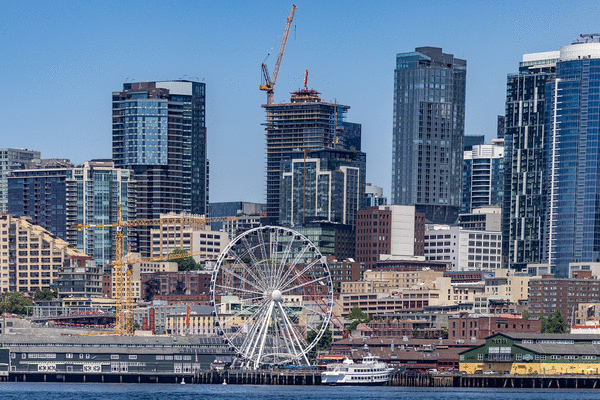
A gleaming Ford F-150 barrels toward us, a hunk of white velocity against the dusky Seattle skyline. In the distance, we can see the familiar outline of the Space Needle and the twinkling lights of the Great Wheel watching over Elliott Bay.
Ford is one of many companies that have used the city and state as a backdrop for national commercials. Tire company Bridgestone recently filmed an ad here, for another example, and car companies are lured by the different kinds of ecosystems they can find near Seattle, location managers and others said.
The Emerald City area is also home to Fortune 500 companies like Amazon, Microsoft and Starbucks, as well as companies in other “high-spend sectors” like tech, aerospace, sports and events and entertainment, Swenson pointed out.
This presence is a boon for the local commercial film sector, but there’s work to be done: Some corporate clients, including local ones, prefer to take big-budget jobs (anything with a budget in the realm of $250,000 to $1 million) elsewhere.
Swenson recently visited a local set where a major corporate client hired a New York-based production company and agency that flew into town for the job. His goal is to flip that script.
“They hired a lot of local cast and crew for it, but the production company and agency were from out of town. Why is that?” he said. “Our conversation now is: Can you hire all that locally?”
Based on roundtables with local, national and international industry experts, Swenson said there’s a perception issue: the feeling that companies are taking a bit of a risk filming in Washington.
“‘Can Seattle do this? Well, we don’t know. We haven’t filmed here with that big of a budget,’” he said. “So they’ll take it to those bigger production spaces just to leverage that risk.”
Visibility is another issue: While about 40% of productions filmed on city of Seattle property come from outside Washington, Seattle is not well-known broadly as a commercial filming destination, Swenson said.
“We also heard that while we’re really qualified and have great crews and the ability to do things, not a lot of people know about Seattle. If you’re thinking of commercial production towns, you think L.A., Chicago, New York and sometimes Austin,” Swenson said, “but Seattle is kind of off the map.”
Swenson said OED will combat both problems.
First, the low-hanging fruit: a webpage explaining the commercial tax incentive (planned for later this year), the local permitting process, tried-and-true shooting locations, local crew experience and more.
Next: targeted outreach. It sounds like a no-brainer, but the film office hasn’t done it in a structured manner before.
Aimed largely at production companies and agencies in Los Angeles and New York, the goal is to attract eight to 10 new productions and generate $5 million to $10 million in new, in-state spending by the end of next year — a 10%-15% increase over the baseline figure. This would create an additional 100 to 200 union-wage hires (representing an estimated 10%-20% bump, respectively).
Additionally, the city aims to keep three to five campaigns with $500,000-and-over budgets from taking work out of the state.
By 2030, Seattle hopes to be a top-five commercial production market in the country.
Will we then see more movies and TV shows made locally? More crew who are able to stay here — or fewer people who feel like they have to decamp for Los Angeles or New York?
Stay tuned for Act II.
———
© 2026 The Seattle Times. Visit www.seattletimes.com. Distributed by Tribune Content Agency, LLC.










Comments