Commentary: So, we're not allowed to criticize the Michael Jackson biopic?
Published in Entertainment News
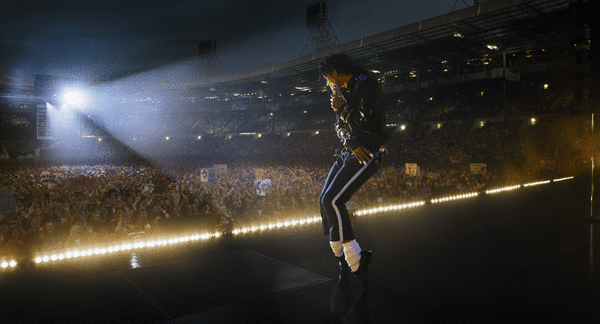
Publicly criticizing "Michael" means recognizing two things: The film, inspired by the early life and career of Michael Jackson, will rake in millions of dollars (it had the highest opening ever for a music biopic), and many viewers will gloss over the movie’s flaws to fanatically defend it.
If this were simply the familiar disconnect between critics and the general audience, then perhaps it wouldn’t warrant much attention. But something more troubling is at play. The knee-jerk reaction to admonish anyone for pointing out the ways in which "Michael" falls short is indicative of an entertainment industry knee-deep in a nostalgic slop era, and the decline of critical thinking has only compounded the problem.
It didn’t take long for fans online to begin reminiscing about their favorite Jackson lore soon after the biopic hit theaters. Remember when Jackson’s sheer talent and celebrity, and the success of 1983’s “Billie Jean,” helped coerce a glaringly white MTV to begin airing music videos by Black artists? Remember how his music helped bring the Crips and the Bloods, notable Los Angeles gangs, together for the “Beat It” video? Remember when Jackson’s hair caught on fire while filming a Pepsi commercial with his brothers in 1984, and he waved his rhinestone-gloved hand at fans as he was rushed to the hospital?
"Michael" has all these moments, playing right into the fans’ expectations and mythologies — and doing little else, reducing the late performer to a single-dimensional artifact. Much of the film, directed by Antoine Fuqua, unfolds like a bulleted, chronologized list of Jackson memorabilia. Reliving some of the proudest moments of Jackson’s life gives audiences, particularly his most loyal Black fans, a welcome dopamine hit during an exceedingly bleak time in history. But it also helps keep the wool over their eyes through a deeply curated story that was widely reported to have been compromised by the late performer’s family and estate, members who have questionably justified credits in the movie.
(That includes Jaafar, Jackson’s nephew, who portrays his uncle. John Branca, Jackson’s attorney and co-executor, is also a producer along with several of Jackson’s siblings, such as La Toya and Jermaine.)
But none of that matters at a time when uncontextualized details concerning a familiar past are far more palatable, and apparently more bankable, than reality or nuance. Many audiences are not even interested in, or perhaps desensitized to, unpleasant news about what’s happening today, choosing instead to scroll right past it when it gets too dark or complicated.
So, of course, deeply reported details about the making of "Michael" or criticism about it won’t be attractive to many audiences interested in escaping to a more comfortable memory. This lack of interest is what contributed to a diminished value in cultural criticism in the first place. But the overzealous, parasocial opposition to it is also concerning. Stans are conflating worthy criticism of the movie with criticism of Jackson himself. TJ, Jackson’s other nephew, helped fuel that discourse when he posted on X, “Don’t ever listen to ‘professional’ critics when it comes to my family. Ever.”
This response sounds a lot like some of the fan reactions to other similarly hollow and rightfully criticized music biopics that gave audiences a funhouse look at their subjects, such as "Respect," "A Complete Unknown," "Springsteen: Deliver Me From Nowhere" and "Bob Marley: One Love." "Bohemian Rhapsody," also penned by "Michael" screenwriter John Logan, is another example.
Race also shapes how that criticism is received. Because Black-led projects still face barriers to being greenlit, films such as "Michael" — helmed by a Black filmmaker and featuring high-profile names like Nia Long and Colman Domingo — can face a greater pressure to receive positive reviews. But that burden often creates a sense that a film like this should be protected or uplifted, even when it underwhelms, feeding into a years-long conversation about the dearth of Black films that are appropriately criticized.
The plot of critical thinking is apparently lost, and few people seem interested in getting it back. To boot, it’s increasingly difficult to raise legitimate questions or concerns about art and navigate online spaces as an intellectual when intellectualism itself is in its flop era.
But none of that matters when so much of what is being offered on screen lately consists of older offerings repackaged as newly interesting fare — from "Scrubs" and "Malcolm in the Middle" to "Frankenstein" and "The Naked Gun." This trend has become so pervasive that it’s now hard to tell whether there was ever an initial appetite for nostalgic slop or whether studios shoved it down audiences’ throats so much that many have become dependent on it and now fiercely embrace it. Maybe that’s a chicken or the egg situation.
At some point, though, many folks lost the ability to sit with or question certain aspects of their own nostalgia in a way that doesn’t also corrupt their enjoyment of it. That’s the very basis of critical thinking.
Too often, the public isn’t challenged by what it sees on screen, but also, too often, audiences don’t bother to challenge it. That’s not an honest way to engage with art.
———
This column reflects the personal views of the author and does not necessarily reflect the opinion of the editorial board or Bloomberg LP and its owners.
Candice Frederick is a Brooklyn-based culture journalist. She writes about pop culture and the arts at the intersection of sociopolitical issues.
©2026 Bloomberg L.P. Visit bloomberg.com/opinion. Distributed by Tribune Content Agency, LLC.










Comments