Howard Chua-Eoan: How many Godzillas is too many Godzillas?
Published in Entertainment News
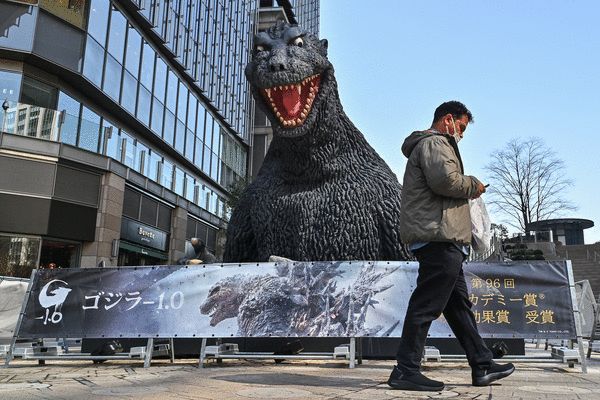
Though I am a lifelong member of the cult of Godzilla, I am a know-nothing neophyte next to some of my fellow enthusiasts. I’m mesmerized by their YouTube deconstructions of a recent movie trailer starring the classic Japanese monster who first stomped through Tokyo in November 1954. They’ve calculated the increased size of Godzilla in his next film by scaling the latest incarnation as it strolls along the Statue of Liberty. It’s work worthy of medieval theologians counting the number of angels dancing on the head of a pin.
The Lady Liberty moment is from a two-minute preview of "Godzilla Minus Zero." The film is due this November from Japan’s Toho Co. Ltd., which released the original creature feature the same year it gave the world Akira Kurosawa’s "Seven Samurai." Meanwhile, Godzillogists have also imposed their exacting scrutiny on the teasers for "Godzilla x Kong: Supernova," the next in the Monsterverse series from Burbank, California-based Legendary Pictures. Their quest: Discover the identity of Godzilla’s enemy in the movie scheduled for a 2027 release. Could the rival kaiju be the demonic Destroyah? Or SpaceGodzilla, that transmutation of our hero but with crystalline shoulder pads?
As you may have surmised, our fanatical cult is in the middle of a schism of sorts. Over the last decade, there have been two cinematic Godzillas roaming the planet — one based in its native Japan, the other out of America. Last week, Toho announced it was going to manage the bifurcation of its hugely profitable icon — a sprawling piece of intellectual property some estimate to be worth $1 billion or more. Might it result in a bigger muddle?
First, some history. In 2004, Toho’s Godzilla movies ground to a creative halt after 28 theatrical releases. Since 1954, Godzilla had evolved from rampaging villain to anti-hero to planetary savior to googly-eyed goofball to box-office poison. The kaiju would not star in another movie until 2014, when Legendary released the critically acclaimed "Godzilla." The U.S. studio (now co-owned by the private equity firm Apollo Global Management Inc.) signed a licensing agreement with Toho for an undisclosed fee to use the monster under strict supervision. The Japanese movie company’s caution was borne of experience: A waywardly reengineered 1998 American version of the creature flopped with critics and fans. Legendary teamed Godzilla with super-simian King Kong; its five Monsterverse movies have so far have each grossed hundreds of millions of dollars worldwide. (Likely providing seed funding for Legendary’s other hit series, "Dune.")
With global interest rising, Toho produced "Shin Godzilla" (the first word meaning “new”) in 2016, reimagining the beast spawned by 21st century ecological disaster and bureaucratic ineptitude. It was Japan’s biggest live-action hit that year. In 2023, Toho brought out a terrifying CGI remake of the 1954 original as "Godzilla Minus One." It was a bigger success than "Shin Godzilla" and a box-office smash overseas, too. Both films were praised for their faithfulness to the spirit of the ‘50s foundation myth of the monster. "Godzilla Minus One" took home the 2024 Oscar for best visual effects, the first Japanese movie to do so, beating out other films with bigger budgets. Hence the "Minus Zero" sequel due later this year.
To keep from clashing over the same audience, Toho and Legendary avoid releasing their respective Godzillas in the same calendar year. But the movies are beginning to bunch up. At the same time, Legendary has a series on Apple TV, now in its second season, featuring both Godzilla and Kong, "Monarch: Legacy of Monsters." To add to the profusion, Toho has cast Godzilla in a number of anime series and short films.
The Japanese studio now declares that all these variants can coexist in what it is calling Godzilla World — something like the Walt Disney Co.-owned Marvel Universe, which ranges from movies to comics to collector’s model kits to T-shirts and mugs. The house that Mickey Mouse built is constantly defending its copyrights and has recently gone after AI companies that have generated Marvelverse characters without permission. The Japanese company’s announcement is a reminder that while there may be many Godzillas out there, Toho rules them all — and will enforce its IP rights if it has to.
The overlord of this effort is Keiji Ota, who has the official title “chief Godzilla officer.” It’s a fun way to describe responsibilities that include Toho’s anime group, products and licensing, digital content sales as well as IP management and strategy. “It’s fine to have different versions of Godzilla,” Ota told a Japanese news site, “Various creators are welcome to join in at any point.” The key word, I believe, is “join” — with likely fees for the privilege. He foresees new movies, new creatures, new audiences, Godzilla for all ages and for the ages. Also, Godzilla branding everywhere. The kaiju’s already on F1 race cars and Lacoste T-shirts.
I’m all for more Godzilla. He’s been the central character of more movies than James Bond (closing on 40 compared to fewer than 30). But I’m also worried about dissipating the meaning of the monster. Ota’s nearly 40-year career at Toho has focused on anime and, though he’s enthusiastic about the Legendary licensing, he’s had less of a hand in the acclaimed "Shin Godziilla" and "Minus One" projects. Will Toho’s famous kaiju wander away from his roots again? That’s beginning to happen as the Legendary movie monsters become more and more cartoonish.
A lot can be said to justify the ways of Godzilla to non-fans, who may find essays about monsters stomping through cities in questionable taste amid turbulent times. But the monster is all too poignantly human.
The original Gojira was galvanized by the March 1954 U.S. hydrogen bomb test in the Bikini Atoll that resulted, among many things, in fallout reaching 23 crewmen of a Japanese fishing vessel anchored 80 miles away. The fishermen would contract or die of cancer. The unfortunate boat’s name was the Daigo Fukuryu — Lucky Dragon Number 5. The real-life combination of nuke and dragon allowed director Ishiro Honda to project some of Japan’s feelings about Hiroshima and Nagasaki via a radioactive leviathan leveling Tokyo. Godzilla was a way of embodying tragedy — and gaining power over it.
Today’s aficionados continue to thrill to kaiju battles — just like the 6-year-old still in me does. But we also revere the deep legacy of the monster. Many have noted the allusion in the "Minus Zero" clip to the Hiroshima dome, the skeletal survivor of the 1945 bombing. Godzilla and his kaiju brethren may act out beastly and primal behavior, but as Rilke said, “All angels are terrifying.” If so, it’s good to be on the side of the monsters.
———
This column reflects the personal views of the author and does not necessarily reflect the opinion of the editorial board or Bloomberg LP and its owners.
Howard Chua-Eoan is a columnist for Bloomberg Opinion covering culture and business. He previously served as Bloomberg Opinion's international editor and is a former news director at Time magazine.
©2026 Bloomberg L.P. Visit bloomberg.com/opinion. Distributed by Tribune Content Agency, LLC.










Comments