Column: 'Woof, woof, woof!' In the late-night wars, Arsenio Hall stands tall
Published in Entertainment News
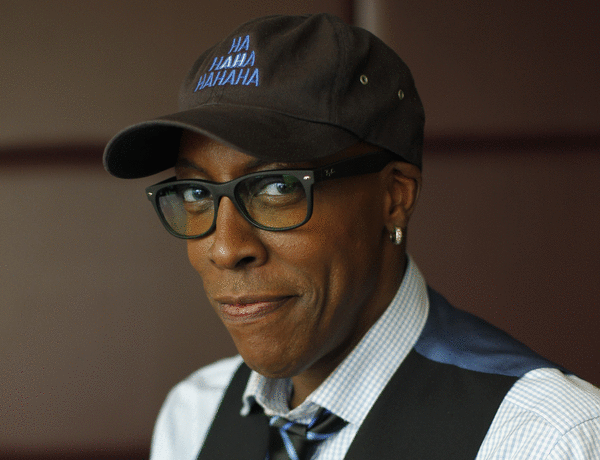
CHICAGO — Reading the recently published book “Arsenio: A Memoir” (Simon & Schuster) is a pleasant experience, surprisingly entertaining as the actor, magician, stand-up comic and former late-night television show host — “Woof, woof, woof,” remember? — gives us all manner of lively showbiz stories, a virtual downpour of name-dropping and considerable charm.
Arsenio Hall shares a dream he had, growing up the son of a Baptist preacher in Cleveland, where he got his first taste of the kick of entertaining when he was 5 years old and was greeted with applause after telling a joke at a wedding. As he writes, “Most kids in Cleveland wanted to be a football star like Jim Brown. I wanted to be an old white man with a talk show. … A crazy, ridiculous, impossible dream. My dream came true.”
It did indeed, though he never became an old white man. After reading about the road that led to his stardom, one is hit with the realization that Hall was more talented and groundbreaking than memory serves, and is an honest and compelling writer, in collaboration with Alan Eisenstock.
It’s impossible not to also think that he was part of an increasingly endangered species known as Late Night Hosts. We have all had our share, some as far back as the pioneer of the form, the amazing Steve Allen, who created “The Tonight Show, ” the format, in 1954. Think now and let your head fill with the faces of Jack Paar, of course Johnny Carson, David Letterman, Jay Leno and Conan O’Brien; Joan Rivers, Jon Stewart, Craig Ferguson, John Oliver, James Corden, Dick Cavett, Trevor Noah, Chevy Chase, Bob Costas, Pat Sajak.
OK, maybe you don’t remember them all, but what a time they and some of us had.
I was this newspaper’s TV critic when the syndicated “Arsenio Hall Show” first appeared on WBBM-Ch. 2 on Jan. 3, 1989. Of it, I wrote, “Hall operated without a desk, instead sitting in a soft chair, his guests next to him on a couch. … One show alone does not a late-night revolution make. There is no denying that (this one) is capable of making some noise.”
Hall sensed that too, writing in his book, “The show exploded, a shock to the culture, hurtling out of nowhere … arriving like a late-night meteor.”
Indeed, it was an almost essential stop for the biggest names. Hall dubbed himself “the talk-show host for the MTV generation.” In 1992, presidential candidate Bill Clinton played “Heartbreak Hotel” on the saxophone and told Hall that he had indeed smoked pot, adding that he did try to inhale. Hall devoted an entire show to the verdict in the Rodney King case. The elusive Prince was a guest. Tom Cruise and Madonna, too. Whitney Houston, Eddie Murphy and Snoop Dogg. When Magic Johnson decided to do a sit-down interview about his HIV diagnosis, he chose Hall’s show.
Hall was on the cover of Time magazine, accompanied by a story by Richard Zoglin that speculated, “We are seeing the future of the TV talk show, and it is, well, funky… less a talk show than a televised party: hip, hyperkinetic and hot. … Hall’s popularity may signal a geologic shift in late-night TV.” He got a star on the Hollywood Walk of Fame, next to that of Marilyn Monroe. He made a lot of money.
Over the next six years, the show was a stage for Hall’s infectious energy, his antic personality, probing interview style, party atmosphere, his own authenticity and ability to book guests. I argued that his show — seen by 5 million nightly, and outperforming competitors among the coveted younger demographics — helped bring Black culture into the mainstream.
And then it was over. Though the show’s ratings had been dipping, it took a hard hit in the wake of Hall’s February 1994 interview with Nation of Islam leader Louis Farrakhan. But the decision to stop the show was his alone and not, as some have falsely argued, the bosses at Paramount, which syndicated the show.
In 2013, Hall tried (and failed) to replicate the previous magic and his show was canceled after one season, many blaming tougher competition than before.
Things have only gotten more so in the decade or so since. As Hall has recently said, while on the book promotion trail, “Today, everybody who has a roof has a show. Maybe CBS won’t let you do it, but you can do it in your crib or in a little studio. I’m the only one that doesn’t have a talk show now.”
For those who do, especially on the major networks, the nights may be numbered. On May 21, Stephen Colbert will host his final “The Late Show with Stephen Colbert.” As I write this, Mr. and Mrs. Trump are calling on ABC to fire the host of “Jimmy Kimmel Live!” Hanging on as ratings plunge are “The Tonight Show Starring Jimmy Fallon” and “Late Night with Seth Meyers.” Lower ratings are but one problem. The shows are accompanied by similar drops in ad revenue and increasing production costs, an ongoing shift to digital viewership, political constraints and publicity-friendly interview questions.
In February, there was an interesting article in Vanity Fair. The headline was “The New Late Night” and it featured 10 hosts. None of them occupied a late-night spot. They were all podcasters and YouTubers. The story by Joy Press begins with this sentence: “The talk show is alive and well, and living online.”
———
(Rick Kogan is a columnist for the Chicago Tribune.)
———
©2026 Chicago Tribune. Visit at chicagotribune.com. Distributed by Tribune Content Agency, LLC.







Comments