Column: 'Lorne' documentary shows us the man behind the 'SNL' curtain, sort of
Published in Entertainment News
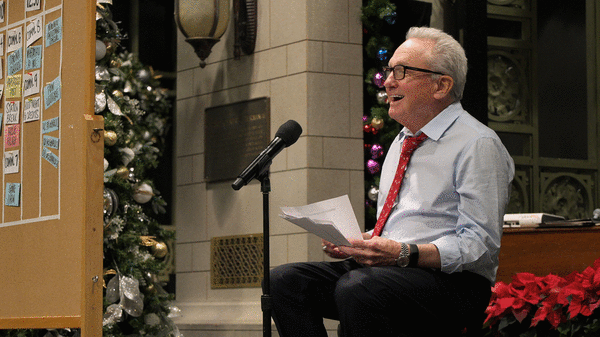
Lorne Michaels, the most powerful enigma in television history, ambles, smiles and hides across movie screens for 101 minutes and, along with such friends and former employees as Paul Simon, Steve Martin, Bill Hader, Tina Fey, Colin Jost, Conan O’Brien and many others, gives us a slim portrait of, well, himself.
We do get some laughs and some good memories evoked by clips of old sketches in “Lorne,” an homage to the creator and longtime executive producer of “Saturday Night Live,” delivered by the Academy Award-winning director Morgan Neville.
But in the wake of all sorts of celebratory entertainments surrounding "SNL’s" 50th anniversary last year — such as the anniversary TV special, Questlove’s music documentary, Jason Reitman’s movie “Saturday Night,” and the “Lorne: The Man Who Invented Saturday Night Live” biography by Susan Morrison — this film adds little, unless you are one of those eager to learn which New York City Italian restaurant is Michaels’ favorite.
There is no exploration of Michaels’ eye for talent, ability to manage NBC’s corporate seas and television’s ratings pressures. This is a lighthearted profile of an accomplished person, but it is all surface and pleasant observations. As such, it fails to explain what makes Michaels more talented than the manager of a baseball team.
I watched the first show, Oct. 11, 1975 (George Carlin was host), and have seen it on and off ever since. It was certainly revolutionary. In a few short years, it altered the face of television, redefining what was permissible and what was funny. It nurtured some grand talents, perhaps did some others in. It made huge stars of minor talents, paved the way for David Letterman and the comedy club boom. It was unique and important.
Michaels helped build and steer this ship. He was at the time a 30-year-old Canadian performer and comedy writer, who had produced a Lily Tomlin special before tackling what would be “SNL.” He did this in collaboration with the even younger Dick Ebersol, the director of late-night programming for NBC, who is unfortunately not mentioned at all in this movie.
They were charged with fashioning something to fill a late Saturday night slot, then occupied by Johnny Carson reruns or old movies. Chevy Chase, Gilda Radner, John Belushi, Dan Aykroyd, Jane Curtin, Garrett Morris and Laraine Newman formed the original cast, joined in the second year by Bill Murray. And soon enough, they began to sail away to movie stardom and other outside projects, and within five years, many were gone, and so was Michaels, leaving the show to flounder in the entertainment wilderness.
Though the show did become a showcase for the immense talents of Eddie Murphy — other cast members included such whatever-happened-to folks as Denny Dillon, Gail Matthius, Ann Risley and Charles Rocket — it was a ratings disaster and inching toward cancellation until Michaels returned in 1985, reenergized the show, brought in such talents as Dana Carvey and Phil Hartman. He has been in charge ever since.
It is obvious from the comments by many, many people, not one of whom does not adore or is not fascinated by Michaels, that he is an unusual sort, maybe genius, but surely a survivor and huge influence.
You will better understand — if you cared in the first place — the show’s creative schedule, which reflects Michaels’ unusual (call it weird) own working ways, about which he comments, “Fatigue is your friend.”
We do not see where Michaels lives in Manhattan, and though we do visit some of the hiking trails and a lake near his blueberry farm in Maine, we are not afforded a look at his house.
We do get the barest glimpse of his childhood, which contains the sad news that his father died when Lorne was 14, but nothing about how that might have affected him. One of his two ex-wives, Rosie Shuster, an “SNL” writer in the early seasons, appears in the film, but we get only the tiniest glimpse (all faces covered) of his current wife and three children. I am not one to need or desire to pry into private lives, but surely learning a bit about his family would not have been so intrusive as a way to add some depth and understanding.
Neville is a talented filmmaker. One can only imagine his frustration here, but he makes of it what he can. He was given considerable access to the behind-the-scenes activities of the show’s production and to many of its stars and staff, none of whom have much to say beyond expressing bemusement at some of Michaels’ personal quirks and habits or praise for his taste in comedy.
But there is little about his relationship with “The Tonight Show” and “Late Night with Seth Meyers,” beyond that he is their executive producer, or about his remunerative role (he’s worth an estimated $500 million) in such movie hits as “Wayne’s World” and “Mean Girls.”
Such a powerful force in the nation’s comedic landscape deserves more than we get in this admittedly entertaining movie, which often struggles in its aim to cover more than half a century.
There is a hint that the 81-year-old is not ready for retirement, but what might that mean for “SNL”? Who knows? No one here is talking.
Michaels certainly deserves credit for his career, and if he comes off as a meticulous and obsessive person, so be it. He’s the man behind the curtain.
As he says, grinning, “People have this idea that they know me … But I don’t know myself.”
So be it.
———
(Rick Kogan is a columnist for the Chicago Tribune.)
———
©2026 Chicago Tribune. Visit chicagotribune.com. Distributed by Tribune Content Agency, LLC.










Comments