'Unfortunate reality': Some aspiring teachers see waning path to dream job
Published in News & Features


It’s a precarious time to become a teacher in Southern Nevada.
Just ask Shawn Anthony Collado, a UNLV junior studying secondary education who hopes to become a Clark County School District high school social studies teacher when he graduates.
A desire to make future generations smarter through civic education has motivated Collado to pursue pedagogy. But as he completes his studies, he has seen how shrinking budgets are threatening teaching jobs districtwide.
Collado’s middle school social studies teacher was removed from her school this year and reassigned to another through the surplus process, in which schools reassign staff because of inadequate funding to maintain positions. His mother and brother, both school district employees, each faced the threat of a similar fate, he said.
Uncertain about the stability of his dream career, Collado said he has applied for a political science minor and is exploring other options, such as graduate school or becoming a lawyer.
“I’d say the benefits (of becoming a teacher) right now outweigh the risks, but the risks are still there,” Collado said. “I’m still thinking about that. I’m still worried about them.”
Collado is part of a cohort of aspiring teachers contending with a new reality: Southern Nevada is starting to have fewer public school teaching jobs.
The Clark County School District, which says it is the largest employer in Nevada, is hiring fewer new teachers to fill a shrinking number of classroom teaching jobs. Meanwhile, schools in the burgeoning State Public Charter School Authority, most of which are in Clark County, aren’t hiring as many teachers as the school district is losing.
The district hired just 532 new teachers ahead of this school year, far fewer than the 2,000-plus teachers it hired only two and three years earlier.
At the same time, the school district is shrinking its number of teacher positions. District teaching positions — both filled and vacant — totaled 15,670 ahead of this school year, a 655-position decrease from the year prior.
Teacher count in the state charter school authority, meanwhile, rose by only 372 between the previous two school years, according to approximations in the latest charter authority data.
By comparison, during the 2025-26 school year in middle and high schools, the district averaged 20 students per teacher while charter schools averaged 26 students per teacher, according to the Nevada Department of Education.
The decline in teaching jobs is a byproduct of shrinking enrollment in the Clark County School District. Fewer students in classrooms leave schools with less money to hire educators, and school district experts predict enrollment will continue declining into the foreseeable future.
School district officials also have said the district has improved at retaining its existing teacher staff between school years, so much so that the district pointed to higher-than-expected average teacher pay as one cause for the midyear $51 million budget shortfall this fall.
Total teacher pay is up and averaging $131,831 per year this school year — $86,551 in salary and $45,280 in benefits — and Nevada ranks 16th in the nation for overall teacher pay, according to the district.
When aspiring teachers do net a school district job, surpluses caused by midyear budget changes often leave them most vulnerable to losing their position or being transferred to a different school.
Megan Griffard, assistant professor of educational policy leadership at UNLV, said the current hiring landscape represents “a leveling off of the supply and demand” for teachers. She said new educators entering the job market might find it more competitive than in the past, but that expected retirements in the coming years should soon reopen opportunities for aspiring teachers.
“Whereas in years past, teachers who were interviewing sort of had their pick of the school and the classroom that they specifically wanted to work in, now it’s more so that the administrators doing the hiring have a little bit more say over who exactly they hire,” Griffard said.
Still, the profession remains a calling for students such as Sahara Chatterpaul-Taylor, a junior secondary education major at UNLV. She said recent school budget uncertainty has made her think more realistically about what her life may look like after graduating.
Chatterpaul-Taylor said she’s prepared to wait more than a year to find a job in a classroom and, if necessary, search for substitute teaching roles to keep her skills sharp.
“I hope things change,” Chatterpaul-Taylor said. “I hope that there is a bit more availability to hire more teachers, but at the end of the day, if there’s not, if it continues to go down, it’s an unfortunate reality, but I would hope that it doesn’t get to the point where it completely discourages me or it makes me feel like I need to do a major switch of careers.”
‘Going to stick with it’
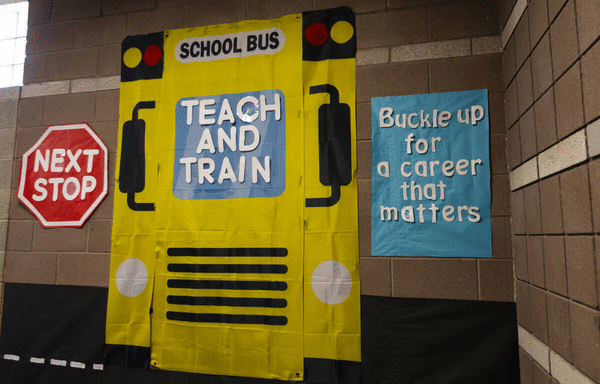
At Desert Pines High School, a small group of students who aspire to be educators are learning how to do the job.
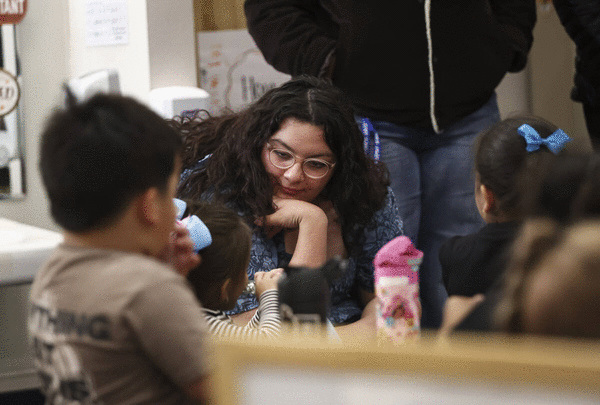
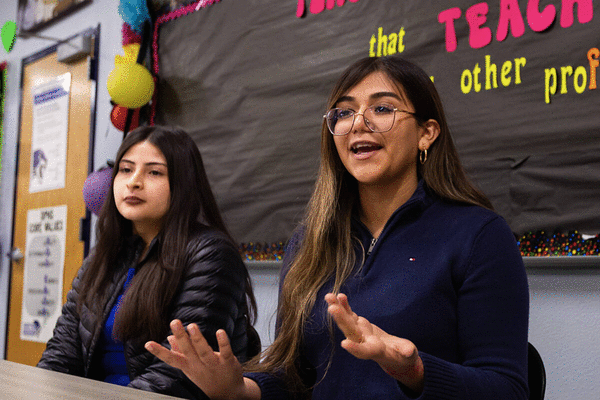
In between crafting lesson plans and learning teaching philosophies, senior Citlali Nunez Araiza and juniors Melany Rodriguez, Suzanne Rodriguez and Donna Flores work several times each month with the school’s new pre-K classes to hone their teaching skills.
“The teacher was showing us how to properly get the students engaged,” Flores said of a teaching-and-learning class she takes at Desert Pines. “She also taught us methods that we could use to get the students’ attentions, and even if they’re misbehaving, how we can put them back on track to engage with what we were teaching.”
All except Nunez Araiza are in the Teacher Academy College Pathway Program, an initiative established in state law in 2023 that mandates large school districts to offer a path to becoming an educator. Students who enroll in the program in high school, attend a state public university and teach in a Nevada public school for three years can get their college tuition reimbursed.
While a teaching job isn’t guaranteed after completing the program, “the district will often offer positions to those that demonstrate strong teaching skills,” according to a Clark County Education Association spokesperson.
Despite the headwinds caused by declining enrollment, all four said they still want to become teachers after they graduate from college.
“I do have hope that things will get better and that I’ll be able to find a job in education as a teacher,” Rodriguez said.
Chatterpaul-Taylor said she and her UNLV College of Education peers share a similarly sunny outlook, albeit weather-beaten by years of discouragement from veteran teachers, social media and well-meaning parents alike.
“To even be an education major, you’re already pretty aware of what is going on. You’re aware of the career that you’re going into. Sometimes it’s not a very sought-after career by many people, but it’s such a needed career,” Chatterpaul-Taylor said. “I may not be guaranteed a job after, but I’m still going to stick with it. I’m going to be here because these kids need me.”
_____
©2026 Las Vegas Review-Journal. Visit reviewjournal.com.. Distributed by Tribune Content Agency, LLC.






Comments