Some school districts pan Pennsylvania's new cellphone ban, saying they already have rules
Published in News & Features
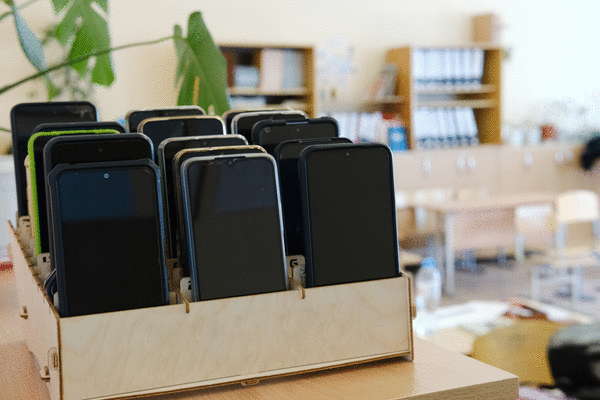
PITTSBURGH — Before Hempfield teens take their seats each class period, they tuck their cellphones into a calculator caddy hanging on the wall, keeping their hands device-free throughout the lesson.
The system, first enforced this school year at the Westmoreland County district’s middle and high schools, permits students to use devices in the hallways, cafeteria and in study halls. It “works extremely well,” Superintendent Mark Holtzman said Tuesday.
But that approach will no longer be accepted next school year after Pennsylvania this week passed a bell-to-bell cellphone ban restricting use of the devices during the school day.
Several school leaders agree with limiting cellphone use at school; many have implemented their own policies in recent years. But some are frustrated by the mandate that requires current policies to change and that could cause parental pushback.
“I [see] both sides of it,” Holtzman said. “I don’t think there’s poor intention. I think it means well and it sounds really good on the surface, but when it’s put out to be implemented with no flexibility, it makes it very, very challenging for the people on the ground floor.”
Statewide ban
Pennsylvania has been considering a bell-to-bell ban for months. Last week, lawmakers passed a bill requiring the ban; Gov. Josh Shapiro signed it Monday.
The state now joins at least 24 others with bell-to-bell laws, according to Lockedin, a California-based phone-management software company.
Pennsylvania’s law requires all public, private and charter schools to adopt a policy prohibiting student possession of phones for the entire school day starting in 2027-28. The policies must establish how phones will be restricted, although it does not require a school to take physical possession of the device.
Exceptions are allowed for documenting medical needs, special education or disability accommodations, English language learning devices and other instructional purposes.
A South Allegheny Middle School eighth grade student gets her phone out of a calculator caddie at the end of class on Tuesday, Oct. 27, 2026.(Justin Guido/For the Post-Gazette)
“There is an entire generation of American children being rendered captive by big tech, and the kids are suffering. … If we can at least give them six hours a day to be normal kids, to socialize, to make eye contact, to think critically, that is significant,” said state Rep. Mandy Steele, D-Fox Chapel, who introduced a bell-to-bell bill in the House, told the Post-Gazette Tuesday.
Passage of the law was a win for several parents organizations statewide, including PA Unplugged, a statewide group founded in 2025 to advocate for distraction-free schools.
“We were just really happy that this is going to be a new standard starting next school year, so that kids just are not being distracted by the constant pool of their personal electronic devices,” Kristen Beddard of Sewickley, co-lead of the organization, said Tuesday.
Beddard pointed to research showing that bell-to-bell bans are “ultimately what is best for students.” Districts, she said, now “need to go that extra step.”
But many local districts have concerns.
“Having something that comes down that says you’re going to do it this way when something was already working for us and us losing a little bit of control, that would be my only negative,” said David McDonald, superintendent at South Allegheny, where middle and high school students put their phones in calculator caddies at the start of class.
“But it is what it is, and we’ll move forward.”
Steele, when asked about district concerns about the bill, said that districts have discretion on how to implement the ban. She added that there’s no cost associated with the new law.
“The best scenario is a true bell-to-bell ban, and that’s what schools are moving toward all over the country,” Steele said. “There’s no reason why Pennsylvania students should be left behind.”
Passage of the bell-to-bell phone ban was a win for several parents organizations statewide, including PA Unplugged, a statewide group founded in 2025 to advocate for distraction-free schools.(Justin Guido/For the Post-Gazette)
Local reaction
Moon, an Allegheny County district of 4,100 students, for years has required K-8 students to keep devices in their backpacks or lockers, Superintendent Jason D’Alesio said.
High schoolers have more flexibility. There, students can use phones for educational purposes at the direction of their teacher. Nothing will change on the K-8 level under the state mandate, something D’Alesio supports.
But officials will now have to fully ban phones in grades 9-12, which D’Alesio said is tricky. He would have liked to see a digital citizenship approach, where high schoolers are taught how to be responsible with their cellphones rather than an outright ban.
Moon will now likely extend its current K-8 policy to the high school.
“Politicians have a hard job,” D’Alesio said. “I respect them greatly. … I don’t think it’s bad to limit device use. But to kind of do a blanket approach on every school, every district, I think is very tough because we all have different challenges. Our technology needs are different.”
In Butler County, the Butler Area School District last year adopted a bell-to-bell ban requiring students to keep their powered-off phones in their bags.
The district of 5,900 students isn’t checking that phones are turned off, Superintendent Brian White said; rather, officials would intervene if there was a disruption.
So far, the policy has worked, White said. Teens are now interacting more with their peers. And parents have peace of mind knowing kids have access to their devices in case of an emergency.
No changes are needed to Butler’s policy to follow the state mandate.
Still, White was apprehensive about another unfunded state mandate.
But having seen the benefits, White said, “schools that haven’t done it yet will come to find it’s beneficial for the learners.”
At South Allegheny, middle and high school students put their phones in calculator caddies at the start of class.(Justin Guido/For the Post-Gazette)
South Allegheny, an Allegheny County district of 1,500 students, implemented its policy in 2023 after teachers were losing the first five minutes of class asking teens to put their phones away, McDonald said. It was an opportunity to teach kids how to live without their phones.
The district now has to change its policy to align with the state law. Officials plan to hold community meetings to gather parent input on different products the district is considering and to address their concerns over things such as being able to reach their child in an emergency.
“If we can figure out how to lower the nervousness that moms and dads have at home, I’ve seen it be positive for kids,” McDonald said.
Back at Hempfield, Holtzman, the superintendent, raised several concerns — teachers and staff might be nervous to handle phones that today can cost thousands of dollars. Students could question why their peer has an exception to use their phone. Families could push back.
And he wondered how to implement the law in a district of 5,000 students, 2,500 of whom are in the secondary schools.
Holtzman balked at purchasing Yondr pouches, a lockable bag students have figured out how to open. And he wondered if staff would be uncomfortable disciplining a child not following the rules.
“What happens when there’s an act of defiance,” Holtzman said. “We’re going to exclude children from school for discipline because they won’t give up a cellphone and they’re being defiant? There’s a lot to unpack there.”
He planned to talk about possible implementation tactics at Tuesday’s principal meeting.
“There’s a lot of good intentions with the cell phone ban,” Holtzman said, “but I don’t know that it’s thought out very well.”
©2026 PG Publishing Co. Visit at post-gazette.com. Distributed by Tribune Content Agency, LLC.






Comments