LA homicides are down to near-historic lows -- but killings of Black men persist
Published in News & Features
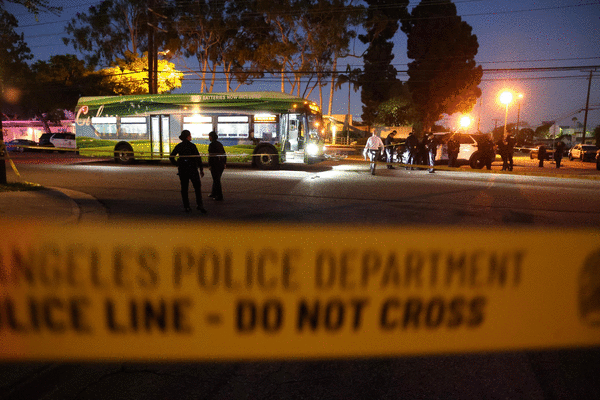
LOS ANGELES — Homicides in Los Angeles still are falling, plunging to levels not seen since the 1960s and continuing a dramatic turnaround from the pandemic crime surge.
But no matter how low the numbers go, an old pattern persists: Black Angelenos are far more likely to be killed than those of other races.
So far this year, 35% of the city's homicide victims were Black, even though Black people comprise just 8% of the population — roughly the same percentage that they represented 20 years ago. Black victims accounted for 57 of the 162 recorded homicides through mid-September, the most recent period for which reliable data are available. That is down from 75 at this point last year, when there were 192 slayings.
Most experts agree the cause of the decline may not be known for years, and even then there likely will not be one simple explanation, with disparities in access to healthcare, jobs and adequate housing thought to be among the factors that affect crime rates in communities of color.
Homicides are down in most big cities nationwide. In L.A., police divisions that have long struggled with rates of killing — such as Southeast, 77th Street and Newton — again lead the city in homicides. In the 77th patrol area, which covers South L.A. around Florence Boulevard, 12 of the 20 people killed there through mid-September were Black, a Times analysis found. Roughly a third of the area's residents are Black.
The latest data show homicides of Latinos fell slightly and remained slightly lower than their population count. Through mid-September, there were 72 Latino victims killed in L.A., compared with 82 over the same period last year.
White victims, who were far fewer in number, also decreased slightly from 28 to 22, while victims whose race was listed as Asian, Middle Eastern or "other" have decreased marginally, from 7 to 6.
The low homicide numbers have been a talking point in the hotly contested mayoral race. Mayor Karen Bass has heralded the crime drop in her campaign messaging far more than her opponent, Councilmember Nithya Raman.
Raman has said in campaign materials she would expand the mayor's community safety office to oversee unarmed crisis response programs as well as other city agencies such as sanitation, fire and transportation. She also would hold weekly reviews of the L.A. Police Department, Fire Department and other city agencies, during which they will "present current performance data, identify system failures, and commit to time-bound corrective actions."
Raman also has spoken about replacing LAPD Chief Jim McDonnell, without detailing how soon she would make the change or who she would pick to lead the department.
Both Raman and Bass have advocated for hiring more gang intervention workers as well as investing in alternatives to policing, such as sending unarmed professionals to calls involving the mentally ill, unhoused people and those dealing with drug addiction.
Bass has said that during her tenure, funding for alternative response programs has tripled and it has begun to be integrated "into the full city's emergency response system, so that it doesn't become a side program" — something her opponent also is pushing for.
Speaking at a news conference Monday touting the city's crime drop, Bass said the racial disparities among homicides underscores the importance of prevention and intervention programs, including the mayor's Gang Reduction and Youth Development initiative.
"I'm glad it's down, but I shudder at what it would be if we had not invested the resources," she told reporters outside of the Van Nuys police station. "I was worried that in previous years it began to be a little watered down and I've brought it back, increased it, expanded [it] and will continue to do that."
The incumbent has embraced a crime-fighting strategy that balances traditional policing with a more public health-oriented approach, pointing out that under her watch the city opened an office of community safety to support gang interventionists who help defuse neighborhood conflicts before they explode into violence.
Bass said her commitment to gang intervention and youth development programs were rooted in "work that I started many, many years ago."
While credited with reducing shootings in the most troubled neighborhoods, the intervention workers have not been immune from violence themselves.
One of the Black men killed this year was Reginald Foreman —"Big Ant" or simply "BA" to those who knew him best. His friends and relatives described him as a caring, generous man with a booming laugh that could rattle windows. He loved anything to do with baseball, especially the Dodgers. He liked to crack jokes. He loved coaching his nieces in softball at Ladera Park.
Foreman grew up in South L.A., in a beige house off of Century Boulevard and Western Avenue, and used to take the bus to Holley Park to play baseball with his friends. His parents raised their kids — three sisters and Foreman, the only son — in the church. But as a teenager, Foreman drifted into gang life, joining the Rollin' 100 Crips that ran his neighborhood.
"When you're in the inner city, how would I say this — you adapt," his sister Aimee Johnson recalled.
She noticed a change in him after the birth of the first of his five children. Running the streets suddenly lost its allure, once he realized he had something bigger than himself to live for, Johnson said. Instead, he went to truck driving school and later went into gang intervention work, following in the footsteps of other men and women who lived through the extreme violence of the 1980s and 1990s. Using his hard-earned wisdom, he sought to steer young people away from prison or the morgue.
On Aug. 6, he had been at his job with 2nd Call, which resolves gang conflicts and cleans up neighborhoods. He was working with a team removing weeds at a vacant lot off of Crenshaw Avenue and 60th Street, as part of the long-delayed Destination Crenshaw revitalization project.
Accounts vary about what happened next, but witnesses said a youth in a medical face mask walked up to Foreman and another 2nd Call worker and started shooting. Both Foreman and his colleague took off running around the corner onto Crenshaw, with the gunman on their heels. The shooter caught up to Foreman about midway through the block, where a small, makeshift memorial of blue votive candles still marks the spot where he collapsed.
Some witnesses recalled that the gunman stood over Foreman and fired into his chest at point-blank range.
Skipp Townsend, the founder of 2nd Call, had hired Foreman in June. The men had known each other for nearly three decades, but as members of rival gangs had kept a wary distance for years.
Townsend had just talked on the phone with Foreman, telling him not to worry about picking up trash. Not 15 minutes later, he said, someone called to say Foreman had been shot.
Townsend pulled up as police were laying a sheet over Foreman's body.
"It was heartbreaking," he said, rubbing his bald head with his eyes closed. Police told the family last month that they expected a break in the case soon, but no arrests have been announced.
Johnson, Foreman's sister, still gets angry when she thinks back to that day. Nothing about what happened seems to add up. She took some comfort in learning that a bystander, a woman, ran over to her brother and prayed over him in his dying moments.
"I believe in my heart that my brother heard that prayer as he was leaving this earth, and that gives us hope," Johnson said.
While the area where Foreman was killed is far safer than it was decades ago, deadly violence still occurs. On July 3, gunfire erupted a block away, killing two and leaving one injured. Police haven't offered a motive for either shooting.
Townsend said this was the first time in the 20 years that 2nd Call had been around that one of his employees was killed. Most homicides, he said, involve the most basic human conflicts: usually starting as an argument, over a women, an unpaid debt or a jab on social media. But on the streets, memories are long, he said.
"The way people looked at him, even though he changed, they didn't," he said of Foreman.
As Townsend spoke, some of his workers filed out of the group's airy office in Baldwin Village, wearing the group's trademark neon green shirts. They just had a grief meeting, where Townsend had given them a chance to air their feelings about how Foreman's death had affected them. Some people spoke up, while others, like the man who'd been with Foreman when he was shot, remained silent, Townsend said. He didn't force the issue, saying he understood the man was processing what happened in his own way.
"It's a journey, but there's no destination," he said.
—Times staff writer Hailey Wang contributed to this report.
©2026 Los Angeles Times. Visit at latimes.com. Distributed by Tribune Content Agency, LLC.





Comments