US judge halts taxpayer-funded TV ads lauding Trump for now
Published in News & Features
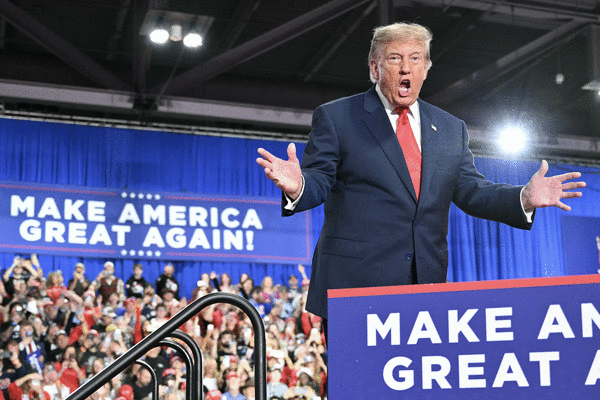
A federal judge in New York ordered the Trump administration to stop for now running taxpayer-funded television ads lauding the president and to halt any payments of public money related to airing them as legal challenges move ahead.
The order from U.S. District Judge Jennifer Rochon on Sunday night will last 14 days as she decides whether to impose a longer-term block. The ads, which have run on cable and broadcast networks across the U.S. in recent weeks, faced pushback not only from Democrats and other critics of President Donald Trump, but also from at least one top Senate Republican.
The Justice Department told Rochon earlier in the weekend that the contested ads would stop running after Sunday and that the Department of Homeland Security “has no plans” to buy more media spots with the current vendor or to use money appropriated by Congress “on any similar contracts.”
But the judge wrote in the brief order that the challengers had shown they’d suffer “irreparable harm” without immediate court action, that a temporary halt “serves the public interest” and that she didn’t believe that the dispute had become irrelevant.
Spokespeople for the White House and the Justice Department did not immediately respond to requests for comment.
The challengers in New York, which include a Democratic Party candidate for state office in Alabama, a union political advocacy arm and a government watchdog organization, accused the White House of violating a congressional prohibition against using taxpayer dollars for unapproved “publicity and propaganda.”
“We are pleased the court acted swiftly to prevent more taxpayer dollars from being used for such blatantly unlawful political propaganda,” the coalition in the New York case said in a joint statement provided by Democracy Forward, one of the groups representing them. “There is no legal justification — and no precedent — for the president to use the machinery of the government and funds set aside by Congress for other uses to influence electoral outcomes that further his own agenda.”
A second lawsuit filed by the Democratic National Committee over the ads is pending in Washington. The challengers in both lawsuits allege the ads are intended to influence voters ahead of the midterms and that using public funds puts Democrats at a disadvantage by freeing more GOP campaign and PAC money for other uses. A judge hasn’t ruled yet on the committee’s request for a short-term block.
The ads feature photo montages and video footage of Trump with messages that touch on various aspects of his domestic and foreign policy agenda, from his vows to root out the so-called “deep state” in government and “fake news media” to defending the war against Iran and military operations in Venezuela. The ads include a disclosure that they were paid for by the U.S. government.
According to the New York Times, Trump directed Russell Vought, director of the Office of Management and Budget, to use government funds to pay for the ads, and that the $20 million contract used money from the Department of Homeland Security.
The White House has defended the TV spots as “presidential public service announcements” and said that Trump is not running for office in the Nov. 3 elections and that the ads don’t support any specific candidates.
In response to bipartisan blowback, Trump announced on Oct. 5 that he would pay for future ads using personal funds and his MAGA Inc. super political action committee. His opponents argue that doesn’t fix the problem of the millions of dollars in taxpayer money already spent on the original ads, as well as new ones already prepared by the White House that haven’t run yet and are being held by the contractor hired to put them on the air.
The case is Common Cause v. Department of Homeland Security, 26-cv-8882, U.S. District Court, Southern District of New York (Manhattan).
©2026 Bloomberg L.P. Visit bloomberg.com. Distributed by Tribune Content Agency, LLC.




Comments