Fourth beluga whale rescued from Canada dies at Shedd, aquarium announces
Published in News & Features
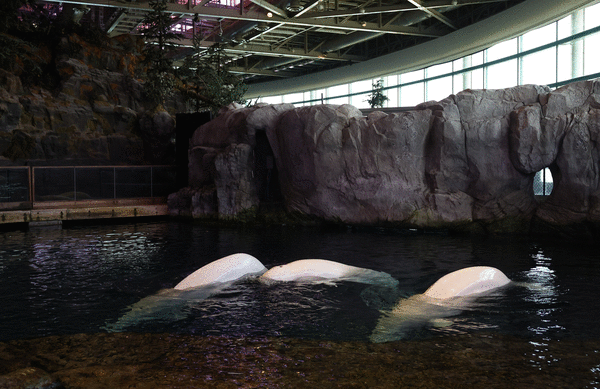
CHICAGO — Another beluga whale rescued from a troubled Canadian marine park and brought to Chicago’s Shedd Aquarium earlier this summer has died, the facility announced Friday.
In a blog post, the aquarium staff said Caspian, a 27-year-old female beluga, died Wednesday evening “despite intensive efforts by Shedd’s veterinary and animal care teams to save her.”
Caspian arrived at Shedd in mid-August as part of the recent international effort to save 30 whales that had previously been housed at the now-shuttered Marineland of Canada in Niagara Falls, Ontario. The whales were evacuated to Shedd and other facilities across the U.S. and Spain after Marineland’s owners threatened to euthanize the belugas if long-term solutions weren’t found, according to a previous Shedd news release.
A total of 10 whales arrived at Shedd over the past few months, more than doubling the aquarium’s pod size.
Caspian marks the fourth rescued whale to die at Shedd since the evacuation efforts got underway. The first was 23-year-old Peekachu, who died Aug. 25. Then followed 30-year-old Rain on Sept. 2 and 26-year-old Osiris on Sept. 21.
Those aren’t the only fatalities in recent weeks. Beethoven, a 34-year-old beluga who had already been living at Shedd for decades, also died in early September. And in Spain, another beluga from Marineland — 19-year-old Jelly Bean — died at Oceanogràfic València just over three weeks ago.
Shedd, in its blog post Friday, said Caspian’s health had been of growing concern for weeks. She’d been eating less than her full diet, which is a serious concern given belugas depend on food for hydration as well as nutrition, the post said. But ultimately, her condition deteriorated Wednesday.
“Veterinary and care teams worked tirelessly to keep her on life support for several hours in an attempt to save her life, but she could not recover and ultimately passed away,” Shedd said in a statement to the Tribune late Friday.
During lifesaving efforts, care teams collected blood samples that showed abnormalities in both Caspian’s electrolyte levels and blood pH, according to the aquarium’s blog post. Her blood pH in particular showed her blood had become dangerously acidic, a disturbance that can interfere with the heart’s ability to work effectively, Shedd’s staff said. But these findings alone do not establish what led to her death. Rather, a necropsy will allow veterinarians and external pathology experts to better understand what happened.
Officials said the loss comes as they are still uncovering more information, through necropsy examinations, about the chronic and severe illnesses that the other late beluga rescues were experiencing before their deaths.
Late last month, aquarium officials released the first glimpse of what may have gone wrong in a report detailing the preliminary medical findings from the losses of Peekachu, Rain and Beethoven.
The report stated that both Peekachu and Rain suffered from chronic gastrointestinal disease that likely developed months or years before their transport. Peekachu’s examinations also revealed that she had bird feathers, sticks and large rocks in her stomach, materials that officials said she could not have ingested while at Shedd.
Officials have since completed Rain and Peekachu’s final reports, staff said this week, which both identified significant, longstanding inflammation in their digestive systems. External pathology experts concluded that underlying diseases may have made both whales more susceptible to cardiovascular stress, which contributed to their deaths, officials said.
Separately, Shedd has also released preliminary findings from Osiris’ examination. Early reports point to chronic liver disease, officials say. For now, though, her full report is still underway, which will help clarify the extent of her illness and its possible role in her death, per the aquarium.
Beethoven, meanwhile, had “health changes associated with aging” that affected his cardiovascular system, veterinarians found. Shedd found no evidence of a shared infectious disease or environmental factor connecting the deaths of Peekachu, Rain and Beethoven.
Some experts, though, have said that the aquarium’s findings fall short. The controversial rescue has also raised the alarm among some activists who say a rushed transfer process may have contributed to the whales’ deaths.
In announcing Caspian’s death Friday, Shedd also acknowledged how the six remaining rescued belugas are faring. All six, according to the aquarium, are eating their full diets. They’re also reaching “new milestones in their care,” Shedd said on its blog.
“Across the institutions involved in these efforts,” the blog stated, “teams continue to share observations, compare the whales’ progress and learn from one another as their care evolves.”
———
(Chicago Tribune’s Finnegan Belleau, Adriana Pérez and Lila Hempel-Edgers contributed.)
———
©2026 Chicago Tribune. Visit chicagotribune.com. Distributed by Tribune Content Agency, LLC.






Comments