Nicolás Maduro and wife charged with ordering torture of Americans in Venezuela
Published in News & Features
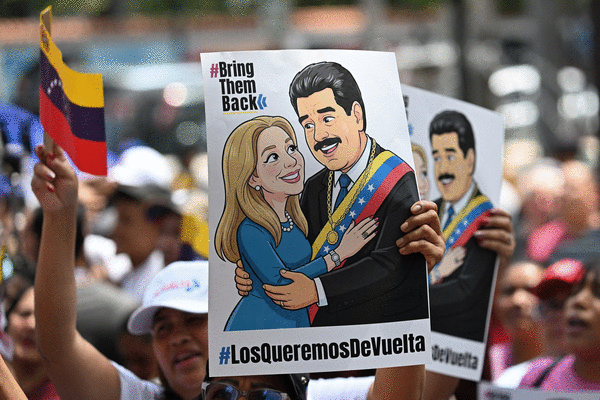
Federal prosecutors in New York filed a new torture conspiracy charge Thursday against former Venezuelan strongman Nicolás Maduro and his wife, Cilia Flores, accusing them of directing a campaign of brutal repression that included the torture of political opponents and American citizens held in Venezuelan prisons.
The new 30-page indictment states that Maduro personally ordered the torture of detainees, received reports on their treatment and sometimes instructed security officials to intensify the abuse. Prosecutors also accuse Flores of ordering torture and helping oversee a system of repression in which prisoners were subjected to electric shocks, simulated drowning, beatings and threats against their families.
Among the cases detailed in the indictment are those of American citizens prosecutors say were subjected to electric shocks, asphyxiation and repeated beatings. One American detainee was told by a Venezuelan intelligence officer that he had been kept alive because he could be useful in a prisoner exchange with Washington, according to prosecutors.
The new charges significantly expand the criminal case against Maduro, 63, and Flores, 69, who were captured by U.S. forces in Caracas on Jan. 3 and brought to New York to face narcoterrorism, cocaine trafficking and weapons charges. Both pleaded not guilty to the earlier charges and remain in federal custody in Brooklyn.
The indictment increases the number of criminal counts from four to five, adding conspiracy to commit torture while retaining the existing drug trafficking and weapons allegations. Their trial is scheduled to begin June 1, 2027, before U.S. District Judge Alvin Hellerstein.
System of repression
The indictment portrays torture as an instrument of government policy rather than isolated misconduct by individual security officers.
Prosecutors describe a network of senior officials, identified in some instances by coded designations, who they say supervised arrests, interrogations and torture without meaningful judicial oversight.
One official, identified as CC-1, ordered subordinates to torture detainees and developed interrogation techniques presented for Maduro’s approval, according to the indictment, while another, CC-2, oversaw torture operations and reported directly to Maduro about specific prisoners.
A third official, CC-3, participated in the detention and abuse of people considered threats to the government.
The document also describes violence against individuals suspected of interfering with drug trafficking operations.
In one incident, Maduro and Flores ordered members of their security details to torture a law enforcement official suspected of stealing narcotics proceeds, prosecutors say. The officer, identified as Official-1, was tied to a military trailer, struck with a shovel and rifle butt, kicked and subjected to other abuse, including injuries to his genitals.
Torture of political opponents
The indictment details several cases involving military officers, opposition figures and other detainees accused of plotting against Maduro.
One involved a Venezuelan military officer identified as Victim-2, who prosecutors say was detained in 2013 because authorities believed he had been meeting with a former senior government official opposed to Maduro.
Intelligence officers transported him to a camp controlled by Colombia’s FARC guerrilla organization, where he was interrogated and tortured over approximately two days, according to the charges. The officer was struck repeatedly, suspended by his hands and feet and subjected to simulated drowning. His captors threatened to kill him and accused him of conspiring against Maduro.
Prosecutors say Maduro later asked about the officer’s treatment and watched a video of his forced confession.
Another section describes the government’s response to protests in 2014, when the government says Maduro discussed kidnapping military officers suspected of disloyalty and using torture to force them to reveal information about potential plots.
During one meeting, according to the indictment, Maduro used a hand gesture and told officials to “squeeze them harder,” directing them to increase the intensity of the abuse.
The indictment also describes a political opponent identified as Victim-3 who was subjected to beatings, sleep deprivation, threats and prolonged exposure to bright lights and loud sounds. Prosecutors say Maduro received updates about the detainee and ordered additional abuse when told he remained defiant.
Following an attempted drone attack against Maduro in August 2018, another detainee, Victim-5, was subjected to electric shocks, beatings, asphyxiation and prolonged interrogation at the Boleíta Norte detention facility in Caracas, the indictment says. Officers recorded some of the abuse, according to prosecutors.
Americans held in Venezuela
The indictment also details the treatment of American citizens detained in Venezuela, including prisoners supposedly used to pressure the U.S. government.
Prosecutors cite the November 2017 arrest of six U.S. oil executives on corruption allegations involving a company affiliated with Venezuela’s state oil company, PDVSA.
Maduro publicly accused the executives of corruption, while a senior official privately described their detention as a means of pressuring Washington, according to the indictment. The executives were released in October 2022.
Other cases involve Americans who prosecutors say suffered physical and psychological torture in Venezuelan prisons.
One U.S. citizen, identified as Victim-7, was arrested in January 2022 and tortured over two or three days, according to the new charges. Officers punched him, covered his face, poured a noxious liquid over him and threatened him with further abuse.
After being transferred to Boleíta Norte prison, he was subjected to electric shocks to his arms, legs and genitals, asphyxiation, beatings and forced injections of an unknown substance that caused seizures.
The indictment says a senior Venezuelan official watched as the American was hit with electric shocks, laughed at him and directed officers to continue. The detainee returned to the United States in October 2022.
Another American, identified as Victim-8, was detained in August 2023 while traveling to Venezuela to visit family members.
Intelligence officers attacked him from behind, causing a serious back injury that required hospitalization, before transporting him to Boleíta Norte, the indictment states. During the journey, officers subjected him to electric shocks and placed a pressure device around his ankles.
At the prison, an officer told him that he remained alive only because officials had discovered he was a U.S. citizen and believed he could be useful in a prisoner exchange with Washington, prosecutors say.
The indictment also describes the January 2025 detention of another American, Victim-9, stating he beaten repeatedly over two days, causing permanent injury to one eye.
He was released in January 2026 after being warned not to publicly discuss his treatment, according to prosecutors.
The document does not identify the Americans by name.
A broader criminal case
The new torture allegations accompany longstanding accusations that Maduro and Flores used Venezuela’s institutions to facilitate international cocaine trafficking.
The January indictment charged Maduro and several associates with participating in a narcoterrorism conspiracy involving Colombian guerrilla organizations, Mexican drug cartels and Venezuela’s Tren de Aragua criminal organization.
Prosecutors accused Maduro and Flores of protecting traffickers, facilitating cocaine shipments and benefiting financially from narcotics operations.
Unlike the January indictment, which also named Diosdado Cabello, Ramón Rodríguez Chacín and other defendants, the new charging document names only Maduro and Flores. The document does not explain the procedural status of the other defendants or whether the charges against them remain pending separately.
Prosecutors describe the drug trafficking and torture conspiracies as interconnected, asserting that proceeds from corruption and narcotics trafficking helped Maduro and Flores maintain the loyalty of officials who enforced their rule.
The indictment also includes forfeiture provisions allowing the government to seek assets connected to the torture conspiracy if prosecutors obtain a conviction.
Trial scheduled for 2027
The expanded indictment comes as Maduro and Flores prepare for trial in a prosecution that has raised questions about the circumstances of their capture and their legal status as former leaders of Venezuela.
Maduro has challenged the prosecution on sovereign immunity grounds, arguing that his position as Venezuela’s head of state should protect him from criminal proceedings in the U.S. Prosecutors dispute that argument.
Flores has separately sought release from pretrial detention on health grounds, a request opposed by prosecutors. She is scheduled to appear before Hellerstein on Thursday for a hearing on her request.
The addition of the torture conspiracy charge places accusations of political repression and the mistreatment of American detainees alongside the drug trafficking allegations that initially brought Maduro and Flores before a U.S. court.
©2026 Miami Herald. Visit at miamiherald.com. Distributed by Tribune Content Agency, LLC.





Comments