Florida's 3 national forests at risk of logging, new roads under Trump rollback, groups warn
Published in News & Features
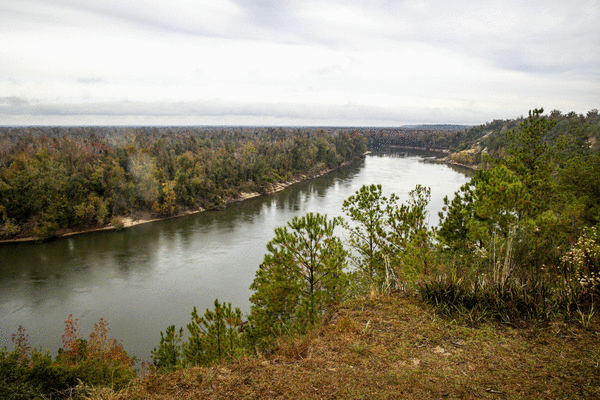
Tens of thousands of acres within Florida’s three national forests could be opened to new road construction and logging under a proposed rollback of protections from the Trump administration, further imperiling wildlife and plants already squeezed by overdevelopment, environmental advocacy groups warned Monday.
The U.S. Department of Agriculture in August moved to rescind a rule safeguarding millions of acres of the nation’s public forests from road construction and timber production. Environmentalists say crucial Florida habitat for more than 130 threatened and endangered plant species and nearly 40 animal species could soon be at risk, and they’re urging the public to weigh in before a comment period ends Tuesday night.
Rescinding a quarter-century of protections under the 2001 Roadless Area Conservation Rule to build new roads and cut down trees could fragment the habitat of the Florida scrub jay in Ocala National Forest; it could pollute lakes and ponds that house the Suwannee alligator snapping turtle in the Osceola National Forest; and it could threaten the state’s largest populations of red-cockaded woodpeckers in the Apalachicola National Forest, according to the nonprofit Florida Wildlife Federation.
“This would be a disaster for Florida’s wildlife and people while development continues to close in from every side,” said Jess Melkun, vice president of conservation policy for the wildlife federation.
“We cannot let that happen.”
The U.S. Department of Agriculture has said the “one-size-fits-all” Clinton-era rule has frustrated land managers and made hard-to-reach swaths of forest more susceptible to wildfires. Republican governors in western states, including Utah, Wyoming and Montana, are among the politicians who have backed the proposal to free up forest management from what Montana Gov. Greg Gianforte called “the heavy thumb of Washington, D.C.”
Timber production occurs in Florida’s national forests, but the “inventoried roadless areas” – the land shielded from logging and road building under the rule – stands at around 50,000 acres, according to U.S. Forest Service data. About half of that acreage is within the Apalachicola National Forest in the Florida Panhandle.
Matthew Schwartz, executive director of the nonprofit South Florida Wildlands Association, said not all of the roadless lands would immediately become available for roads or logging if the rule is rescinded. Some lands have pre-existing protections, he said, including roughly 6,000 acres of wilderness that has been assessed by federal forest staff as critical to wildlife.
But by his count, an area about the size of Florida’s Walt Disney World – roughly 25,000 acres – could be vulnerable to new roads and logging, with possibly more in the future, he said in an interview. Other Florida environmental groups have said all 50,000 roadless acres in Florida’s national forests could ultimately be at risk.
“Florida’s continuing loss and fragmentation of wildlife habitat make remaining intact public lands increasingly important,” Schwartz said.
He said it’s harder for animals, especially smaller critters, to cross roads through the heart of their habitats when motorized vehicles zip through all day.
A spokesperson for the U.S. Department of Agriculture did not respond to a request for comment. As of Monday afternoon, there were more than 325,000 public comments made on the federal register about the proposed rollback.
“As someone who lives in a developing city, seeing small forests and animals leave my home slowly because of construction of storage units and car washes, I have to wonder how much of natural Florida will still be here for my grandchildren to experience,” wrote one commenter on Sept. 12.
“Florida should not build roads through, or touch, untouched land.”
_____
©2026 Tampa Bay Times. Visit tampabay.com. Distributed by Tribune Content Agency, LLC.






Comments