Judge denies Lindsay Clancy's request to be found not guilty of murdering her kids
Published in News & Features
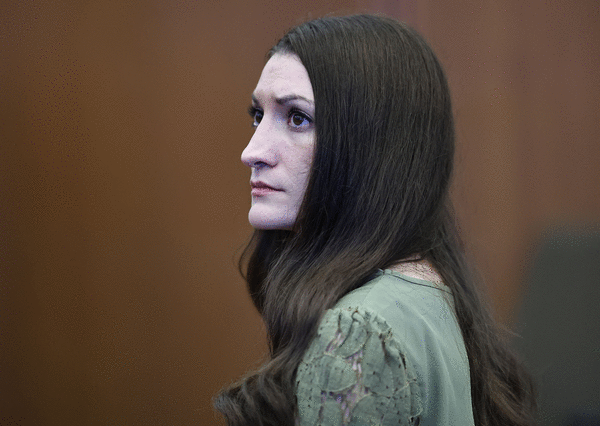
BOSTON — A judge denied Lindsay Clancy’s bid to have him find her not guilty of the murder of her three children after her trial ended in mistrial.
Clancy’s attorney Kevin Reddington had filed a motion for a required finding of not guilty on the murder charges because, he argued, the prosecution had failed to provide enough evidence that Clancy was responsible for killing them and that, even if so, that she was criminally responsible for their murder.
“The Court finds that the evidence, when viewed in the light most favorable to the Commonwealth and with the reasonable inferences permitted to be drawn, was sufficient to have satisfied any rational trier of fact beyond a reasonable doubt as to the essential element of the defendant’s criminal responsibility,” Judge William F. Sullivan wrote in his Thursday decision.
Clancy was on trial in Plymouth Superior Court for the strangulation murders of her three children, Cora, 5, Dawson, 3, and Callan, 8 months, at their Duxbury home on Jan. 24, 2023. It ended in mistrial.
In his order, Sullivan summarized the prosecution’s case that on that night Clancy had ordered food from a restaurant in Plymouth and that she had sent her husband, Patrick Clancy, to pick it up and that as he was out she also sent him on an errand to CVS. All this time, Lindsay Clancy remained at home with the three children.
When Patrick Clancy returned home, he testified, he found his wife on her back in the yard and she told him that she had tried to kill herself and that their children were in the basement. Patrick Clancy called 911 and then went to the basement where he found his children with exercise bands tied around their necks.
Sullivan says that this evidence, circumstantial or not, “was sufficient to satisfy any rational trier of fact beyond a reasonable doubt.”
It is on the issue of criminal responsibility that Reddington, at both trial and in his motion, is most insistent about his client being found innocent.
At trial, Reddington had not challenged that his client had been the hand that killed her children. In his motion, Reddington wrote that both the defense and prosecution’s expert witnesses agreed that Clancy had not been in her right mind that night due to a number of factors, not least of which was the medley of psychiatric medications she was prescribed.
“No rational jury could find beyond a reasonable doubt that she had no mental disease or defect when the Commonwealth’s own proof established that she did,” Reddington wrote in his memo.
The prosecution contests that their witnesses’ testimony came to that conclusion, and in fact argued the opposite.
Sullivan concludes that these experts “testified that it was their opinion that the defendant did not lack substantial capacity to appreciate the criminality or wrongfulness of her conduct and did not lack the substantial capacity to conform her conduct to the requirements of the law at the time of the killings.”
Sullivan adds that “Although the defendant also produced expert witnesses who disagreed with the Commonwealth’s experts, it is within the discretion of the fact finder,” in this case being the jurors, “to place little or no weight on that evidence.”
A text message to Reddington asking for comment on this decision was not immediately returned.
_____
©2026 MediaNews Group, Inc. Visit at bostonherald.com. Distributed by Tribune Content Agency, LLC.






Comments