Where Florida governor candidates Donalds, Jolly stand on gun laws and Parkland
Published in News & Features
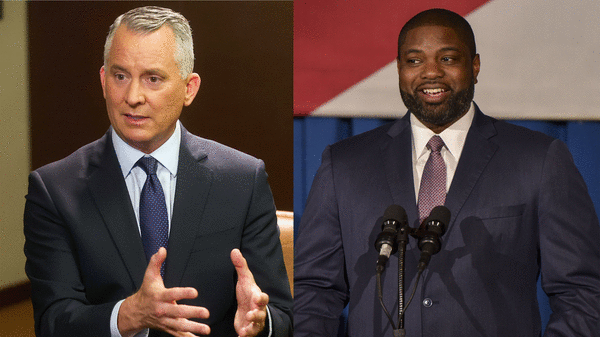
TALLAHASSEE, Fla. — Nearly nine years since a gunman opened fire in a Parkland high school, killing 17, the mass shooting’s shadow still hangs over Florida politics.
A law that state legislators passed in the aftermath of the shooting, the Marjory Stoneman Douglas High School Public Safety Act, stands today. But it is facing mounting opposition from Florida’s gun lobby and some Republican politicians, who say it curtails the Second Amendment.
Florida’s Republican nominee for governor, U.S. Rep. Byron Donalds, voted against the act when he was in the Florida House. Florida’s Democratic nominee for governor, David Jolly, has said he doesn’t want to dilute the safety package.
Florida’s next governor will have the final say over whether the state repeals the law, along with a litany of other gun issues.
Donalds and Jolly have sparred over their differences on gun policy. Ahead of the primary election, the Donalds campaign put out clips of Jolly on MSNOW, formerly MSNBC, where Jolly said it was necessary to “crush the culture of guns in the United States.”
In response, Jolly said Donalds was willing to “sell Florida’s kids out to the gun lobby.”
Here’s what to know about where both candidates stand on firearm issues.
Red flag law
The Parkland shooting inspired Florida’s 2018 red flag law.
Under that law, courts can issue a risk protection order to temporarily require that someone surrender their firearms if they pose a danger to themselves or others. In Florida, only law enforcement can initiate the petition.
Donalds, as a freshman lawmaker that year, voted against the post-Parkland bill. He has said he would still like to see the red flag law repealed, arguing the law violated the Fifth Amendment’s right to due process.
Under Florida law, no lawyer is guaranteed for people subject to a risk protection order (although they can choose to retain an attorney).
Jolly, a Democrat, said on his campaign website that he would like to “preserve and expand” the red flag law, contending it should “never be rolled back to appease special interests.”
Jolly’s campaign declined to respond when asked what expansions he would seek.
So far, Florida lawmakers haven’t had the appetite to remove the red flag law, even with Gov. Ron DeSantis’ urging. The law has been supported by Florida’s sheriffs and other law enforcement officers, who say it helps prevent violence.
Gun buying age
The Marjory Stoneman Douglas safety package also prohibited young Floridians from buying guns. Under that bill, people under age 21 can’t purchase a firearm.
The Florida House has for several years passed a bill that would lower the minimum age for gun purchases back to 18, although the measure hasn’t gained much traction in the Senate.
People younger than 21 can possess a rifle or firearm if they obtain it another way, like having it gifted to them. And members of law enforcement, correctional officers and service members can purchase guns if they are younger than 21.
Coming into this year’s legislative session, there will be extra pressure to repeal the age limit – the U.S. Department of Justice in September issued an opinion concluding that a similar federal restriction is unconstitutional.
Donalds has said he opposes Florida’s law restricting gun sales, saying it creates a two-tier system for adults. In a radio interview on the Bob Rose Show, Donalds said removing the purchase ban and the red flag law would “probably be job one.”
Jolly, in a town hall in Broward County last year, said he doesn’t want to “dilute” the post-Parkland safety package, according to the South Florida Sun-Sentinel.
Campus carry
Florida law largely prohibits anyone on a college campus from carrying a gun.
But after a deadly shooting last year at Florida State University, lawmakers expanded the school guardian program to include colleges and universities. That program, which was created after the Parkland shooting and was initially for K-12 schools, allows select staff or an employee hired for security to carry weapons on campus if the school opts in.
That means colleges can now choose to let select college faculty carry firearms.
But most of Florida’s students are still unable to keep a firearm in their dorm room or with them as they go to class.
Neither Donalds nor Jolly have spoken publicly about where they stand on allowing guns on campus. But Bryan Avila, Donalds’ pick for lieutenant governor, said he would support campus carry, according to a video recorded by a Second Amendment advocate.
Avila, in the video posted on YouTube, also said he would encourage schools to adopt the guardian program.
Donalds and Jolly both declined to clarify their stances about guns on campus when reached by the Times.
Other gun issues
The post-Parkland safety package also created a ban on bump stocks.
A bump stock is a gun accessory used to increase the shooting rate. Having one is punishable by up to five years in prison.
Donalds is opposed to the bump stock ban, according to the pro-gun group Gun Owners of America, which endorsed him. He also opposes bans on certain semiautomatic rifles referred to as assault weapons, like AR-15s.
On Jolly’s campaign page, he proposes banning the sale of new assault weapons. He says he would grandfather in firearms that people already own.
His campaign page also includes a frequently asked questions section, where Jolly includes data about how many Floridians die from gun injuries each year and information about how many gun deaths are suicides.
He also proposes requiring universal background checks for all gun sales. Donalds has voted against a law that would require universal background checks.
©2026 Tampa Bay Times. Visit at tampabay.com. Distributed by Tribune Content Agency, LLC.






Comments