Apparent double murder-suicide that left family of 3 dead in San Diego revives questions over VA wait times
Published in News & Features
SAN DIEGO — No one can know what happened inside the house on Boulder Lake Avenue in the hours before the Voight family was found dead earlier this month.
San Diego police are still investigating the shootings, and suspect a decorated war veteran shot and killed his wife and daughter, then turned the gun on himself.
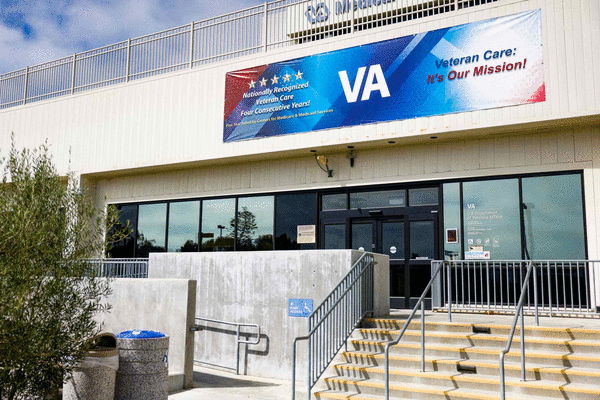
Relatives say Amy Voight drove her husband, retired U.S. Navy bomb-disposal expert David Voight, to a local Department of Veterans Affairs facility for emergency mental health treatment on the last day of their lives but were allegedly turned away.
“They told him there was nobody available, and people were busy,” Gerald Austin, Amy Voight’s father, told the Union-Tribune after police discovered the couple’s bodies and that of his granddaughter, 13-year-old Mya, inside the home Sept. 16.
While the tragedy sparked grief and second-guessing across the San Carlos community, it also revived questions about how military veterans access mental healthcare — and how recent reductions in staffing to the VA have affected those services.
It’s not clear where the Voights went, with whom they spoke or specifically what they were told when they apparently tried to seek help before their deaths. The VA declined to discuss the Voight case in any detail, citing confidentiality rules, but a VA spokesperson disputed the family’s claims.
“V.A. can’t comment on this particular case due to privacy concerns,” spokesperson Quinn Slaven said by email. “What’s being alleged regarding V.A. services is not accurate. All V.A. healthcare facilities offer same-day emergency mental healthcare to all veterans who need it.”
Veterans groups and other advocates credit the VA with delivering terrific healthcare — once former service members are enrolled.
But the wait for specialty services, including mental health treatment, can stretch for months or longer, leaving many veterans on their own, VA data show. The lucky ones find help from within or through the kindness of family and friends before the federal government is able to help, veterans and advocates say.
“Transitioning back to the civilian community after the military is very much like migrating from one social order to another,” said Ron Stark, who spent 20 years as a submarine technician for the U.S. Navy before retiring in the 1990s.
Much of the acclimation after leaving the service, he said, “falls on the veteran himself to find their own way — and that’s not easy.”
Stark said he still has to work at reintegrating himself into civilian society — and he has been out of the military for more years than he served.
He copes in part by volunteering with the San Diego Veterans Coalition, a group of nonprofits that helps veterans navigate the nonmilitary world. Stark is particularly proud of Onward Up, a program that finds and sponsors veterans at risk of falling through the social safety net.
“There are much more services available than are being used,” he said. “We think we can go it on our own, and then we can’t — and then we really can’t. But there’s hardly anything out there that will do it all for you. You have to be engaged.”
The Department of Veterans Affairs operates the largest integrated healthcare system in the United States, treating more than 9 million enrolled veterans for everything from basic medical services to specialized cancer and other treatments.
But while patients and their advocates generally give high marks to the quality of services provided by the VA, there are persistent criticisms that the bureaucracy is too slow to enroll patients and that there are unacceptable delays in delivering specialized treatment.
According to VA data, established patients seeking individual mental healthcare around San Diego County generally must wait between nine and 18 days to be seen by a therapist. For new patients, the wait stretches from 25 to 76 days.
Clinics in Kearny Mesa and Oceanside are able to schedule sessions with troubled veterans who are established patients in nine days, but the wait is 10 days at the Rio center in Mission Valley and at the Escondido clinic, federal records show.
The same database says wait times for individual counseling at the Jennifer Moreno Department of Veterans Affairs Medical Center in La Jolla are 12 days, and 18 days at the Chula Vista clinic.
Independent researchers say delays have grown worse over the past two years, as the Trump administration used attrition, early retirements and a hiring freeze in a move to reduce as many as 30,000 jobs from the VA under the so-called Department of Government Efficiency, or DOGE, overseen by Elon Musk.
Front-line healthcare workers, including doctors and nurses, were exempt, the VA spokesperson said, and the positions that were eliminated have not affected patient services.
“Average wait times for V.A. mental healthcare are lower under the second Trump administration than they were under Joe Biden,” Slaven said.
He pointed to national VA data that show new patients wait an average of nearly 16 days compared to 20 days in fiscal 2023 and 19 in fiscal 2024. The VA completed a record high of 15.5 million mental healthcare appointments last fiscal year, as well as set new records for veteran suicide screenings, he added.
But in March, ProPublica reported that veterans across the country were losing access to mental healthcare as a result of Trump administration policies. In January, the nonprofit news organization said the VA had some 500 fewer psychologists and psychiatrists than it did a year earlier.
The Vet Voice Foundation is a nonprofit based in Portland, Oregon, that mobilizes veterans to improve their communities and protect democratic policies. In April, the foundation released a study finding that wait times at VA centers across the country have escalated in recent months. It said 90% of 21 centers tracked in the report acknowledged experiencing severe shortages in the number of doctors on staff.
“Under the current administration, Trump’s leadership team has sought to shrink the V.A. workforce all while denying any negative impact on veterans’ access to V.A. care,” researchers wrote. “The V.A. is violating its own standards for timely access in many specialties in most locations.”
The report found that wait times at VA facilities rose gradually between separate three-month periods under the Trump administration. Researchers compared data over the three months that ended Nov. 19, 2025, with the same data for the three months ending Feb. 20, 2026.
They found that the wait for individual mental health treatment was 27 days between August and November 2025 and increased to 27.4 days over the following three months. Group therapy wait times climbed from 17.2 days to 29 days over the same period.
The same study cast doubt on the veracity of information posted on VA websites.
“Anecdotally, there are discrepancies between listed wait times and what veterans are being told by facilities, raising concerns that reported wait times are inaccurate or misleading,” it said.
The VA said the Vet Voices study was deeply flawed and biased.
The report “focuses on a tiny percentage of specialty health services, relies on incomplete data, arbitrarily decides what counts as a significant change in wait times, and counts every specialty and clinic the same, regardless of whether they serve a few patients or thousands,” Slaven said.
Getting answers, getting help
At least one local veteran said the VA was unable to help when he sought assistance.
The former combat veteran suffering from substance-use and post-traumatic stress disorders told the Union-Tribune that he contacted the VA in San Diego for help one day after completing a residential program a few years ago.
He said he was interviewed online for less than 15 minutes before being prescribed a cocktail of various drugs for sleep, anxiety, depression and other symptoms, but that it would be 14 months before he could sit down in person with a mental health counselor.
“They don’t know what to do with you because they don’t have enough therapists, so they dope you up,” said the former fighter, who did not want his name published to avoid any ramifications with the VA or his professional work. “You just live in this fog.”
The veteran said he relied on close friends to overcome his challenges — and a psychedelic therapy program his military buddies referred him to in Mexico. The experience worked wonders, he said. He’s now sober, and he kept that long-awaited VA appointment.
“When I got a therapist 14 months later, she was wonderful,” he said. “She was incredible. The VA just doesn’t have enough therapists, and it takes too long to see one.”
Tom Moore is a combat veteran from Vista who left the armed services with a permanent 100% disability. Even with a circle of friends and advisers, he said it took weeks to get enrolled in the VA and access his benefits, including mental healthcare.
“When I was in the service, I went through counseling, so I have some experience and I know how it works — it worked for me,” he said. “The stigma has decreased over the last 20 or 30 years, but that’s dependent on the person’s environment and their education level as far as what counseling really is.”
Moore, who is now 51 and commander of the San Diego American Legion District 22 chapter, said the group runs what’s called the Be the One program targeting vulnerable veterans.
“We try to recognize the signs of somebody that may be in trouble and get the person to a place where they are safe,” he said. “A lot of veterans don’t feel comfortable opening up to just anybody. We are more comfortable talking to each other, no matter what service you’re from.”
Moore said the American Legion is committed to continuing “service after service.” Part of that commitment is confronting horrific cases like the Voight family shooting earlier this month, he said.
“We do talk about it because it is an issue,” the District 22 commander said. “With the Be the One program, that’s what we are supposed to be doing. If you are having issues, please reach out.”
Jeff Gering was the CEO and director of the VA San Diego Healthcare System from May 2012 to 2015, and now chairs the board of the regional chapter of the National Alliance on Mental Illness, or NAMI. He said veterans he speaks with are “happy (with) and proud of” treatment from the local VA.
He noted that mental health issues can bring severe symptoms one day and mild the next. “It’s always not predictable,” he said. For friends and family trying to help, Gering said they can face “an ongoing struggle.”
“Sometimes they listen to you,” he said. “Sometimes they don’t.”
Help outside the VA
There are also outside groups trying to get mental healthcare to veterans, including the Headstrong Project, a nonprofit that provides outpatient mental healthcare for veterans and transitioning service members with trauma.
Headstrong, which has a presence in San Diego, provides veterans one-on-one sessions with private-practice clinicians who have military cultural competence. The sessions are confidential and outside of the VA system. The first 30 sessions are free.
“A big thing for us is trying to reduce barriers to access for care,” said psychologist Amy Williams, the organization’s chief clinical officer. She called the service “the easy button for clients.”
Last year, Headstrong served 374 veterans in California, providing them more than 7,000 sessions.
The organization does not provide emergency care. Williams said it takes an average of 12 days from an intake interview over the phone to the person’s first appointment with a provider.
Anyone — not just veterans — who needs to access mental health crisis services can call the national suicide and crisis line day or night at 988. Military veterans can press 1. The crisis line can also be reached via text at 838255. The support is free and confidential.
Any patient — including veterans — seeking urgent mental health treatment may also visit any emergency room for assistance.
©2026 The San Diego Union-Tribune. Visit sandiegouniontribune.com. Distributed by Tribune Content Agency, LLC.





Comments