Multiple belugas have died at Shedd Aquarium since dramatic rescue from Canada. Activists say the transfers happened too quickly.
Published in News & Features
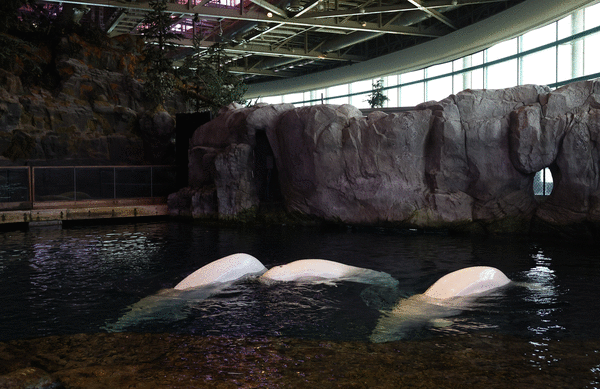
CHICAGO — More than three weeks have passed since the last beluga whales were transported from a shuttered marine park in Canada to Shedd Aquarium and other facilities across the U.S. and Spain. The dramatic rescues involved lifting the whales with cranes and flying them across international borders.
But since then, five belugas have died: Three who arrived at Shedd from Canada, one already living at the Chicago aquarium and another in Spain. Advocates for animal well-being say a rushed transfer process may have contributed to their deaths, and they are worried about government approval of export agreements lacking commitments not to breed the whales.
“This situation should have been handled so much better from the start,” said Kaitlyn Mitchell, director of legal advocacy at Animal Justice, a Canadian nonprofit specializing in legal advocacy for animals. “These animals deserved better, and yet here we are.”
The international rescue effort moved 30 whales out of Marineland of Canada in Niagara Falls, Ontario. Marineland’s owners threatened to euthanize the belugas if long-term solutions weren’t found, according to a previous Shedd news release.
Shedd took in 10 whales, with the others going to the Georgia Aquarium in Atlanta, SeaWorld San Antonio, SeaWorld San Diego and Oceanogràfic València in Valencia, Spain.
Eight belugas arrived at Shedd in July and August. Before the aquarium could rescue the final two, 23-year-old Peekachu died Aug. 25. The cause of her death is still unknown, but the whale was consistently undereating, and blood samples before her death showed dehydration, the aquarium said in a post.
The remaining whales arrived at Shedd on Sept. 1.
One day later, the aquarium announced the death of 20-year-old Rain, who came from Marineland in August. Beethoven, a 34-year-old beluga already living at Shedd for decades, also died the same afternoon.
Necropsies for the animals were still ongoing, Karisa Tang, vice president of animal health at Shedd, said Friday, and it was too early to speculate on what led to any of the whales’ deaths.
Another beluga from Marineland, 19-year-old Jelly Bean, died at Oceanogràfic València on Sept. 17, a spokesperson for the aquarium confirmed in an email to the Tribune. Jelly Bean had trouble eating but was showing signs of improvement before dying, according to an aquarium news release.
The most recent death was 26-year-old Osiris on Monday morning. The Marineland transfer died at Shedd after “ongoing clinical concerns” throughout September, a spokesperson told the Tribune.
In a Friday post by Shedd, staff identified 22-year-old Secord as another rescue consistently undereating in a manner similar to Osiris. If Secord can’t take in enough calories or water, she may be placed in a medical habitat providing supplemental fluids, electrolytes and medication.
Experts also consider Caspian, 27, to be of “clinical concern” due to consistent undereating, a Shedd spokesperson told the Tribune on Wednesday. She joined the aquarium alongside Secord in August.
The Association of Zoos and Aquariums, which accredits Shedd, said there were no plans to require incident reports for the belugas, as their deaths were due to preexisting medical conditions.
An Oceanogràfic València spokesperson said Wednesday that no other whales had died. The Georgia Aquarium and SeaWorld confirmed no whales had died at any of their facilities.
Evolving plans
Lori Marino, president and founder of the Whale Sanctuary Project based in Nova Scotia, is a neuroscientist specializing in animal behavior. She said a number of factors, from infectious disease to stress imposed by travel, could have led to the belugas’ deaths.
Beluga whales are found globally in Arctic and sub-Arctic waters, according to the National Oceanic and Atmospheric Administration. Many are near Alaska.
Some beluga populations are listed as endangered or depleted. Weighing an average of 3,150 pounds, the whales have been hunted for subsistence, commerce and sport.
Shedd’s eight female whales from Marineland were captured in Russian waters, while the two males were born at the Canadian park, according to a NOAA agreement.
Stress from new animals moving into his habitat may have also affected Beethoven, the whale already living at Shedd who died, Marino said.
“The stress can be real enormous,” she said. “That might have been too much for him. I hope that it wasn’t anything like a pathogen they brought.”
Every whale was tested for infectious diseases before transport, and they all came back negative, Tang said.
A Shedd spokesperson said Wednesday that the whales do not currently share habitats, but some of the Marineland belugas have met the other whales who were already living at the aquarium.
“The decision on where animals are and who they are with changes day by day,” the Shedd spokesperson said. “Belugas are social animals, so we have to consider their social well-being in the same way we monitor their physical health. Our plans evolve every day depending on what we observe from their behavior.”
‘A tough position’
After Marineland closed in 2024, the park’s initial plan was to ship the whales to China.
Joanne Thompson, Canada’s minister of fisheries, denied the request in 2025, as it would have returned the whales to public entertainment, according to a statement posted on X. Marineland then proposed sending the belugas to the U.S. and Spain.
The minister is responsible for approving or denying export permits for cetaceans, according to Ira Khedkar, Thompson’s press secretary, in an email to the Tribune on Wednesday. The belugas’ exports required health assessments for each whale and a detailed transportation plan, she said.
But more should have been done for the whales before they left Canada, Mitchell said.
“They said, basically, if you don’t issue these export permits quickly, we’ll just have to kill them,” Mitchell said. “So our minister was in a tough position; I completely understand that, but that wasn’t the end of it. There were so many other things that could have happened.”
Attempts to reach Marineland of Canada for comment were unsuccessful.
The province of Ontario could have supported additional care to restore the animals’ health before transport and then billed Marineland, Mitchell said, but this didn’t happen.
Several agencies at the provincial and federal level declined to comment.
Marino said the Whale Sanctuary Project offered to bring experts to Marineland and care for the animals before transport, but Andrew Burns, an attorney who owned the shuttered park, refused the organization’s help.
“We’d (have been) happy to go to Marineland, help keeping them healthy, getting them healthy, in an effort to find the best future for the animals,” she said. “But Burns was not interested.”
Burns did not respond to a request for comment.
The Whale Sanctuary Project is creating a sanctuary for whales off Canada’s east coast. A netted-off area is proposed to cover 100 acres of ocean with depths of over 52 feet, Marino said.
Mitchell theorized that Marineland wanted to get rid of the whales quickly because the park sits on a tract of land that Animal Justice estimates is worth hundreds of millions of dollars. The Toronto Star reported a conditional sale of Marineland went through last week, and the property is being considered for a theme park.
“They wanna sell it fast,” Mitchell said. “And they’ve been trying to do that for a while.”
Breeding agreements
A major concern for Marino and Mitchell was the lack of commitment by the participating aquariums not to breed the belugas. A Canadian law passed in 2019 prohibits the breeding of whales for non-research purposes, but no such protections exist in the U.S. on the federal level.
Prohibitions on breeding are important, Marino said, as they prevent more animals from being born into captivity and spending their lives in “concrete tanks.”
“They’re basically saying, ‘Canada does not approve of keeping these animals in tanks for entertainment,’” she said. “And then they send them places where that’s exactly what’s going to happen.”
Export permits were issued for whales in the past only when the Canadian government ensured aquariums would not breed the animals, Mitchell said.
This was the case in 2021, during the transfer of belugas from Marineland to the Mystic Aquarium in Mystic, Connecticut. The aquarium agreed to a breeding prevention plan, according to the National Oceanic and Atmospheric Administration.
Three of the five belugas sent to Mystic Aquarium also died. A representative for Mystic Aquarium wrote to the Tribune in July that the deaths were due to preexisting conditions undetectable in live animals.
Marino would like to see each aquarium pledge not to breed their belugas. She said the Georgia Aquarium was a particular concern. Both of its new whales are male, joining an all-female group already at the facility, according to the Georgia Aquarium website.
“It’s so obvious what happened at the Georgia Aquarium,” she said. “They got two boys, two males from Marineland of Canada. And they have four females, and they want to breed them. They want to make more.”
Animal Justice called on the Georgia Aquarium to make a public pledge not to breed their two belugas from Marineland in a news release.
“Our concern is that, because the situation (was) so rushed, Marineland essentially held a gun to the animals’ heads and told the minister that the export permits needed to be issued or they’d die,” Mitchell said. “And, so it seems like in the rush to issue them, no breeding commitments were entered into.”
A spokesperson for the Georgia Aquarium did not specifically answer a question as to whether the aquarium had committed to not breeding its belugas, writing, “Breeding is not our focus. Our focus is making sure the whales acclimate and adjust well.”
As for Shedd, Tang said there was no breeding plan at the moment but did not rule out the possibility.
“We can’t say what lies in the future, and right now we are solely focused on helping them survive,” she said.
What’s next for Shedd
Throughout the summer, aquarium attendees tried to peer between gaps in black fabric covering windows to the new whales’ habitats.
One memory that stuck out to Tang was arriving at Shedd with belugas in tow. After staying up for about 26 hours, “maybe 40 or 50 people” greeted her at the loading dock at 3 a.m.
“They’re waiting with open arms to welcome us, and just knowing that everyone is in the best possible care, that we’re bolstered by our community, that everyone across the aquarium and the city are there for us — very, very emotional,” Tang said.
During a July visit by the Tribune, four whales from Marineland swam alongside each other and played in an expansive tank. Only three remain alive after Osiris died Monday.
While staff learn from every animal they treat, Tang said the standard of care after the belugas’ deaths is the same for the remaining whales. They are still under 24/7 monitoring, with experts watching everything from the whales’ breathing rates to how much they’re eating.
“After any animal passes away, we do a very complete examination that takes weeks to conduct, where we leave no stone unturned, and that is true of any animal that lives here,” Tang said. “So nothing has concretely changed.”
Shedd started a blog for members of the public interested in beluga updates. Previous posts generally outlined some of the philosophies and methodologies involved in caring for the whales.
For Marino, Shedd is an improvement over Marineland. Yet the whales are still living in captivity for entertainment purposes, she said, which will have negative effects on their brain health.
The Whale Sanctuary Project had once hoped to house some of Marineland’s belugas at its completed site, Marino said.
“We watched them go from one concrete tank to another,” she said. “It’s just, you know, it’s very disappointing.”
____
©2026 Chicago Tribune. Visit at chicagotribune.com. Distributed by Tribune Content Agency, LLC.






Comments