An immigration crackdown, a tragic death and an impossible goodbye
Published in News & Features
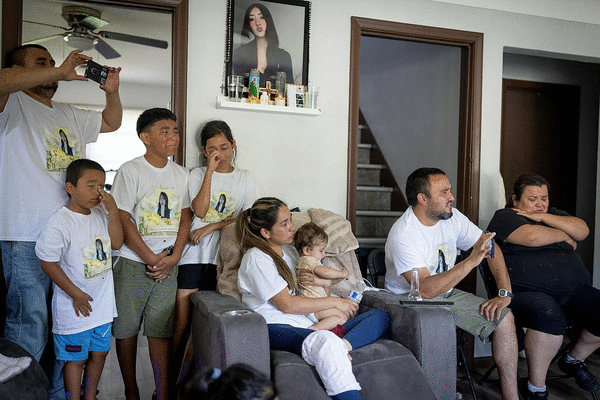
Ismael and Guadalupe never imagined they would have to watch their teenage daughter’s funeral from 2,000 miles away. But last month, the parents gathered with their three younger children in the front room of their St. Paul home to say goodbye to Kimberly, a 16-year-old daughter who dreamed of a life in the U.S.
Flowers and candles formed a memorial on a family room shelf. At its center was a photograph of Kimberly; her lips pursed as if she were about to blow a kiss.
On the television screen, Kimberly lay in her casket, dressed in white, with a crown of pink flowers around her head.
Seeing their daughter for the first time in months brought a flood of grief to Ismael and Guadalupe’s faces. They sobbed as relatives in Jalisco, Mexico, panned a smartphone camera around the room.
Their daughter’s wake and burial in Mexico culminated two months of grief and uncertainty and illustrates the difficult choices undocumented immigrants face when a family tragedy collides with President Donald Trump’s push for mass deportations.
In June, Kimberly and her boyfriend, Leàn, were found unresponsive inside a car in a small garage on St. Paul’s East Side. The Minnesota Star Tribune is using only the first names of Kimberly, her relatives and her boyfriend because some family members have pending immigration cases and fear of reprisal.
Her death left the family with a dilemma. If they buried her near their St. Paul home, and were later deported, they feared they would never be able to visit Kimberly’s grave. If they returned with her remains to Mexico, the family would give up their dream of life in the U.S.
“At first, we were sad that she went back home alone, without us,” Guadalupe said. “Now, we feel better because she can rest in peace.”
Ismael, Guadalupe and their children, including Kimberly, fled cartel violence in Jalisco, Mexico, and arrived at the southern border in late 2024 to seek asylum. They received permission to work while their application was processed, but like many immigrants, the couple was fearful of being detained and deported during Operation Metro Surge.
Ismael and Guadalupe struggled to work and pay the rent, and weighed whether to self-deport to Mexico.
“We were ready to go back, but she begged us to stay,” Guadalupe said. “Our daughter loved it here.”
Despite living in the U.S. for less than two years, Kimberly was a typical Harding High School student, her parents said. She liked makeup and clothes and wouldn’t leave her room unless her look was perfect.
Kimberly met Leàn shortly after she moved to St. Paul and enrolled at Harding, the city’s largest and most diverse high school, where roughly 40% of students are immigrants.
Like Kimberly, Leàn did not have legal status. He was from Honduras and lived with an aunt while attending school.
“He seemed shy,” Ismael said. “I think they connected because they were in the same situation.”
When their friendship evolved into something more, Kimberly’s family told Leàn that he should ask for Ismael’s permission to date her. After Ismael agreed, Leàn visited their home regularly, often for dinner.
“He loved Mexican food, so he loved coming here to eat,” Guadalupe said.
The day they died was the last day of school.
Kimberly left that morning in a rush. When she didn’t come home that afternoon, Guadalupe started to call anyone who might know her whereabouts.
“She was always responsive and punctual,” Guadalupe said. “I started getting very nervous, very anxious.”
They finally reached Leàn’s aunt, who lived with Leàn in a nearby apartment complex. The couple was discovered in a garage stall in the back of the apartment complex.
By the time Ismael and Guadalupe arrived, the ambulance was gone, only the police and the medical examiner were on the scene.
Two months later, the Ramsey County Medical Examiner ruled their deaths accidental from carbon monoxide poisoning.
The deaths devastated Ismael and Guadalupe. There was a lot about the incident that didn’t add up. The teens must have known running a car in an enclosed space was dangerous.
“It just didn’t make any sense,” Ismael said. “My daughter was a happy kid.”
Even before Trump began his second term, there were few pathways for immigrants with pending cases to leave the U.S. for an emergency and return legally without losing their place in line. But under Trump’s immigration crackdown, the options dwindled and then vanished completely.
On Aug. 13, the Board of Immigration Appeals ruled that immigrants who left the country while their asylum case was pending were “inadmissible” for re-entry. Their cases would be considered abandoned, and they would have to wait years before they could try again.
“No one takes lightly the decision of leaving the country,” said Julia Decker, policy director for the Immigrant Law Center of Minnesota. “They know there could be massive consequences for their case.”
Immigrant families have always grappled with distance and connection after losing a loved one, said Melissa Gonzalez, pastor of a predominantly immigrant congregation at Lutheran Tapestry in Richfield.
Technology has closed some of those gaps, but it cannot replace the healing nature of being with family and community in times of loss.
“The loss is immense and is magnified by not being able to be there with family,” Gonzalez said. “It takes a village to bury a child.”
Ismael and Guadalupe felt overwhelmed by what they described as impossible choices.
Sending remains to another country for burial can cost more than $10,000 and is fraught with bureaucratic red tape. Ismael started a fundraiser to help cover the cost.
The family had fled violence in Mexico in 2024 and their son Mateo was recently born in the U.S. Traveling back to Mexico to bury Kimberly would mean they likely couldn’t return to pursue their asylum cases.
But the parents dreaded the thought of Kimberly traveling alone. They were so determined to go with her; their young son was baptized so he could attend the burial if their family opted to leave.
After weeks of deliberation, the family decided to honor their daughter by sticking with her dream and staying in St. Paul.
It was a difficult choice, but they took solace in knowing Kimberly would be laid to rest near relatives.
“A lot of people reminded us we should be thinking about our other three children’s futures,” Guadalupe said.
The family tried to stay busy during the weeks after the burial. It was quickly time for back-to-school.
Ismael and Guadalupe’s 5-year-old daughter, Regina, was starting kindergarten.
That morning, Guadalupe patiently combed and braided Regina’s hair as their youngest child crawled around the family room.
“Kimberly used to love me to braid her hair,” Guadalupe remembered. Then she watched as Regina, wearing a pink backpack with Hello Kitty patches, got on the bus to school.
That day marked three months since Kimberly’s death.
_____
©2026 The Minnesota Star Tribune. Visit startribune.com. Distributed by Tribune Content Agency, LLC






Comments