A federal judge believes Philly DA Larry Krasner may have broken the law, and he referred the case to the US Attorney's Office
Published in News & Features
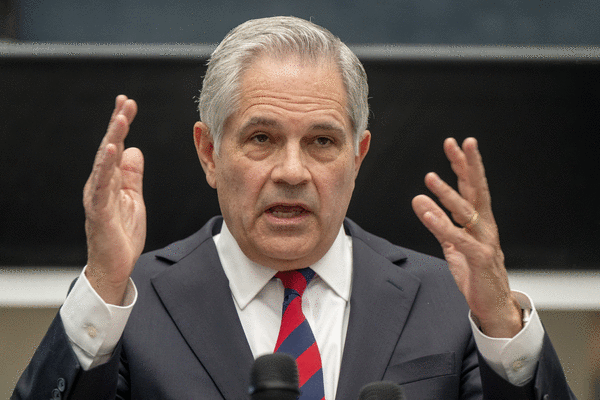
PHILADELPHIA — A federal judge said Tuesday that District Attorney Larry Krasner may have broken the law while overseeing a contentious post-conviction case, and he said he referred the matter to the U.S. Attorney’s Office to investigate whether Krasner should be charged with crimes including conspiracy or obstruction of justice.
U.S. District Judge Paul S. Diamond made those stunning statements in a memorandum in which he also ruled that Krasner and one of his top supervisors, Matthew Stiegler, could no longer participate in the case — a matter in which a man is seeking to have his murder conviction overturned.
Diamond wrote that over the past several months, as he conducted hearings to learn more about how attorneys in DA’s office handled that case, testimony from some of Krasner’s staffers revealed actions by Krasner and Stiegler that Diamond called “troubling,” “disturbing” — and potentially illegal.
Those actions, he wrote, included pressuring other staffers to take steps to protect Stiegler and blame one of his subordinates, urging staffers to lie to Diamond in court and threatening “consequences” for those who did not follow Krasner’s orders.
“I have thus reluctantly concluded that Philadelphia’s highest law enforcement official and one of his top assistants may have violated the law,” Diamond wrote. “In these circumstances, with the issuance of this Memorandum, I refer the DAO, Mr. Krasner, and Stiegler to this District’s United States Attorney’s Office for investigation and other appropriate action.”
In a statement Tuesday, Krasner said, “I respectfully and vigorously disagree” with Diamond’s findings, adding: “I look forward to appealing to the higher court as soon as the law allows.” He said he could not comment further because the case is pending.
Stiegler did not respond to a request for comment, nor did a spokesperson for the U.S. Attorney’s Office, which would have to determine whether to open an investigation or file charges. Diamond, as a judge, cannot do so himself.
The filing was the latest explosive development in the case, which is centered around Dennis Johnson’s 2009 conviction for second-degree murder. Johnson has been fighting to have that conviction overturned, and the matter before Diamond began years ago as a routine petition in federal court.
But in recent months, the case has led to a series of unusual revelations about the inner workings of the district attorney’s office as various lawyers have worked on aspects of the case. And it comes as Krasner’s office has faced increasing scrutiny over the way it has acted in other murder appeals — including a forceful opinion from the Pennsylvania Supreme Court, which said Krasner’s office had misled judges so frequently and flagrantly in such matters that state prosecutors must now review instances when his office says a conviction should be overturned.
Diamond, in his filing Tuesday, said the assertions in his courtroom — made primarily by members of Krasner’s staff — were not only proof of significant internal disagreements about Johnson’s case, but also “evidence of possible criminal wrongdoing by Mr. Krasner and Stiegler.”
Contentious internal discussions
The origins of the controversy began to take shape in 2022.
That year, after the district attorney’s office had spent years opposing Johnson’s bid for freedom, then-Assistant District Attorney Jaclyn Mason filed a brief changing course.
In her filing, Mason agreed with Johnson’s lawyers that his trial counsel had been ineffective. She also said the office had discovered additional problems with the case while reviewing it again, and she recommended that Johnson’s conviction be overturned.
A federal magistrate — relying on Mason’s brief — agreed, but Diamond was the judge with the power to accept or reject the recommendations. And this spring, he scheduled an evidentiary hearing to evaluate some of the evidence before deciding how to proceed.
That led to a series of contentious developments within the DA’s office, prosecutors have since testified.
First, Mason’s supervisors in the law division reviewed her brief and found a series of what they called “material misstatements.” They decided they needed to try to withdraw Mason’s filing and apologize to Diamond for the mistakes.
They asked Mason to sign on to the filing with them, but she declined and resigned instead. She’s since said she only filed her brief because Stiegler pressured her to do so, and she thought her supervisors, in preparing an apology, were angling to make her a scapegoat on Stiegler’s behalf.
During testimony before Diamond in recent months, her supervisors said that wasn’t true. But the supervisors — Katherine Ernst, Steven Wildberger, David Napiorski, and Peter Andrews — said Stiegler and eventually Krasner did try to persuade them to direct blame toward Mason.
Potential crimes?
In the supervisors’ telling, Stiegler asked them to review every case Mason had handled to find other errors in her work. That way, Stiegler suggested, Mason could be painted before Diamond as a “rogue” prosecutor who was routinely making mistakes in problematic filings.
Krasner echoed that potential course of action, and even described it as a “good idea,” the supervisors testified.
Diamond said those actions were “troubling.” He wrote that Krasner “did not simply learn of the Stiegler proposal; he urged the Law Division supervisors — who serve at Mr. Krasner’s pleasure — to implement it and to present a false narrative to the Court.”
And Stiegler, he said, was “urging the DAO to present the Court with a false account to shield himself.” Diamond said he found all of Stiegler’s testimony “contradictory, evasive, or outright dishonest,” and said Stiegler may have committed perjury while on the stand.
In addition, Diamond said, as internal discussions continued about how to proceed in the case, Krasner repeatedly rejected requests by the law division supervisors to refer it to the attorney general’s office. The supervisors generally agreed that was the appropriate course because the inner-office drama surrounding the matter was hampering their ability to handle it properly.
But Krasner, they testified, was vehemently opposed — in part because of his disdain for people who worked in the attorney general’s office. And during some meetings, they said, Krasner said he wanted to “protect the office”; expressed opposition to telling Diamond about the referral deliberations; and said they would face “consequences” if they did so, which they took to mean being fired.
Diamond, in his memorandum, said such a threat “could amount to obstruction of justice.” And he said the efforts by Krasner and Stiegler to present a false narrative to the court “might amount to conspiracy.”
It was not immediately clear Tuesday if federal prosecutors would agree with Diamond’s assessment, or if they’d seek to empanel a grand jury to evaluate it.
Johnson’s petition, meanwhile, remains on hold. Diamond said the district attorney’s office could continue to handle the case moving forward, but it was not clear who might do so.
All of the law division supervisors have already recused themselves, and Diamond said Tuesday that neither Krasner nor Stiegler could have any role in the matter. He also said he also would not allow an outside attorney selected by Krasner to handle the matter on his behalf.
_____
©2026 The Philadelphia Inquirer. Visit inquirer.com. Distributed by Tribune Content Agency, LLC.





Comments