Trump plans to ban imports of some Canadian dairy, alcohol
Published in News & Features
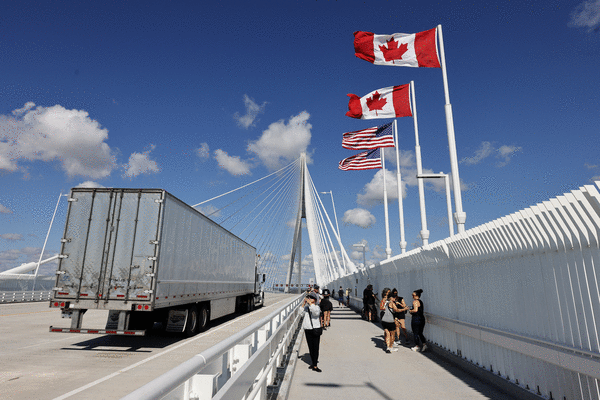
WASHINGTON — The United States escalated its trade war with Canada, moving to block imports of some alcoholic beverages, dairy products and motorcycles, as well as seeking to bar Canadian companies from selling to U.S. government contractors.
President Donald Trump signed a series of proclamations on Tuesday that included bans on motorcycles, whey, molasses, non-alcoholic beer, and a range of alcoholic beverages.
The import bans for some Canadian dairy products and alcohol will take effect in three weeks, a senior administration official told reporters. Modifications to the Section 338 tariffs will go into place in one week.
Canada is the largest supplier of dairy products to the U.S. by volume, accounting for about 14% of the country’s imports, according to the U.S. Department of Agriculture. Those shipments, totaling over 120,000 tons last year, were worth about $433 million.
The changes announced Tuesday also exclude some products from previously enacted tariffs — including some toilet paper, bed sheets, fishing rods and some whiskies and liquors.
Meanwhile, the senior administration official said Trump’s threats to increase Canadian auto tariffs to 50% on January 1 remain in place.
Earlier Tuesday, in a Truth Social post, the president announced he would cut Canadian goods from U.S. government buyers “unless Canada restores full and fair reciprocity for American Farmers and Companies.”
Trump said Canadian goods and services sold under the so-called Multiple Award Schedule are worth more than $50 billion each year. The senior official later clarified that while the White House calculates that the U.S. has a $50 billion procurement market, Canadian companies don’t always account for all of that.
The U.S. president’s actions are the latest salvo in a trade fight that has expanded well beyond tariffs. Talks between the U.S. and Canada on a trade truce collapsed at the last minute in August, leading the Trump administration to follow through with a 50% tariff on billions in Canadian goods.
Trump has since ordered Late Ontario renamed Lake America, prompting an outcry from Canadians and even some Republican allies at home. He’s also threatened to end sales of Canada-based Bombardier Inc. jets in the U.S. and raised questions over the value of Canada’s currency.
Canada’s Prime Minister Mark Carney has refused to back down. After the trade talks collapse, he vowed to retaliate “dollar-for-dollar,” and on Tuesday counter-tariffs on hundreds of U.S. consumer goods, including motorcycles, cosmetics and cheese, went into effect. Carney’s government also increased duties on many U.S. steel items to 50% from 25%.
If implemented, Trump’s government contracts decision could amount to a widespread ban on Canadian companies doing business with the U.S. government and roil contracting across the country. It doesn’t appear to apply to defense contracts, at least for now.
Canadian government officials didn’t immediately respond to a request for comment.
Since the beginning of fiscal year 2021, U.S. federal agencies purchased $13 billion in goods and services sourced from Canada, according to data compiled by Bloomberg Government. That didn’t include classified contracts.
Trump has been in favor of the system. He signed an executive order last year encouraging the use of such contracts in an effort to get the government to purchase more off-the-shelf products and services instead of more expensive bespoke procurement.
Likewise, existing agreements between Canada and the U.S. give American businesses the ability to compete for contracts from many Canadian federal and provincial departments and entities.
But after Trump returned to the White House, Canada began to curb that access. Ontario, for example, canceled a deal with Elon Musk’s Starlink for Internet access in rural parts of the province. The province of Quebec just announced changes that allow it to reserve some public contracts for companies with a presence in Canada or Quebec.
The Canadian retaliatory duties threaten to wreak havoc on closely integrated supply chains, impacting key industries including auto manufacturing. The U.S. and Canada have been top trading partners for years and the political stakes from an extended trade fight for both Carney and Trump are high.
Canada’s measures could have a particularly damaging impact in states such as Michigan and Ohio that also boast key races in November’s midterm elections to determine control of the U.S. Congress. Trump is already facing voter angst over his economic agenda and a war with Iran that has caused energy prices to spike.
Officials negotiated for weeks after Trump threatened to impose tariffs on Canada under a never-before-used authority. Since, then both countries have blamed each other for the intensifying trade fight, trading sharp rhetoric and in some cases insults.
The threat against Bombardier prompted concern from Republican Senator Jerry Moran, who said in a post on X he reached out to the Trump administration “to make certain the President is aware of the significant contributions of Bombardier to Kansas,” including with jobs.
Bombardier has sought to ease tensions, noting that it’s a major contributor to the U.S. aerospace sector with employees in more than 20 states. And the company has touted plans to inaugurate a new facility in Fort Wayne, Indiana, this year.
The trade war has already had ripple effects. Sapporo Breweries Ltd. is moving some production to the U.S. from Canada because of the 50% tariffs imposed on beer exports from the country.
_____
(With assistance from Paul Murphy, Gregory Korte, Derek Decloet, Ilena Peng and Ryan Chua.)
_____
©2026 Bloomberg L.P. Visit bloomberg.com. Distributed by Tribune Content Agency, LLC.




Comments