US pursues deportees abroad for hundreds of millions in unpaid fines
Published in News & Features
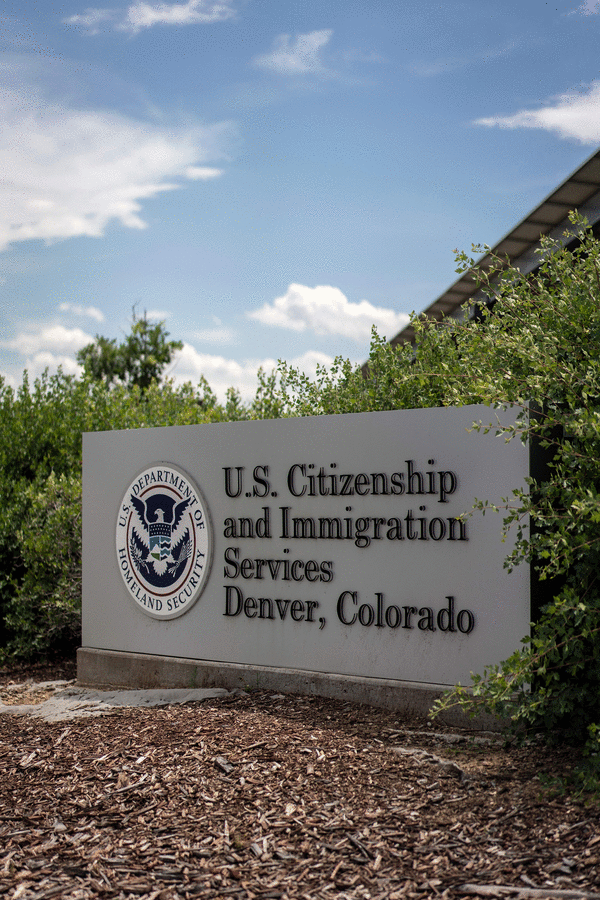
WASHINGTON — The Trump administration is hiring private contractors to track down deported migrants who it claims owe the U.S. government hundreds of millions of dollars in unpaid penalties, a move that will test how far its immigration crackdown can reach across borders.
U.S. Customs and Border Protection says it is trying to recover about $423 million in fines and fees from more than 66,300 people who have been removed from the U.S. Last month, the agency agreed to pay as much as $36 million to four firms to find people in Mexico, Honduras and Guatemala it claims are in arrears, according to a notice posted on a government procurement website.
The initiative marks a striking expansion of President Donald Trump’s immigration enforcement efforts that would extend the government’s power over people it has already expelled from the U.S. However, collecting could be challenging. It’s unclear whether the U.S. can legally require people who have been removed from the country to pay. The contract notice doesn’t explain how the U.S. could compel payments or what role, if any, the governments of Mexico, Honduras and Guatemala would have.
It’s also far from certain whether deportees would be able to pay what the U.S. says they owe. Many may have limited resources or lack access to a U.S. bank account, which is required to pay the fines, according to payment methods described in federal documents. In past cases, the U.S. has threatened that unpaid fines could affect future immigration cases.
The contractors may photograph homes or obtain utility bills, employment records or court papers to locate deportees and establish their ability to pay, according to the contract documents.
CBP awarded the two-year contracts last month to Global Recovery Group, The Baptiste Group, Caduceus Inc. and Response AI Solutions, according to federal records. Each agreement has a maximum value of $9 million. The companies didn’t respond to requests for comment.
The amount CBP is trying to collect represents only a small portion of the larger pool of penalties imposed by the U.S. Department of Homeland Security. From Trump’s return to office on Jan. 20, 2025, through July 16, 2026, Immigration and Customs Enforcement, DHS’s enforcement arm, issued more than 103,000 civil fines totaling more than $84 billion, according to DHS. By July 16, the government had collected just $1.2 million.
“Our message is clear: Illegal aliens in the country unlawfully should leave now or face consequences — including financial penalties,” DHS said in a statement.
The fines are based in part on a provision of a 1996 immigration law that allows the government to impose daily penalties on certain people who refuse to leave after being ordered deported.
The authority was rarely used until Trump’s first term, when his administration sent large bills to immigrant families. The previous administration of President Joe Biden ended that effort in 2021, saying it had proved ineffective and diverted resources from other enforcement priorities.
Trump has now revived the penalties on a far broader scale. Some immigrants can be fined nearly $1,000 for every day they remain in the country after being ordered to leave. Charges can accumulate into the hundreds of thousands, or even millions, of dollars.
$1 Million Bills
The fines are part of a wider strategy intended to make remaining in the U.S. increasingly difficult and expensive. The administration has filed lawsuits to collect unpaid penalties, seized tax refunds and withheld money from wages. Some immigrants still pursuing legal claims to remain in the U.S. have received bills of $1 million or more.
At the same time, the government is offering incentives to people who agree to leave. Immigrants who register through CBP Home, a mobile-phone application used to arrange voluntary departures, can receive paid travel and cash-in-hand from the government. Homeland Security has said certain outstanding fines may also be forgiven.
Some deportees are already receiving bills. Mexican citizens deported this year have received collection letters from CBP at their addresses in Mexico, said Juan Cuellar Torres, director of advocacy at the Kino Border Initiative, a humanitarian organization that works along the U.S.-Mexico border.
The fines, typically about $250, came with a warning that interest could accrue if they were not paid, he said. The notices also warned that unpaid debts could be considered in future U.S. immigration proceedings, a potentially significant consequence for deportees who later want to apply for a visa or seek permission to return. They also warned the debts could be turned over to a private collection agency.
David Leopold, an immigration lawyer in Cleveland, called the overseas effort unnecessarily punitive.
“Going into these countries and pursuing folks who have been deported is just one more step in terrorizing people for no reason,” Leopold said. “It’s icing on the cake of cruelty.”
©2026 Bloomberg L.P. Visit bloomberg.com. Distributed by Tribune Content Agency, LLC.






Comments