Washington officials warn more ballots rejected as 'late' after USPS changes
Published in News & Features
SEATTLE —Before a key midterm election, Washington elected officials are warning voters it’s getting increasingly risky to rely on the U.S. Postal Service to deliver ballots in time to be counted.
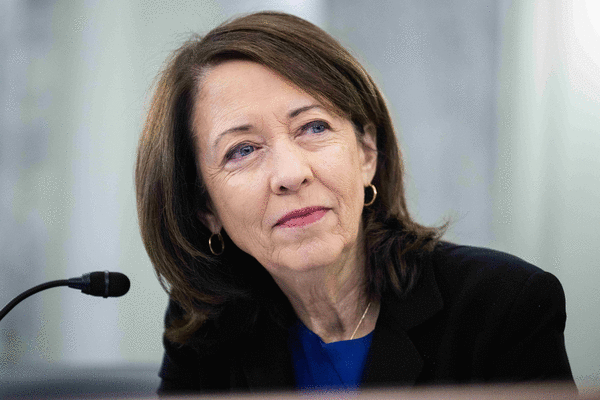
At a news conference Wednesday in Seattle, U.S. Sen. Maria Cantwell and Washington Secretary of State Steve Hobbs pointed to an uptick in ballots rejected in the recent August primary compared with the primary two years ago.
In the August primary, about 20,000 ballots were not counted because they were postmarked too late, according to data from the secretary of state’s office. That’s up from about 16,000 invalidated late ballots in the 2024 primary.
It’s a relatively small slice — 1% or less — of the roughly 2 million ballots cast in each of those elections.
But Cantwell and Hobbs called the rise in late-ballot rejections unacceptable, linking them to new U.S. Postal Service changes that mean ballots are no longer getting postmarked at local post offices. Instead, they’re postmarked at regional mail processing centers, adding delays that have invalidated some votes.
“Why are we disenfranchising Americans when we’ve had one of the best systems in the United States?” Cantwell said, referring to the state’s vote-by-mail system.
The rejection of late ballots is hitting some counties — particularly in rural areas — much harder. In 19 counties, more than twice as many 2026 primary ballots were disqualified for late postmarks compared with two years ago, according to an analysis by Cantwell’s office.
In Mason and Stevens counties, for example, the rate of ballots rejected as late quadrupled this year compared with 2024.
Some Republicans have also expressed concern about mail ballot rejections in rural areas, including some precincts where 5% of ballots were disqualified.
“If you’re in rural WA, you’re 2x more likely to have your vote tossed than if you live in a city,” state Rep. Joshua Penner, R-Orting, wrote on Facebook this week, citing postal delays.
The picture looked better in some more populous counties, where late-ballot rejections actually declined compared with 2024. In King County, for example, the rate of late-ballot rejections was 25% lower in the August primary compared with two years ago. Pierce, Spokane and Clark counties also saw fewer late-ballot disqualifications.
The complaints from state officials come amid a backdrop of broader tension over mail voting between the state and the Trump administration.
Trump has repeatedly denigrated mail voting in states like Washington as ripe for fraud, even as he has personally voted by mail in Florida.
The state and the administration are at odds in a Department of Justice lawsuit demanding access to the state’s full voter list, including private information such as partial Social Security and driver’s license numbers.
State leaders also have sued to block a Trump executive order that seeks to bar the Postal Service from delivering any mail ballots in states that won’t turn over their full voter lists.
In light of the uncertainty, Cantwell and Hobbs urged voters to mail ballots early, or to deposit them in ballot drop boxes that don’t rely on the postal service. Voters are increasingly relying on drop boxes — with nearly 70% using them in the August primary.
Hayward Evans, president of the Seattle King County NAACP, who joined Hobbs and Cantwell at the news conference, said protecting access to voting is an issue that goes “very deep to the heart of our democracy.” “For Black Americans, the ballot never really came easy. We had to fight for it,” he said.
_____
©2026 The Seattle Times. Visit seattletimes.com. Distributed by Tribune Content Agency, LLC.





Comments