The face of terrorism 25 years after the attacks of 9/11: Are we really any safer now?
Published in News & Features
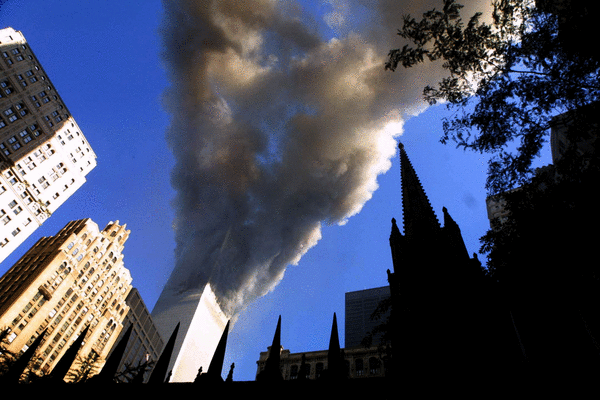
NEW YORK -- Terrorism in 2026 looks very different than it did 25 years ago when the Twin Towers fell on 9/11.
While the United States has not seen an attack on that scale since then, the risks have become more varied and complex. Now, fighting terror is police focusing on the havoc a lone gunman can wreak in Times Square, a Boko Haram commander discussing how AI can help plan an attack and the fear of attacks on synagogues amid growing antisemitism because Sept. 11 this year falls on Shabbat.
Terrorists have adapted to the new reality, with groups such as ISIS inspiring self-radicalized jihadists and lone wolves carrying out more diffuse attacks in places as varied as big cities, leafy suburbs and quiet towns. The Center for Strategic & International Studies identified in a May report four types of terrorism: anti-government extremism. partisan extremism. jihadism and white supremacy.
“Twenty fires years after 9/11 it is an expanding threat, rather than a diminishing one because of the multiplicity of ways things can be carried out,” former Police Commissioner Bill Bratton said. “The good news is there’s a lot more tools with work with, but the bad news is [terrorists] also have access to those tools so it’s a constant one upmanship and who has the better technology to prevent it, detect it and to respond to it.”
“We also haven’t seen the first terrorist attack with drones in the United States,” Bratton noted.
In the immediate aftermath of 9/11, Police Commissioner Raymond Kelly created the first counterterrorism bureau in a municipal police force in America when he took the reins of the NYPD in 2002.
The bureau actively gathered intelligence as it sought to identify potential threats before attacks could be mounted. In the years since, the NYPD has helped thwart dozens of terror plots, though accusations of Muslim spying dogged the department for years and led to greater oversight of its intelligence-gathering programs.
Recent attacks point up the new landscape.
On Aug. 20, Jessica Bowie, 35, of Albany, was charged with planning to carry out an ISIS-inspired terror bomb attack on the state capitol, telling informants she wanted to kill as many lawmakers as possible, according to court papers.
On May 15, the head of an Iranian-backed militia was charged with plotting to attack a Manhattan synagogue. A protest outside Gracie Mansion in March led by Jake Lang — a far-right activist — drew two ISIS-inspired counter protesters busted as they tried to set off an explosive device.
In July 2025, Michael Gann, 55, who said online that he was bothered by immigration in the city, was accused in an indictment of making bombs, putting some atop residential buildings in Manhattan and tossing one onto the subway tracks of the Williamsburg Bridge. None were detonated.
And in November 2022, two armed men were busted at Penn Station, authorities calling them a threat to Jews and saying they planned to target a synagogue.
New York University Prof. John Gersham, who in 2004 was the lead author of a think tank report critical of the Bush administration’s counterterror policies after the Sept. 11 attacks, said that on many levels authorities are far better equipped now than 25 years ago to deal with the ever-evolving threat stream, noting the better coordination between the FBI and other law enforcement agencies.
“We have threats that didn’t even exist and technology that didn’t even exist 25 years ago,” Gersham said. “We have partisan terrorism. We have white supremacists. We have it on the left. We have it on the right.”
But he worries that the Trump administration has done damage to the nation’s counterterrorism infrastructure, with, among things, critical cuts in funding and resources diverted to the president’s focus on immigration enforcement other matters
“They have re-directed FBI agents to doing immigration enforcement and other things, and away from counterterrorism, redirected DEA agents into supporting ICE,” Gershman said. “So I fear that, 25 years later, institutionally and fund-raising wise, some of the investments that were useful are being used for other things.”
The crackdown has its critics as well amid concerns that civil liberties are being sacrificed in the effort to make Americans feel more secure. If there is a growing suspicion of government, it is not without reason, said Donna Lieberman, head of the New York Civil Liberties Union.
“My fears about what lay ahead as a result of the attacks, pale by comparison to what we have seen,” she said, recalling her concerns in 2001. “We knew that we were in for a long term reaction that was going to put our rights and liberties in peril in the name of fighting terrorism but none of us had a clue just how massive and how sustained that would be.
“The political and policy response to the burgeoning surveillance state and the very complex and deep infrastructure of surveillance that has grown up, both through government and the private sector has been pathetic — and the guardrails that are in place are far too limited and wobbly and porous and the need for protections grows exponentially by the day.”
She did note. however, that concerns about privacy rights have spiked during the Trump administration because the public “doesn’t trust government with out data and the public doesn’t trust them to do the right thing.”
Gershman noted the same sentiment — among both liberals and conservatives. One example point is the increasing use of automated license plate-reading cameras, which several thousand law enforcement agencies use. The FBI credited the cameras with helping lead to Jessica Bowie’s arrest, but critics have raised concerns mass surveillance and data privacy.
Bratton calls it “a great technology” but notes that too often law enforcement agencies, particularly in smaller towns, are not fully transparent about what they are doing and do not have clear regulations and guidelines in place. He noted there is a sharp generational divide around that issue.
“This generation, ironically, they don’t mind posting all kinds of information on TikTok, social media, but somehow or another they’re afraid of cameras problem that are actually making them safer,” he said. “Until there’s a large-scale terrorist incident in this country again the country as a whole I don’t think is thinking about it.”
-----------
©2026 New York Daily News. Visit at nydailynews.com. Distributed by Tribune Content Agency, LLC.





Comments