'It felt like a cyclone': Nepal survivors recall terror of flood
Published in News & Features
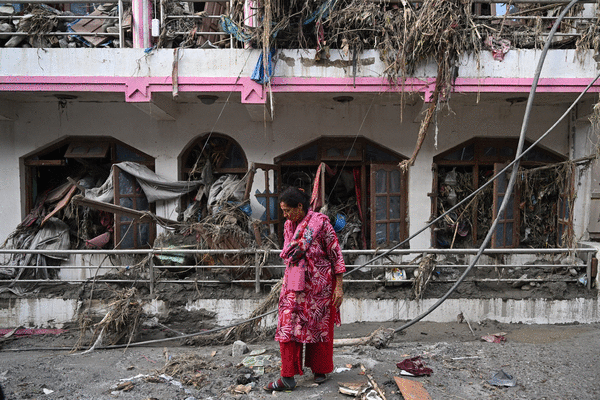
Before Prem Prasad Subedi could see anything, his keyboard began to shake.
“It felt like a cyclone forming,” said Subedi, a customs officer in Nepal. “Like the blast of wind you feel when a helicopter is landing.”
On Wednesday, the 50-year-old had turned up around 8 a.m. at his office in Nepal’s Rasuwa District, near Timure Bazaar and the border with the Chinese territory of Tibet, for what looked like an ordinary day of paperwork. Less than an hour later, that changed after a giant chunk of ice broke away from a nearby glacier, unleashing a violent torrent through the Himalayan valley. Subedi said he and his colleagues fled uphill toward Khaidi, a small mountain village, as the floodwaters surged through the area.
Subedi ran out, unsure what was happening. “At first we thought it was an earthquake, or rocks falling off the mountain above,” he said. “Or a flood? We were guessing.”
He wasn’t alone. Rajendra Dhungana, the chief customs officer among the small group at the office that morning, said their outpost was about 3 kilometers (2 miles) from the Tibet border. “When we went outside, we saw it coming so fast, with a very loud, rumbling sound,” Dhungana said.
As the giant chunk of ice cascaded to the valley below and pulverized into water, it appeared to onlookers like Subedi as if the flash flooding was coming from the Chinese side.
“The wind came about 10 seconds ahead, then there was vibration and a rumbling sound,” Subedi said. “The air was mixed with water, with dust and noise and dirt.”
Assessments based on seismic and satellite data indicate the initial flood was triggered by the collapse of glacial ice and underlying bedrock, causing a 5.2-magnitude seismic event that sent water, ice, rock and debris downstream.
At least 547 people have been confirmed dead, a toll that’s expected to rise in the coming days after fast-moving waters swept through villages, wiping out bridges, roads and entire settlements in a Nepalese valley close to China. More than 1,500 people are missing across both countries, including visitors from India, Malaysia, Australia, the U.K. and the U.S.
Dhungana, who said he’d worked at the office for about two months, said smaller surges in the river had occurred before and that Chinese police would sometimes warn their Nepalese counterparts when heavy rains created the risk of flooding.
“That day there was no message,” he said.
Downhill at Timure Bazaar near the border, no one thought the river could reach them. At the time the water hit, Subedi said maybe some 2,500 to 3,000 people were in and around the market.
Chinese authorities had issued such warnings before, alerting their Nepalese counterparts when heavy rain upstream threatened to swell local rivers, Subedi said. Dhungana said the most recent had come about 15 days earlier. Neither man received a warning on Wednesday.
“There had been a traffic jam overnight,” he added, but no rain. “Nobody imagined the Koshi’s water could come that high,” he said.
The speed of nature’s fury meant the difference between survival and death was ultimately measured in seconds. For Subedi, Dhungana and their colleagues, the only way out was up.
Within seconds of dashing outside, they could see a wall of water roughly a meter and a half high closing in fast. It was moving with so much power that the ground seemed to shake. “Once we understood, we ran straight for the mountain,” Subedi said.
A road just outside their office took them past two houses to a mountain path 25 meters away. As all escape routes closed quickly on either side, they clambered up a slope.
“My heart said only one thing: run up,” Dhungana said. “I don’t even know how we got up there.”
As they darted away, they saw a tsunami-like wave bearing down on them from below. Subedi said he fell as he ran, hitting his head. He pulled himself up by clutching trees with both hands.
“Those who managed to run within those 15 seconds survived,” he said.
“In that window of about 15 seconds, whoever got clear survived,” he said. “Whoever didn’t make it in that time, that’s where it happened.”
Dhungana said the water was getting dangerously close and they believed reaching as high up the mountain as possible offered their best chance of survival. “For half an hour we climbed. We didn’t look back,” he said.
As they fled, the group scattered. “We were going up and didn’t know where any of our colleagues were,” Dhungana said.
“By the time we looked down, everything that was white had turned black,” he said. “In that moment, we couldn’t think straight at all.”
Subedi said they scaled the mountain without stopping for about a kilometer and a half. Only then, he said, were they certain the water couldn’t reach them.
After reaching higher ground, “everyone’s chest felt heavy,” he said, comparing the sensation to breathing in dust.
“We were so afraid it might rise again and again that we kept climbing,” Subedi said.
As for their customs outpost, Dhungana said barely anything remains. “Nothing is left of our office,” he said. “It used to look green and full of life - it was the smallest building there. Nothing left. Two structures still standing, and nothing else.”
In total, Subedi said about 15 people from his office and support staff were still missing and he believed they were dead. With some, he’d had tea together 15 minutes before the disaster struck, or played badminton and gone for a walk that morning.
“And within an hour, all of this happened,” he said. Subedi spoke from Kathmandu, where he and Dhungana had been taken after being rescued by helicopter.
The 40-kilometer stretch of road connecting the area had been wiped out entirely, Subedi said, along with any bridges. “It’s simply unimaginable how much human loss there’s been,” he said. “It’s beyond belief.”
©2026 Bloomberg L.P. Visit bloomberg.com. Distributed by Tribune Content Agency, LLC.






Comments