UK's Burnham warms to global role after 24 hours in Ukraine
Published in News & Features
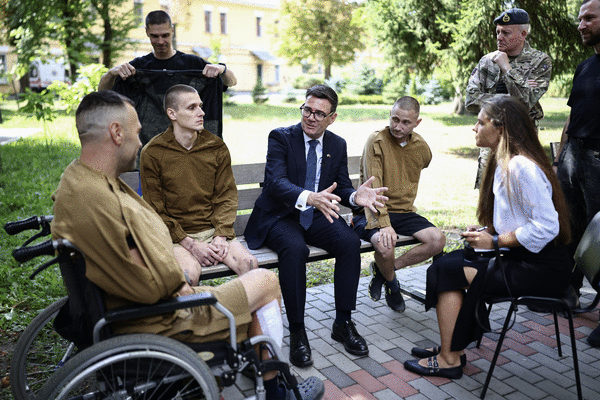
Andy Burnham sits on a bench in Kyiv with three Ukrainian soldiers who are being treated for serious injuries suffered on the frontline. Their conversation, through a translator, is not easy: what do you say to a young man whose body is covered in deep wounds and held together by metal pins?
One tells his story. A Russian attack sprayed shrapnel through his legs, arms and abdomen, and killed the soldier next to him on the spot. “Do you mind me asking, do you also need psychological support?” says a visibly moved Burnham. The young man, with a thousand-yard stare, replies simply: “Yes.”
Later, Burnham told Bloomberg he was “gutted” by the exchange and angered by the destruction he saw on visits to a bombed-out shopping mall and a market that had also come under attack. “Those poor people,” he said of the fruit sellers he had met. “Wrong on every level.”
Speaking in his first major foreign policy interview since becoming U.K. prime minister a month ago, Burnham made clear that watching President Volodymyr Zelenskyy greet the crying mothers, wives and children of killed Ukrainian soldiers will stay with him long after his return to London.
“I’m at my best when I can see the injustice and I can go at it: I see it here and I feel it here,” Burnham said. “I was aware, but obviously I’ve not been here and seen some of the scenes I’ve seen today. So I come away more determined to do something.”
The visit — his first abroad since taking office on July 20 — was intended to show Zelenskyy, the Kremlin and counterparts in Europe and the White House that British policy supporting Ukraine won’t change under new management. Burnham is the sixth British prime minister Zelenskyy has had to hold introductions with since his own election in 2019.
“I didn’t want anyone to have a scintilla of a doubt that I was wavering,” Burnham said. “Far from it.”
That message is needed because Burnham has made clear since entering 10 Downing St. that domestic policy is his priority, focusing his early efforts on reducing bus fares and energy bills and touring the U.K. to hear concerns on the cost of living while making only passing mentions of the many global crises impacting Britain.
While his predecessor, Keir Starmer, a strong supporter of Ukraine, sometimes faced criticism that he spent too much time abroad on international issues and not enough connecting with voters back home, little was known about how Burnham would approach international relations.
“I’d rather do my trips with a real reason behind them,” Burnham said. “I’m here for a reason.”
The premier is often a critic of what he sees as simplistic narratives told about politicians, and he finds frustrating the charge that he’s disinterested in foreign affairs.
“Maybe it’s the social media age, people like to paint caricatures, simple ways of describing people,” he says. “I have more experience on the international stage than people might realize.”
Still, coordinating with Ukrainian mayors in his old job as mayor of Greater Manchester is different from chairing a call of the Coalition of the Willing of Ukraine’s allies, telling seasoned leaders like France’s Emmanuel Macron and Italy’s Giorgia Meloni when to un-mute their microphones, and lobbying U.S. President Donald Trump to hand over Patriot air-defense missiles to Kyiv.
Burnham is busy enough at home over the coming months with his Labour Party’s annual conference at the end of September, the government’s first budget on Oct. 28 and a promised 10-year plan to transform Britain. He also expects to host Macron soon and travel to the U.S. with other European leaders next month to talk to Trump about Patriots, Ukraine’s top priority ahead of a challenging winter.
“I’ve not fully confirmed the details yet, but it’s likely I will go, particularly after today’s discussion,” he said. “I’m quite clear what I need to do in the next few weeks.”
While Burnham and Trump are no ideological bedfellows, he made a point of praising the president. “It’s important to recognize the Americans have been providing support. My team are clear today that that’s real support.” Can he forge a relationship with Trump to get Ukraine what it needs? “I will try.”
With Ukrainian long-range strikes and Western sanctions badly damaging the Kremlin’s ability to finance its war, the U.K. assesses that the Russia-Ukraine conflict is at a “critical moment,” Burnham said.
The key is not to throw away that progress by allowing Moscow to break Ukrainian morale with an attritional ballistic missile campaign targeting energy infrastructure and civilians in the sub-zero months. “There is a difficult winter ahead but if we can help them I think early next year could be quite something,” the prime minister said.
In that scenario, could Russia be facing a strategic defeat? “There are signs that Russian public opinion is changing,” Burnham said, citing new assessments that Russia’s military has suffered 1.5 million casualties since its full-scale invasion in 2022.
“Does the Russian public know that? That’s quite a big deal,” he said. He appears undeterred by renewed Russian threats to launch arson attacks in Britain as payback for its support for Ukraine, saying: “It feels like a moment to dig in.”
Burnham aims to bring a more personal manner to his diplomacy than many of his predecessors. He said he takes inspiration from Zelenskyy, and sees similarities in their communication style. In a private moment, Burnham told the Ukrainian leader he found his emotional connection with the people to be “very powerful.”
Later, he said Zelenskyy’s approach is “a bit like I do my politics,” but on a very different level, “carrying that emotional weight” during a war. The two men have quickly struck up a warm relationship: Zelenskyy was outwardly delighted by an impassioned speech Burnham gave outside Saint Sophia cathedral to mark the 35th anniversary of Ukraine’s independence.
The new approach was on show when a Ukrainian soldier handed Burnham a guitar, which the premier unhesitatingly tuned before starting to play a song by the Smiths. With other prime ministers, British officials managing the trip might have balked at the footage going viral. With Burnham, they’re relaxed because it appears genuine rather than trite. “You’re a top man,” the prime minister told his temporary bandmate.
“I’m an instinctive politician,” he said later. “I always think it’s better to do politics when you feel it.” Riding the Kyiv metro at rush hour, Burnham lets commuters who haven’t been vetted hug him, pose for selfies and tell stories about their neighborhoods coming under daily bombardment.
It’s hard to imagine Starmer doing similar in his time in office, but it demonstrates what Burnham says is a continuity in policy if not personality. “I’m paying credit to Boris, who set the tone from the start,” he said, referring to Boris Johnson, Britain’s Conservative prime minister at the time of the full-scale invasion. “Everyone who came before me did the same. Keir did the Coalition of the Willing.”
Burnham knows there are challenging times ahead in Britain, too. The only time he appears unsure of himself is when asked if he’s worried about Treasury worst-case scenario modeling that shows U.K. economic growth will flatline next year if the Strait of Hormuz remains closed, an outcome that could ruin his efforts to bear down on the cost of living. He laughs nervously and says: “Of course.” What can he do about it? He avoids the question.
Instead, Burnham says he’s optimistic about the future of Britain and its place in the world. He sees a progressive resurgence across the globe and, reading between the lines, a worldwide reaction to what he clearly view as the instability brought by right-wing populism, Brexit and Trump.
“The change I sense in Britain possibly is a change that’s going to come a bit more around the world,” he said. “We’ve had a decade of populism that isn’t working for people.”
“We were maybe the first into it with Brexit; we lived that politics for a long time,” Burnham continues, adding that the public are now “fed up” of division. “The populism of the last decade hasn’t delivered. The pendulum has to swing back.”
©2026 Bloomberg L.P. Visit bloomberg.com. Distributed by Tribune Content Agency, LLC.




Comments