'It's all very chaotic': Inside the Bay Area's mass immigration hearings
Published in News & Features
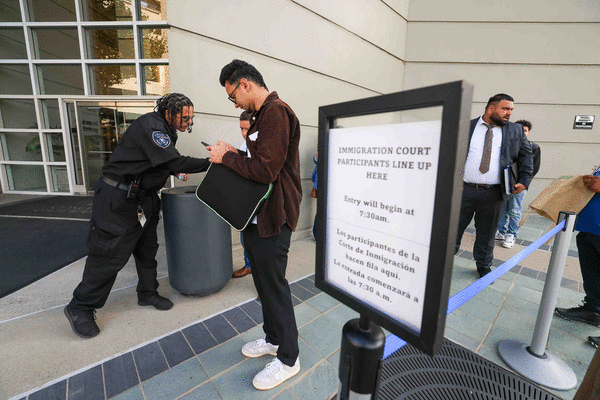
Inside a crowded courtroom on the 10th floor of a Concord, California, office building, a three-year-old girl in pink Minnie Mouse sneakers climbed into her mother’s lap as the Mexican mother of five turned to face a black-robed judge.
Moments earlier, the judge had told the woman and the two dozen other migrants in the courtroom they had been summoned because the federal government sought to deport them. At least a dozen more sat outside in the waiting area for their cases to be heard.
The judge asked the woman, accompanied by her five children, whether she wanted more time to find an attorney before scheduling her next court date. “Sí,” she replied, nodding to an interpreter.
After the hearing, the woman, whom the Bay Area News Group is not identifying to avoid influencing her case, explained in Spanish that she came to the United States in 2024 with her family to escape gang violence overwhelming their home state of Michoacán. She had feared cartel members would come for her two teenage boys, as they did for her brother, who she said disappeared six years ago.
“They took him, and they never returned him,” she said.
The woman’s case is part of a surging docket now straining Concord’s immigration court, following the Trump administration’s firing of local immigration judges and its near-total closure this year of the Bay Area’s only other immigration court in San Francisco. The Concord court is now left with just 10 judges as it has begun taking on roughly 115,000 pending cases from San Francisco.
Under pressure from federal officials to clear an immense case backlog, Concord has begun holding mass hearings with as many as 100 people, often including families with small children, according to local attorneys. Immigrants who fail to show up risk immediate deportation orders, which have soared alongside the fast-tracked proceedings.
Immigration advocates say growing numbers of migrants with credible fears of returning to their home countries are receiving removal orders after missing the hearings due to late notice from the court or because their hearing dates are suddenly rescheduled after being set years in advance, raising due process concerns. In June, the month the mass hearings began, removal orders for failing to appear at the Concord court more than doubled to 1,046, according to a recent analysis of court data by independent immigration researchers Joseph Gunther and Brandon Marrow.
“It’s all very chaotic,” said Milli Atkinson, director of the San Francisco Bar Association’s Immigrant Legal Defense Program. “They’re constantly shifting priority for which cases move forward and which cases don’t.”
Unlike criminal or civil courts, immigration courts are part of the executive branch and must follow directives under the Trump administration’s immigration agenda, including the dismissal of immigration judges nationwide and tightening restrictions on granting migrants asylum protections in the U.S.
In May and June, immigration courts across the country began holding the mass hearings, according to attorneys and advocates. While the proceedings appear to have begun without any formal announcement, the administration has recently issued guidelines to expedite immigration cases and publicly stated that clearing backlogs is a top priority.
Trump officials have blamed the Biden administration for the backlogs, totaling more than 3 million cases nationwide, accusing it of accepting millions of people seeking asylum into the U.S. without proper vetting.
“A large backlog works to the advantage of aliens without meritorious claims and encourages further illegal migration by aliens who pose a threat to life and property as described by President Trump,” the Department of Justice, which oversees immigration courts, wrote in a March memo to Congress.
The department did not respond to questions about whether it ordered the mass hearings and why, or about advocates’ due process concerns.
The push to resolve cases comes as the agency has fired more than 100 immigration judges, including at least 14 in the Bay Area. The administration has begun hiring new judges whom it says will “restore integrity” to the immigration system. But many former judges — including some who allege they were dismissed over their prior advocacy for immigrants — contend the firings are part of a broader effort to increase deportations.
“The message is to judges: move forward, move faster, order people removed,” said Jeremiah Johnson, a former San Francisco immigration judge fired last year.
In June, the administration also abruptly closed San Francisco’s main immigration court, leaving just two judges to continue hearing cases there, but under the Concord court’s jurisdiction. Federal officials said they shuttered the court, one of the busiest in the country, handling cases from across the Central Valley and Northern California, to save costs.
Even before that decision, Concord had a backlog of around 60,000 cases, according to immigration court data gathered by Syracuse University. Now, federal officials say almost all of San Francisco’s 115,000-case backlog is expected to be transferred to Concord by the end of the year.
As the Concord court takes on more cases from both San Francisco and its existing backlog, it’s left with eight judges, down from at least 30 across the two courts before the mass firings. Some judges hired to replace those fired preside remotely over courtrooms from as far as Texas, immigration attorneys said.
At a hearing this month, Judge Lauren Black appeared via video call for a morning docket of 86 cases — about three times the size of what had been a typical case-scheduling proceeding, according to Johnson. It was unclear from where Black had called in to the hearing, which was separate from the hearing that included the woman who fled from Mexico.
Black reminded immigrants cycling through the fluorescent-lit courtroom that if they missed a future court date, she may order them removed from the country, leaving them vulnerable to arrest, detention and deportation. After making her way through the docket, she determined half of those summoned to court hadn’t attended the hearing.
However, the Department of Homeland Security attorney representing the administration had failed to upload all of the necessary documentation for the judge to review remotely before deciding whether to issue removal orders. It was a heavy caseload that day, the attorney explained, and she needed more time. The judge agreed to postpone the rulings until an upcoming hearing, but cautioned there was no guarantee she would be able to issue them then.
Outside the courtroom the day prior, the woman from Mexico said she was confident her case wouldn’t end in a deportation order. She said she planned to hire an immigration attorney, who is also representing a relative, to help with her case.
Even as more than 90% of the 140-plus asylum decisions judges issued in Concord this June were denied — up from 23% in the same month in 2024, before Trump took office — the woman remained undeterred, saying she would file an appeal if her claim is rejected.
Asked what she hoped for her future if allowed to remain in the country, the woman, now staying with her sister in Manteca, said her goal would be to obtain a work permit and find a steady job to support her family.
“Whatever it is, I’m not picky,” she said. “I came here to succeed.”
_____
©2026 MediaNews Group, Inc. Visit at mercurynews.com. Distributed by Tribune Content Agency, LLC.






Comments