Trump risks China blowback with plan to isolate Iran's economy
Published in News & Features
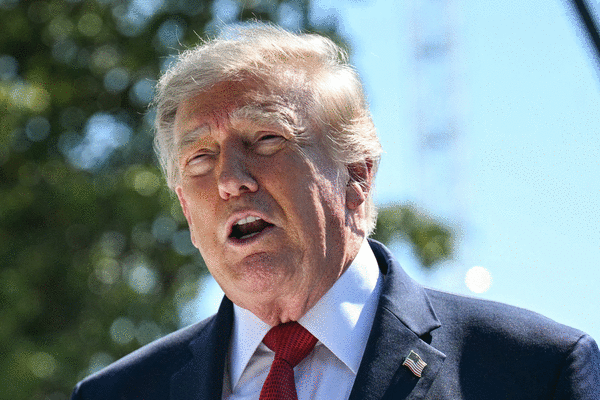
WASHINGTON — When Treasury Secretary Scott Bessent vowed to ramp up pressure on Iran by targeting its economic partners, he echoed former President George W. Bush’s warning to U.S. allies after the Sept. 11 attacks.
“You are either with us, or against us,” Bessent said in an interview with CNBC Thursday. “This is going to be the greatest coordinated economic isolation in the history of the world.”
That stark language was meant to underscore Washington’s desire to punish countries that still do business with the Islamic Republic, with Bessent saying he would unveil a plan at a Monday news conference.
But it also reflects a worrying lack of U.S. options to wind down the unpopular war, while referencing an infamous phrase that presaged two decades of U.S. forever wars in the Middle East that President Donald Trump and his defense chief Pete Hegseth have repeatedly pledged they would avoid.
China will provide the biggest test of Washington’s determination to follow through.
Beijing is the main buyer of Iranian oil and the Trump administration has so far shown little appetite for challenging its economic links with Iran, particularly with President Xi Jinping visiting the U.S. next month and the world’s two largest economies navigating a tenuous trade truce.
Iran has already been subjected to decades of tough sanctions and the U.S. is enforcing a naval blockade of its ports after months of airstrikes failed to force Tehran to sign a deal to end the war, reopen the Strait of Hormuz and give up its nuclear material.
It’s unclear what meaningful economic actions Washington has left, other than targeting China or playing a ramped-up sanctions whack-a-mole against smaller entities doing business with Iran in other countries. Meanwhile, the damage to economies around the world is mounting as the war drags on.
“The U.S. doesn’t have the bandwidth to enforce an airtight sanctions regime on a country like Iran, which has expertise in circumventing sanctions,” said Ali Vaez, a deputy program director at the International Crisis Group. “The president doesn’t have the patience that is required for such a policy to bear results, which will be measured in months, not weeks.”
Trump on Wednesday warned that “ANY country that allows its financial institutions, businesses, airports, or government entities to provide any type of lifeline to Iran will itself face TREMENDOUS Economic Consequences.” The president highlighted “Oil smuggling, swap lines, cash transfers, exchange houses, ship registries, front companies — It all needs to stop NOW.”
That oil focus puts a bullseye on Beijing, which buys 90% of Iranian petroleum exports. Washington has already sanctioned some of China’s independent refineries since the start of the war in February, but has stopped short of targeting major Chinese banks that finance the trade.
“Is the White House willing to prioritize this new economic warfare campaign above its China relationship? And if it chooses to, there are serious ramifications,” said Chris Kennedy, an economic statecraft analyst at Bloomberg Economics. Kennedy said the new threats are also an “admission that the U.S. is running out of options.”
Any decision to hit China would risk worsening tensions just weeks before Trump hosts Xi for the Chinese leader’s first visit to Washington in a decade. It also raises the threat of Chinese countermeasures that could inflict pain on the U.S. economy ahead of November midterm elections that will hinge on pocketbook issues.
Beijing has already demonstrated a willingness to push back against Trump, most notably by announcing export restrictions on rare earths that forced the White House into a climb-down from their tariff fight.
China’s Foreign Ministry dismissed Trump’s threats to unleash “economic warfare” on Iran’s trading partners, saying it wouldn’t work to resolve the tensions in the region.
“Nothing the Trump administration can offer is sufficient to ask Xi to kowtow to Trump in such a public and consequential way,” said Brett Erickson, managing principal at Obsidian Risk Advisors and a sanctions expert. “This is asking Beijing to willingly allow the United States to dictate who they can and cannot conduct business with, and that is a precedent that they have no intention of establishing.”
Trump’s focus on stopping oil sales, Tehran’s top source of revenue, has had an effect. “Under these conditions, our oil exports have virtually stopped,” Iran’s Central Bank Governor Abdolnaser Hemmati told state TV this week.
While China is the most obvious target, other nations are also on the frontline if the U.S. moves to further isolate Iran’s economy.
The United Arab Emirates has been Iran’s largest trade partner overall and a top provider of foreign goods and hard currency to the country. The UAE this week though said it is cutting all economic ties with the Islamic Republic, claiming Tehran had fired ballistic missiles at its territory.
Turkey, a NATO ally of the U.S., is the biggest buyer of Iranian exports after China, according to data compiled by Bloomberg. India, a U.S. strategic partner that Trump is seeking to negotiate a trade deal with, is also a major source of imports for Iran, particularly food and medicine.
Exchange houses in the UAE and Iraq also help Iran repatriate funds once it makes oil sales, converting payments — often received in Chinese yuan — into currencies Tehran can use. But targeting those firms may not be enough to force Iran to concede.
Even without pushback from other countries, there are doubts a stepped-up U.S. economic pressure campaign can succeed at all. Analysts have also cautioned it’s unclear whether the U.S. can fully sever Iran’s trading ties — including overland routes — with neighboring states, which have endured for generations due to their geographic proximity and deep historic links.
Much will depend on the details of the U.S. policy and the level of enforcement, said Claire O’Neill McCleskey, a former Treasury official and co-founder of sanctions advisory firm Clarity Compliance Consulting.
“At this point, broad public threats alone are unlikely to change behavior,” she said. “It will take actual action against a foreign bank or company for third countries to understand exactly what the Trump administration is willing to target.”
(Meghashyam Mali contributed to this report.)
©2026 Bloomberg L.P. Visit bloomberg.com. Distributed by Tribune Content Agency, LLC.




Comments