Colorado Bureau of Investigation's failure to stop scientist's crimes was outrageous government conduct, judge finds
Published in News & Features
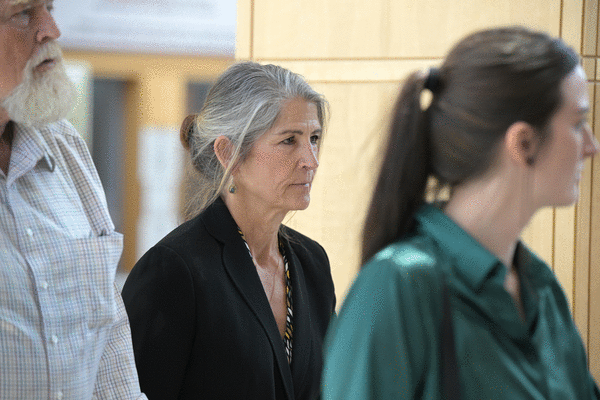
DENVER — The Colorado Bureau of Investigation’s years-long failure to stop the misconduct of DNA analyst Yvonne “Missy” Woods constituted outrageous government conduct, a Weld County District Court judge ruled this month.
Judge Vicente Vigil dismissed a felony sex assault on a child case after finding that the CBI’s inaction, even after multiple coworkers raised concerns about the quality of Woods’ work, rose to the level of outrageous government conduct, that is, “conduct that violates fundamental fairness and is shocking to the universal sense of justice,” he wrote in an Aug. 2 order.
“The management at CBI at best fostered a workplace culture where case processing numbers were prioritized over rigorous technical oversight, and at worst actively sought to shield Ms. Woods, a favored employee, from having her deficient work product come to light,” the judge wrote.
The Weld County District Attorney’s Office appealed the judge’s ruling to the Colorado Supreme Court on Monday. It’s extremely rare for Colorado courts to find that official misconduct meets the legal standard of outrageous government conduct, Vigil noted in his order.
“The fact of the matter is that Ms. Woods chose to become a cancer within the Colorado Bureau of Investigation, and that agency chose first to ignore, then place a bandage on the tumor until it could no longer be hidden from public view,” the judge wrote in the scathing six-page order. “When the integrity of our justice system is (compromised) as it was here, if we as the judiciary do not condemn such intolerable acts, we make a choice to tolerate them.”
Woods mishandled DNA testing in at least 1,045 criminal cases during her 29-year career at the statewide criminal justice agency, an internal investigation found. She deleted, omitted and manipulated data to speed up the testing process and boost her productivity, creating unreliable DNA testing results in hundreds of criminal cases and sending shockwaves through Colorado’s criminal courts.
The 65-year-old former scientist in June pleaded guilty to four felonies related to the data manipulation. She will be sentenced to between eight and 16 years in prison on Sept. 8.
Several of Woods’ colleagues raised repeated ethical concerns about her work years before the scandal broke open — in 2014 and again in 2018 — but the CBI failed to stop her misconduct until an intern discovered a pattern of missing DNA data in Woods’ work in 2023. That discovery prompted the first serious inquiry into Woods’ misconduct on the job, leading authorities to uncover the full scope of her crimes.
Rob Low, a spokesman for CBI, said in a statement Tuesday that the bureau is monitoring the case.
“We have tremendous respect for the courts and the judicial process and will watch the appellate review of this case,” he said. “We stand firmly behind the integrity of our Forensic Lab.”
Vigil found that CBI had “little taste for oversight” and described the agency’s inaction as “incomprehensible.” Woods’ conduct “left a dark mark on the history of Colorado justice,” he wrote in the order.
“The Woods scandal is not merely about one case, but the conduct of the government over a shockingly wide field,” the judge wrote. “If the scope and breadth of the Woods’ scandal does not constitute outrageous government conduct, this Court would struggle to imagine something that would. If this is not outrageous government conduct, then that doctrine may as well not exist.”
Vigil dismissed a charge of sex assault on a child against 31-year-old Daniel Eatinger filed in connection with a 2018 incident in Colorado. Vigil, a registered sex offender, was previously convicted of a sexual battery charge in Florida in connection with an assault on a victim between the ages of 12 and 16, according to Florida court records.
Court records detailing the Colorado allegations were not immediately available Tuesday. The district attorney’s appeal to the Colorado Supreme Court was suppressed and was not immediately available Tuesday.
Vigil noted in his order that he is aware of only one instance in state history in which an appellate court upheld a finding of outrageous government conduct, and that was in 1988, when La Plata County law enforcement created a fake criminal case against a fake defendant, charged the fake defendant with fabricated crimes and presented the case as real to a judge so that the fake defendant — an undercover officer — could hire a particular defense attorney and investigate the attorney for drug use.
In that instance, the judge wrote, the integrity of one case was compromised.
“Here, the integrity of one thousand cases in presumably multiple courts has been compromised,” he wrote. “The integrity of the role of forensic evidence in our criminal justice system has been compromised. The manipulation of data in a thousand cases can be described no other way than violating principles of fundamental fairness, that forensic testing is reliable and will guide us to the truth because it has no opinion and cannot lie. Ms. Woods has taught us a hard lesson, that the integrity of a test relies on the integrity of a person.”
_____
©2026 MediaNews Group, Inc. Visit at denverpost.com. Distributed by Tribune Content Agency, LLC.






Comments