Studies look at 'less bad' options for farmers facing groundwater cutbacks
Published in News & Features
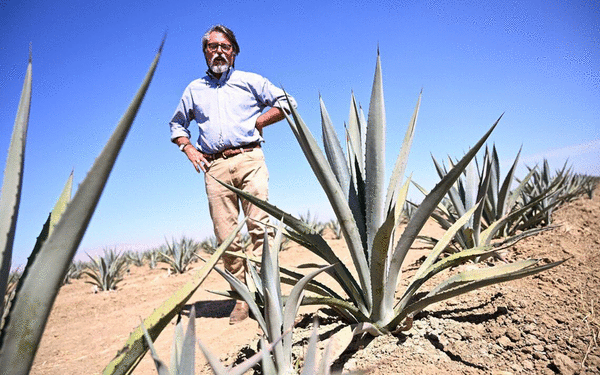
Growing more drought-tolerant crops could be an option for San Joaquin Valley farmers facing severe groundwater cutbacks, according to two joint studies by the Public Policy Institute of California (PPIC).
The studies looked at growing winter crops or forage using less water as an economic alternative to straight out fallowing ground.
“This is not a solution or means of (groundwater) demand reductions, but a way to make that fallowing less bad,” Caitlin Peterson, PPIC Associate Director and one of the authors of the studies, told SJV Water. “How can we still achieve that reduction in pumping but not reduce productivity?”
The studies looked at types of crops that could be grown with much less water and the economic viability of those crops.
Farmers in the San Joaquin Valley are under extreme pressure to reduce pumping in order to comply with the Sustainable Groundwater Management Act (SGMA), which mandates aquifers be brought into balance by 2040.
The state has already placed the Tulare Lake subbasin, which covers most of Kings County and Tule subbasin, in the southern half of Tulare County, on probation for lacking adequate plans to stop excessive groundwater pumping that has caused huge swaths of land to sink and damaged domestic wells.
Probation comes with significant reporting and fee requirements and the state is now looking at imposing its own pumping limits in the Tule subbasin.
Without any new surface water, that means land will have to be fallowed.
Estimates are that nearly 1 million acres will have to be taken out of production throughout the valley in order to achieve SGMA’s goals. The bulk of that, about 600,000 acres, is expected to be fallowed in Kings, Tulare and Kern counties alone.
When land is fallowed, that means farmers aren’t making any money. And untended land causes dust, pest and other problems.
“Farmers are going to try to find a way to make this work. That’s what we do, we try to adapt,” Hanford-area farmer Matt Brown told SJV Water.
He said the PPIC studies add another piece to that puzzle.
“I think the way I’m looking at it, all options are on the table. Everyone in this situation is looking at all their options with the available water there is.”
Working with researchers at California State University, Fresno, the PPIC study authors got feedback from farmers and area water managers to look at the feasibility of growing low-water crops, Peterson told SJV Water.
The studies focus on farmers using available resources – rainfall and open land – to stay in production and offset the negative effects of barren fields.
The crop study discusses four low-water crop groups:
Desert-adapted crops – agave, jojoba, guayule, which can be grown with a few inches of water annually
Low-water summer forages – Sorghum or sorghum-sudangrass hybrids, which requires 20% less water than corn
Cover crops – grown in the winter, cover crops benefits soil health and water retention
Winter grain and forage – wheat, barely, oats, rye and triticale
The financial viability study found that farmers in Tulare and Kings counties may profit from growing winter crops with eight inches of irrigation, on top of the region’s annual rainfall.
In those counties, dairies offer the biggest potential demand for winter grains as they dairies usually buy out-of-state grains to feed their cows, the financial study states.
While the financial study found that profits do depend on more water than just rainfall, farmers may prefer modest returns instead of fallowing land.
For landowners looking to improve soil health, winter grain and forage crops can also alleviate high levels of nitrate in the soil, which has been abundant in Tulare and Kings counties.
Brown, who also sits on the grower advisory committee for the Mid-Kings River Groundwater Sustainability Agency (GSA) said farming practices have changed drastically over the years.
“We don’t have the ability to do it exactly as in the past, we have to work around this new (SGMA) framework,” he said.
It will be up to the individual farmer to decide, however, what path they choose.
“Farmers with open land will need to decide whether they keep land fallow or try to grow winter forages and try to make an income from a limited use of groundwater on that winter crop and determine its viability each year within their operation,” Brown said.
That’s just what the PPIC authors want farmers to take away from this study.
“I do think that a key to note is that there is a lot of anxiety over fallowing and what that would mean. We want to avoid that to the extent possible,” Peterson said.
©2026 The Fresno Bee. Visit at fresnobee.com. Distributed by Tribune Content Agency, LLC.






Comments