Mangione guilty plea: What led to it, what lies ahead
Published in News & Features
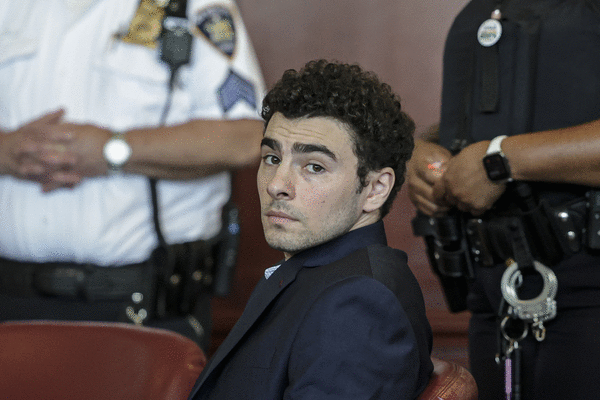
BALTIMORE — Not that any murder case can truly be considered typical, but the brazen shooting of UnitedHealthcare CEO Brian Thompson in December 2024 and Towson native Luigi Mangione’s guilty plea on Friday was far from it.
“This is anything but a normal case,” said Baltimore defense attorney Andy Alperstein. “The president talks about it. It raised serious concerns about the healthcare system.”
He and other attorneys, unconnected to the case, offered their thoughts on what led to the extraordinary plea by Mangione, 28, part of a prominent Maryland family and the valedictorian of his Gilman class, that resolves the federal charges against him and could lead to a dismissal of the state case as well.
Here is a condensed version of their takes on what led to this point and what lies ahead.
Q: Trump’s attorney general at the time, Pam Bondi, called for the death penalty for Mangione, and Trump himself was successfully prosecuted by the same New York office handling the state charges against Mangione. What role might that have played behind the scenes that led to the federal guilty plea that now threatens the state case?
A: “There’s no question that Donald Trump has no love for [Manhattan District Attorney] Alvin Bragg,” said David Jaros, a University of Baltimore law professor. “Otherwise, it’s hard to understand why federal prosecutors would be so eager to get a conviction that could have waited for the state case. They’ve created real, live issues for the state.”
“They were so eager to jump in and get a guilty plea, they were willing to jeopardize the state prosecution,” he said. “Now we’ve created this complicated double jeopardy issue.”
Q: Why would Mangione plead guilty to charges that carry a potential life sentence?
A: “This was a strategic decision,” said Rod Rosenstein, the former U.S. Attorney for Maryland who rose to the number two post at the Justice Department. “By pleading guilty, he might receive credit for accepting responsibility and showing remorse and get a lighter sentence.
“By pleading to federal charges, he might avoid state prosecution,” Rosenstein said in an email, “and ensure that he will spend his life in a federal prison with more comfortable accommodations than a New York state prison.”
“Normally, when crimes violate both state and federal law, state prosecutors go first and federal prosecutors step in only if the state case fails or the sentence is too light. In any event, if the first case results in a life sentence, there is no need for a second case”
Q: How is Mangione using double jeopardy to seek the dismissal of his state murder charges?
A: “Mangione claims that his plea protects him from prosecution for the same crime,” said Gerard Martin, a former federal prosecutor. “The State of New York says that the federal crime of stalking that leads to death at the hands of the stalker differs from the murder charges because the rationale for the stalking statute is different from the rationale for the plain murder statute.”
Q: What’s your prediction?
A: “This case is going to the Supreme Court,” Martin said.
Q: What could have motivated Mangione to plead guilty rather than go through a trial?
A: “There was an overwhelming amount of evidence against him,” Jaros said of what is publicly known about the case. “He doesn’t really have a great deal of leverage. This gives him more cards to play.
“Once someone has pleaded guilty and faces life in prison,” he said, “what is the point of having a full trial?”
Q: What might happen at the Dec. 18 sentencing hearing?
A: “There will be witnesses on both sides,” Alperstein said. “I would expect the defense to put on medical experts. [Mangione’s] medical records will likely be part of what’s reviewed by defense experts.”
Q: Will the families of the victim and the defendant both play a role?
A: “Victims in all murder cases have a right to victim impact testimony, and that could come in oral testimony or with a letter,” Alperstein said.
Q: And for the Mangione family?
A: “Every day of the man’s life wasn’t evil,” Alperstein said.
©2026 Baltimore Sun. Visit baltimoresun.com. Distributed by Tribune Content Agency, LLC.






Comments