Trump vaccine order takes aim at states that limit exemptions
Published in News & Features
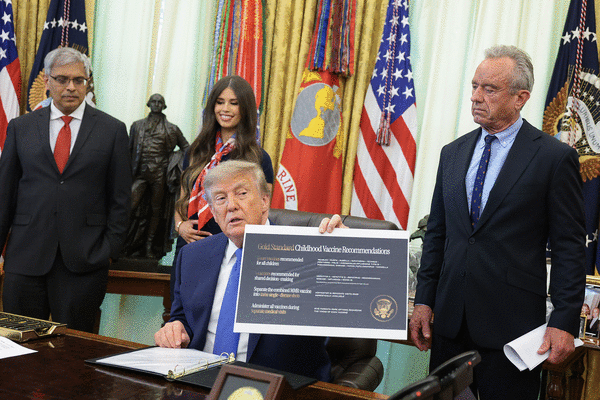
A largely overlooked part of the executive order President Donald Trump issued this week scaling back the schedule for childhood vaccines threatens legal action against the four states that don’t allow personal or religious exemptions to school vaccine requirements.
Those states — California, Connecticut, Maine and New York — are among the states with the highest immunization rates, and they are among those that have been most successful in controlling the worst measles outbreak in more than three decades.
All 50 states and the District of Columbia require students to have certain vaccines before attending public school. All allow exemptions for children who cannot be vaccinated for medical reasons. Forty-six states plus the District of Columbia also allow exemptions for religious and/or personal beliefs.
Trump’s order, which he signed on Monday, says the attorney general will take legal action against states that do not provide “religious and medical exemptions from childhood and adolescent immunization requirements.”
Some health officials said that Trump’s order, which has questionable legal authority, is unlikely to prompt the states without nonmedical exemptions to change course. And any legal action would take years to wend its way through the courts.
But they criticized the executive order, and its legal threats, for contributing to the misinformation and skepticism that have lowered vaccination rates nationwide.
“It puts a lot of misinformation and a lot of fear and doubt in parents’ minds,” said Dr. Thomas Lew, clinical assistant professor at the Stanford University School of Medicine. “It clouds the conversation around vaccines and their importance and their safety.”
Dr. Molly O’Shea, a pediatrician who practices in suburban Detroit, warned that nonmedical exemptions “increase the number of parents who opt to forgo one or more vaccines for any list of reasons.”
“The learning environment is then more fragile because of the risk of disruption by infectious illness,” she said.
At the same time, O’Shea said, public health requires empathy with parents who are sincerely worried about their children’s well-being and may have been misinformed about the safety and effectiveness of vaccines.
“Families who are opting not to vaccinate are doing it from the same place that we’re recommending vaccines. They want their children healthy and well,” O’Shea said. “Just because we come to the opposite conclusion doesn’t mean we didn’t start with the same values.”
In response to Trump’s order, political leaders and health officials in many states, including California, Connecticut, Maine and New York, vowed to maintain their vaccination rules.
California currently has 52 measles cases, Connecticut has two, Maine has five and New York has 10. All four states have vaccination rates higher than 95%, considered critical to “herd immunity” that can protect the unvaccinated to some degree.
“Maine will continue to follow the science and the facts, and our approach to vaccines remains unchanged by yesterday’s executive order,” Maine Democratic Gov. Janet Mills said in a statement published Tuesday.
As of early August, measles cases were at their highest level since 1991. The states with the highest numbers were South Carolina (670), Utah (524), Pennsylvania (216), Texas (216) and Virginia (176). All of those states allow families to opt out of the school vaccine requirement for personal or religious reasons.
Of the five states with the most cases, only Virginia has a school vaccination rate of more than 95%.
Virginia’s statewide rate was 95.6% for 2024-25, but the measles outbreak was in two rural counties west of Richmond, where measles vaccination rates are less than 75%.
Deaths from another vaccine-preventable childhood illness, whooping cough, also are on the rise. Last year, there were 32 whooping cough deaths, the most since at least 1999. Before vaccines became available in the 1940s, as many as 200,000 children contracted whooping cough every year and 9,000 died.
Whooping cough death statistics for every state were not available, but Kentucky reported three whooping cough deaths last year, its first fatalities in five years, while Louisiana reported two deaths.
____
Stateline reporter Tim Henderson can be reached at thenderson@stateline.org.
©2026 States Newsroom. Visit at stateline.org. Distributed by Tribune Content Agency, LLC.



Comments