Minnesota sets early voting record ahead of Tuesday's primary election
Published in News & Features
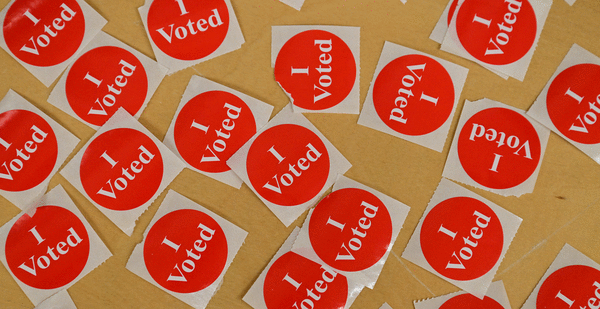
ST. PAUL, Minn. — Minnesota voters on Tuesday will pick the Democratic-Farmer-Labor and Republican nominees for offices — including for U.S. senate and governor — in primary races that have attracted millions in spending and record early voting.
As of Monday, more than 206,000 Minnesotans voted early ahead of the primary election, according to Minnesota Secretary of State Steve Simon. That’s the highest number of absentee and mail ballots cast ahead of a primary in a non-presidential election year, Simon’s office said.
Asked why there had been higher-than-normal turnout ahead of primary election day, Simon told reporters he believed it was due to “hot races.” The DFL Senate Primary and the GOP Senate and gubernatorial primaries are heavily contested this year.
“That tends to really drive primary turnout in Minnesota,” Simon said. “If they’re contests that animate and excite people that they’re passionate about and or that are very closely contested, they’re very competitive where the outcome isn’t necessarily known, that tends to really drive turnout.”
Simon said the modern-day high for voter turnout in a Minnesota primary was around 22% to 23% in 2018. While it’s yet to be seen whether this year’s turnout will beat that record, the 2026 primaries have also captivated voters, he said.
“That, again, was due at least in my judgement to some really compelling contests,” Simon told reporters. “There was a gubernatorial primary that year on both sides, there were other races that captivated people and that were otherwise close,” Simon said. “All of that is to say, if I think if we met or exceeded that, that would be extraordinary.”
The winners of the DFL and GOP primaries on Tuesday will advance to the Nov. 3 general election.
The following offices are on the ballot statewide: governor and lieutenant governor, U.S. Senate, attorney general, secretary of state and state auditor. Primaries also are taking place in Minnesota’s eight Congressional districts and in a handful of its 201 state House and Senate districts.
There also are a number of offices on the ballot for county and municipal elections.
To see what’s on your ballot go to myballotmn.sos.state.mn.us.
Governor
U.S. Sen. Amy Klobuchar is the endorsed DFL candidate for governor and the overwhelming favorite to win. Kobey Layne, who sought the DFL endorsement at the party convention, also is on the ballot.
Candidates in the Republican Primary for governor with the most demonstrated support so far include state House Speaker Lisa Demuth, My Pillow CEO Mike Lindell and GOP-endo.sed candidate Kendall Qualls.
Senate
The DFL Senate primary has six candidates, but much focus is on the highly competitive race between U.S. Rep. Angie Craig and Lt. Gov. Peggy Flanagan, who won the DFL endorsement after Craig skipped the convention in May.
Top candidates seeking the GOP nomination for Senate are Republican-endorsed Adam Schwarze, a former Navy SEAL, former sportscaster Michelle Tafoya, and 2024 GOP U.S. Senate candidate and former NBA basketball player Royce White.
Other offices
Simon, who is seeking a fourth term as secretary of state, and Zack Filipovich, who is running to replace outgoing DFL State Auditor Julie Blaha, are the only DFL candidates in their races. Attorney General Keith Ellison, who is seeking a third term, appears on the DFL ballot with David J.S. Madgett.
Ronald Schutz is the only Republican candidate for attorney general. Former judge, state legislator and Hennepin County Commissioner Tad Jude, who has the GOP endorsement, and Wendy Phillips are the Republican choices for secretary of state.
Auditor candidates appearing on the Republican ballot include Will Finn, GOP-endorsed Nate George and 2022 GOP gubernatorial candidate Scott Jensen.
Find out more about the candidates
To read more about candidates for statewide and local offices go to twincities.com/tag/2026-election.
How to vote
Unlike many other states, Minnesota does not require party registration to participate in a primary. However, voters can only vote in one party’s primary.
Voters had until July 21 to register to vote, or they can register to vote at the polls on the day of the election.
Absentee ballots must be received by an elections office by 8 p.m. on the day of the election. Simon said it’s best to hand-deliver absentee ballots if the deadline is just a day or two away as Minnesota won’t accept ballots based on the postmark.
Monday was the last day to vote in person early.
More information on polling places and the ballot for your address can be found on the Secretary of State’s website at myballotmn.sos.state.mn.us/, or by calling 1-877-600-VOTE (8683).
Eligibility
Anyone 18 or older who is a citizen of the U.S., has been a resident of the state for 20 days before Election Day, is not currently incarcerated, and hasn’t been stripped of the right to vote by a court can vote in Minnesota.
Students who are in college should vote from the address they currently consider home, according to the Secretary of State’s Office. If college students visit their parents but no longer consider the address “home,” they should register to vote where they live for school.
Out-of-state college students can vote in Minnesota elections if they consider Minnesota home, even if they have out-of-state tuition or have a driver’s license from another state.
________
©2026 MediaNews Group, Inc. Visit at twincities.com. Distributed by Tribune Content Agency, LLC.






Comments