Tahoe-area avalanche victims asphyxiated, coroner finds, but redacted reports leave questions unanswered
Published in News & Features
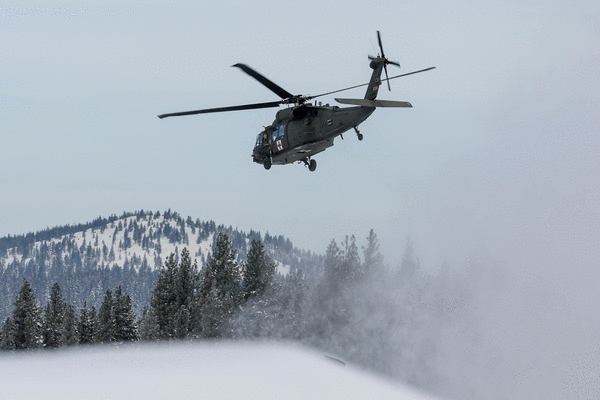
In a new finding, a coroner’s report released Thursday showed nine backcountry skiers killed by an avalanche in February near Lake Tahoe died of asphyxiation, not from traumatic injuries from getting hit by hurtling slabs of snow and swept away.
The heavily redacted reports leave questions unanswered, including whether any of the three ski-tour guides and six clients suffered additional injuries before being buried five to six feet deep in snow, or whether any had drugs in their system or had consumed alcohol.
Sections on the reports were blacked out, for medical issues including drug or alcohol use, along with sections for injuries and the condition of bodies at the avalanche scene.
Not all avalanche victims die by asphyxiation — injuries from getting hit by a wall of snow, or being swept through trees and rocks, can kill people even if they’re not buried or suffocated. Whether any skiers suffered injuries that didn’t cause their death remains unclear.
The Nevada County, California, Sheriff’s Office, which operates the coroner service, did not immediately respond to questions about the redactions.
The Sheriff’s Office said in February it would conduct an investigation of possible criminal liability over the incident. The office did not immediately respond to questions Friday about its probe. State workplace-safety agency Cal/OSHA was also investigating whether worker-safety violations occurred. The agency did not immediately respond Friday to questions.
The nine skiers were part of a party of 15 that set out Feb. 17 during a ferocious blizzard, attempting to return home after a three-day trip to Frog Lake Huts, led by Truckee, California, backcountry-guiding company Blackbird Mountain Guides.
A slide hit all but three members of the group, near Castle Peak, a rocky summit visible to the north from I-80 across from the Boreal ski resort.
Six close friends were killed: Carrie Atkin, 46, of Soda Springs; Danielle Keatley, 44, of Soda Springs and Larkspur; Kate Morse, 45, of Soda Springs and Tiburon; Caroline Sekar, 45, of Soda Springs and San Francisco; Katherine Vitt, 43, of Greenbrae; and Lizbeth Clabaugh, 52, of Boise, Idaho. Three of the four guides on the trip also succumbed: Nicole Choo, 42, of South Lake Tahoe; Andrew Alissandratos, 34, of Verdi, Nevada; and Michael Henry, 30, of Tampa, Florida.
The coroner found that Atkin was the person whose body was found three days after the other victims were located the day of the avalanche, a determination not made public earlier.
The group had left the huts and traveled through avalanche-exposed terrain when the slide danger was rated “high” by the Sierra Avalanche Center, one step below the highest danger level of “extreme,” with large to very large slides considered likely. Questions have swirled about the decision-making by guides that preceded the tragedy.
An April report by the U.S. Forest Service National Avalanche Center and the Colorado Avalanche Information Center found basic safety practices were skirted. The group traveled close together below avalanche terrain and through the runout zone of an avalanche path, the report found. The report noted that exposing only one person at a time to an avalanche zone is an accepted best practice for backcountry travel. Also, analysis of past avalanche accidents indicates that larger group sizes (four or more people) have higher chances of being caught in avalanches, the report said.
A Sierra Avalanche Center expert said in March that whether the slide was caused naturally or by human activity would probably remain unknown, but that it was likely triggered by the ski party.
The center reported earlier that the 400-foot-long avalanche buried the nine dead skiers between five and eight feet deep. The autopsy reports narrowed that range down to five to six feet, but noted that heavy snow continued falling after the incident.
Avalanches like the one in February that involve slabs of sliding snow typically happen on slopes with an angle from 30 degrees to 50 degrees, a similar incline to a ski run rated black or double black diamond, the U.S. National Avalanche Center said. The avalanche center reported that the deadly slide appeared to have started on a slope above the skiers with a steepness of 36 degrees to 40 degrees.
©2026 MediaNews Group, Inc. Visit at mercurynews.com. Distributed by Tribune Content Agency, LLC.





Comments