Rocket engine valve ID'd as culprit for Blue Origin's massive pad explosion, CEO says
Published in News & Features
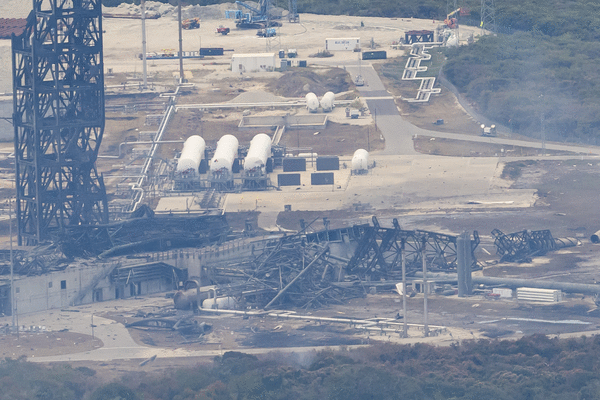
One malfunctioning valve has been identified as the reason why Blue Origin’s New Glenn rocket exploded during a test that destroyed much of the company’s launch pad in Cape Canaveral.
Blue Origin CEO Dave Limp gave an update on the company’s investigation to the May 28 incident that resulted in a massive fireball that destroyed the rocket and a major portion of the infrastructure at Launch Complex 36 at Cape Canaveral Space Force Station.
“The anomaly originated at the main oxygen valve on one of the BE-4 engines, which was later confirmed by hardware recovery and inspections,” Limp said in an update posted to the company’s website. “Extensive component-level and engine hotfire tests have been conducted to understand the failure mode better and inform mitigations.”
The explosion measured 2.5 on the Richter scale, according to the U.S. Geological Survey, and several buildings were damaged at the site with debris found as far as 1/2 mile away, according to the Space Force.
New Glenn is the company’s heavy-lift rocket, which has flown three times — twice in 2025 and once in April. The company had been gearing up for its fourth launch with the first and second stages of a new rocket on the launch pad when the explosion occurred.
The first stage uses seven of the BE-4 engines on launch and is designed to make recovery landings downrange in the Atlantic similar to how SpaceX Falcon 9 rockets are recovered.
“The path forward is clear. We’re making small modifications to the valve that can be quickly retrofitted to existing engines,” Limp said. “We’re manufacturing the updated hardware, which will be ready by the end of this month. In parallel, we’re working through the remaining fault tree analysis.”
The first stage that was used on both the second and third flights was successful and continues to be refurbished at Blue Origin’s rocket factory in Merritt Island for when it completes reconstruction of the launch pad.
Versions of the BE-4 are also provided to United Launch Alliance, which uses two of them to power its Vulcan rocket. It’s unclear if ULA’s BE-4 engines would also need modification before any future flights of Vulcan. The Sentinel has reached out to both Blue Origin and ULA for clarification.
Blue Origin has some time before it would be lining up its next launch, though.
Cleanup of debris was complete in nine days and teams have since been pulling down infrastructure that will then be rebuilt as Blue Origin tries to get LC-36 up and running to support New Glenn launches before the end of the year.
Because parts of the existing launch infrastructure would take longer to replace, it shifted its design in how it will support launches. Instead of a “transporter erector” vehicle that rolls out to the pad and raises the rocket to a vertical position, the company will instead use cranes to lift the rocket into place adjacent the launch tower.
The explosion took out the transporter erector but the main launch tower remained viable.
Teams have been taking down that tower in pieces to get upgraded fluid and control apparatus installed to support the new launch operation plans.
“This includes adding cryo systems, pneumatics, and mechanisms,” Limp said. “We’ll also add in floors for access before we begin re-stacking. This allows us to work in parallel, keeping with our return-to-flight timeline.”
While the explosion’s size initially led to speculation of more damage, much of the supporting equipment at the launch site survived.
In addition to the vehicle access tower, other recoverable infrastructure include a tank farm, the integration facility building adjacent the pad and a water tower.
The return of New Glenn to flight is essential for NASA’s plans for its Artemis moon program.
A version of Blue Origin’s Blue Moon MK2 lunar lander is supposed to fly as part of the Artemis III mission in mid 2027.
----------------
©2026 Orlando Sentinel. Visit at orlandosentinel.com. Distributed by Tribune Content Agency, LLC.






Comments