Rubio says recovery, reconciliation must come before elections in Venezuela
Published in News & Features
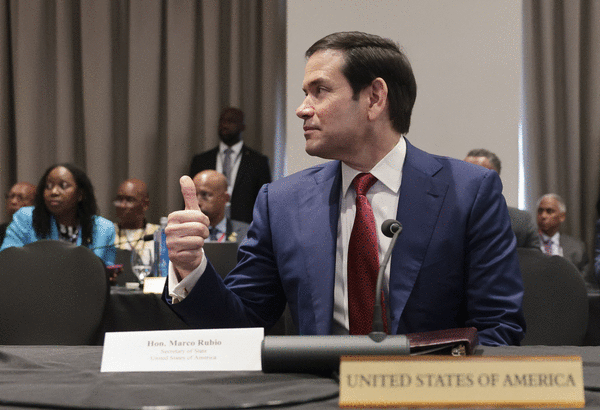
Secretary of State Marco Rubio said the Trump administration envisions Venezuela’s return to democracy as a gradual, three-stage process culminating in elections only after the country achieves political stability, economic recovery and national reconciliation, offering the clearest public description yet of Washington’s long-term strategy following the removal of Nicolás Maduro.
Speaking in an interview that aired Saturday on Fox News’ My View with Lara Trump, Rubio said the United States never viewed Maduro’s capture as the end of Venezuela’s transition but rather as the beginning of a lengthy rebuilding process after more than a quarter century of authoritarian rule.
“A system that’s been in place for over a quarter century... those are deep roots that you have to deal with,” Rubio said. “We’ve always talked about phase one, where our priority was stabilization. We didn’t want the country devolving into civil war, mass migration, civil unrest and so forth.”
Rubio said the administration believes Venezuela has now entered the second stage of that strategy, focused on economic recovery, although he acknowledged that the devastating June 24 earthquakes have complicated the effort.
“Step two is a recovery phase, which I think we’re into,” Rubio said. “Obviously, the earthquake adds complexity to it. You’ve got to have a functioning economy. You need to have laws and rules and regulations in place so that investors from America and around the world can go in and safely invest and create prosperity.”
Only after those objectives are met, Rubio said, should Venezuela move toward democratic elections.
“Ultimately, you have to have transition,” he said. “At some point in time, there has to be legitimate elections at every level so that people know that the government that’s there is a legitimate government chosen by their people.”
Rubio added that national reconciliation would be the first prerequisite for that transition, arguing that Venezuelans have remained politically divided for decades and suggesting that post-communist transitions in Eastern Europe offer useful models.
“Step one towards that is a national reconciliation,” Rubio said. “This is a people that have been divided politically for a very long time against each other, and you’re going to have to look at models like what you saw happen in Eastern Europe after the fall of the Soviet Union.”
The comments are likely to reinforce concerns among many Venezuelans that elections may be farther away than many had hoped following Maduro’s capture in January. The interim government led by acting President Delcy Rodríguez has repeatedly argued that reconstruction and economic recovery must take precedence over electoral preparations, particularly after the earthquakes that have killed more than 5,000 people and left thousands displaced.
Rubio’s comments come as the United States backs efforts to launch political talks between representatives of the interim government and a faction of the opposition led by Dinorah Figuera, head of the opposition-controlled 2015 National Assembly. While both sides have announced the dialogue, media reports indicate the process has so far been limited to preliminary contacts, including an initial phone conversation between the two delegations.
The negotiations, however, do not include María Corina Machado, Venezuela’s most popular opposition leader and the 2025 Nobel Peace Prize laureate. Machado has said she will judge the process by whether it produces concrete advances such as restoring democratic institutions, freeing political prisoners and establishing a credible path toward elections. Her exclusion has fueled skepticism among many opposition supporters after more than a decade of unsuccessful negotiations with successive Venezuelan governments.
Rubio said Washington sees its role not as dictating Venezuela’s future but as helping facilitate the country’s transition.
“I think the role the U.S. government can continue to play is as a facilitator of all of this.”
©2026 Miami Herald. Visit at miamiherald.com. Distributed by Tribune Content Agency, LLC.





Comments