California could require voter ID. Both sides say voters are being misled
Published in News & Features
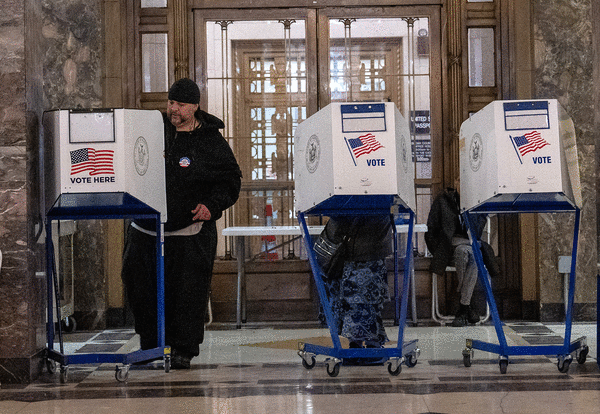
A fight is heating up over a California ballot initiative to implement voter ID as it heads to the courts, pitting advocates who say it will ensure election integrity in the vote-by-mail era against critics who say it would impose needless burdens that could disenfranchise voters.
The state initiative, known as Proposition 39, drew dueling lawsuits this week over the ballot language that both sides are calling misleading. A judge has until Aug. 10 — the deadline to finalize what voters will see in November — to order any changes.
The new legal action comes as the opposition has started to mobilize with two separate groups forming to fight the measure. One of the No on 39 campaigns is being sponsored by the California Donor Table and the ACLU of Northern California, while the other has named former Health Secretary and gubernatorial candidate Xavier Becerra and state Assembly Speaker Robert Rivas as honorary co-chairs who will help with fundraising efforts. They jump into action as the measure’s backers — Reform California, a statewide organization led by state Assemblymember Carl DeMaio — have already amassed a more than $13 million war chest, according to the campaign filings.
Prop. 39 would amend the state Constitution, requiring voters to present a government ID when voting in person or provide the last four digits of a “unique identifying number” when voting by mail. The measure does not specify what qualifies as a unique identifying number and whether its verification would replace the signature verification process.
It would also mandate the Secretary of State’s Office and county election officials to report annually what percentage of the voter rolls have been verified for citizenship. When registering to vote in California, individuals are currently required to submit their driver’s license number or the last four digits of their Social Security numbers as well as check a box saying that they are a citizen under penalty of perjury.
The measure is estimated to increase the annual cost to state and local governments by tens of millions of dollars to low hundreds of millions of dollars, according to the nonpartisan Legislative Analyst’s Office.
On Monday, the Yes on 39 coalition filed the first lawsuit over the measure that they placed on the ballot, accusing state Attorney General Rob Bonta of trying to rig the election by changing the title of the measure to indicate that it would “prohibit” citizens from voting unless they have a government ID. The measure’s previous title signified that it would establish voter ID rules.
Bonta wrote in a July 24 social media post that it is “common for ballot titles and summaries to change” from the circulation petition to what makes its way on the ballot. A spokesperson for his office said in a statement that “we take our duty to prepare a title and summary and ballot label seriously, and we are confident the court will agree we have faithfully executed that duty here.”
Several days later, Rivas, the assembly speaker, and state Senate President Pro Tem Monique Limón also filed a lawsuit, attempting to block the argument in favor of the initiative that was written by the measure’s backers and will appear in the statewide voter guide.
Among their objections was that Prop. 39 “makes it easier to vote.” Rivas and Limón called the statement false and misleading, arguing that the measure would require voters “to comply with new voter identification requirements in order to vote.” The lawsuit also seeks to remove mention that “more than 100,000 ballots were rejected due to signature mismatches” in the last election.
“Nothing in Proposition 39 mentions or will affect the signature verification process,” the lawsuit said. “Proposition 39 adds voter identification requirements, but it does not repeal or change the other procedures that already exist to confirm voter identity under State law.”
State Assemblymember Carl DeMaio, a San Diego Republican and one of the authors of the measure, called the lawsuit “frivolous” and said they are trying to distract “voters from their tampering of the ballot title.”
In an interview, DeMaio said Prop. 39 would help restore trust and public confidence in California elections and is a “superior model” to the SAVE America Act — a federal bill that would require proof of citizenship when registering to vote and a photo ID when voting in national elections.
“We keep the convenience of mail-in ballots,” he said of the differences. “We reject the notion that voters should have burdens put on them for documents. Instead, we provide voter ID in a manner that imposes no burdens on voters, but instead challenges election officials to adopt best practices to do their job better.”
The measure mandates the state to provide a free voter ID card for any eligible voter who wants to use that instead of a driver’s license, passport or other government-issued document.
But opponents of the measure disagree with DeMaio’s characterization of voter ID.
Darius Kemp, the executive director of California Common Cause, a nonpartisan organization that is opposing Prop. 39, said he’s concerned about it potentially disenfranchising voters — especially individuals who recently changed their names on their driver’s license. Voter registration does not automatically update when changing your name.
Kemp called it an “extension of the Trump administration’s SAVE Act.”
“We don’t want laws like the SAVE Act here in California,” he said. “This is just targeting Californians because they know that our voice and our votes are sacred and it’s the only thing that is keeping the Trump administration from unchecked power.”
The SAVE Act, which recently passed through the House of Representatives as part of a broader budget bill, could have implications for the way California operates its elections. The legislation would require individuals to register to vote in person with the necessary documents, effectively limiting or ending registration online or by mail.
The type of documents needed to register is also much more stringent, and most driver’s licenses wouldn’t be enough — a secondary form of identification like a birth certificate would be required if the individual used their driver’s license to register. Valid types of ID include a REAL ID that indicates the person is a citizen — only five states issue this type of identification — a passport or a military ID.
Prop. 39, in contrast, would require a government-issued ID for in-person voting and the last four digits of an identifying number. Since the measure does not specify what the number needs to be, Kemp and other opponents have raised concerns that some people will use their Social Security number, exposing them to identity theft.
The push for voter ID in California comes as recent polling has shown Americans’ overall confidence in elections has dropped. A March 2026 poll from PBS, NPR and the Marist Institute for Public Opinion found that 66% of respondents had confidence that their state or local government would hold a fair election in November — that was down from 76% in October 2024.
But despite rising concerns about election integrity, Thad Kousser, a professor of political science at UC San Diego, said there’s little to no evidence that voter fraud is a widespread issue in the United States.
A 2025 study from the nonpartisan Brookings Institution found that in general elections between 2016 and 2022, mail voting fraud was found in 0.000043% of total ballot cases — about four cases for every 10 million votes.
He said California uses a “fairly stringent voter identification system” for mail-in ballots — the method that a majority of voters in the state use to cast their ballots. The process includes verifying the signature on the ballot with the signature the individual used when registering to vote.
“It’s a very secure, slow system,” Kousser said. “That’s part of why it takes California so long to count all these mail ballots; it’s because registrars are doing that close, human-supervised work of a signature verification.”
©2026 MediaNews Group, Inc. Visit at mercurynews.com. Distributed by Tribune Content Agency, LLC.




Comments