As illegal crossings plummet, Border Patrol turns focus to bolstering checkpoints in San Diego
Published in News & Features
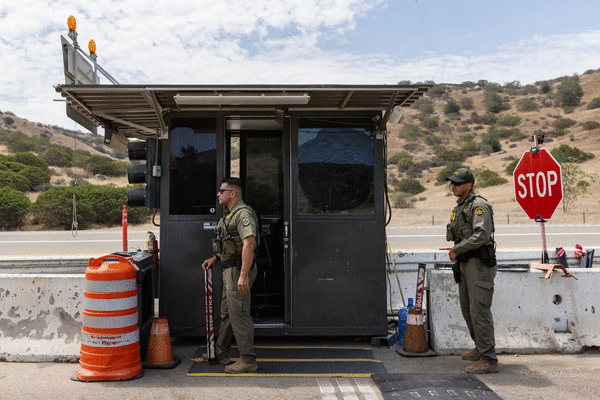
The Border Patrol has been putting a renewed focus on highway checkpoint operations in the San Diego area as migrant crossings at the U.S.-Mexico border have quieted under the Trump administration.
Border Patrol officials said they are now able to restore some operations, and the region could get an infusion of money under the latest federal budget to modernize and expand a checkpoint on westbound state Route 94 in Jamul.
The highway checkpoints have been part of the local landscape for decades and have at times been the subject of controversy when U.S. citizen-residents have complained about traffic issues and the extra scrutiny they face during routine travel. The Border Patrol said the checkpoints are needed to detect and intercept smuggling activity.
The renewed focus on staffing the checkpoints is an indicator of how operations have shifted. Nearly 18 months into the Trump administration’s crackdown on illegal immigration, San Diego Sector Border Patrol Chief Justin De La Torre said that agents are focusing on law enforcement roles again, allowing agents to also concentrate on patrolling and assisting in combating maritime smuggling.
“Now we’re able to patrol the entirety of our 60 miles,” De La Torre said in an interview. “We’re able to patrol the coastline, and to establish our checkpoints, which allow us to detect groups that got away from us on the immediate border.”
According to officials, Border Patrol agents have also apprehended individuals carrying contraband, including drugs and guns, as well as human smugglers who are U.S. citizens or residents, at San Diego sector checkpoints. De La Torre said that checkpoints “impact cartel decisions.”
About 100 people have been arrested at San Diego checkpoints on suspicion of being in the country without authorization so far this fiscal year, which began Oct. 1, according to the chief.
For about two years, operations at federal checkpoints within the agency’s San Diego sector were “very limited” as agents were busy processing the hundreds of migrants, many of whom were asylum seekers, who arrived at the border daily, officials said.
Instead of fleeing from Border Patrol agents, migrants turned themselves in once they crossed onto U.S. soil. They needed transportation to be processed into the immigration system, and then either detained at a facility or released into the community with notice of a court date. There were 324,000 migrant encounters in the sector during fiscal 2024.
“That’s the most that we’ve seen in decades out here,” De La Torre said. “We had to focus the majority of our agents on intaking those folks and processing them, and then ultimately many of them were released during that time, and so we weren’t really able to get out and do proactive law enforcement work.”
Border Patrol officials reported nearly 50,000 apprehensions in the sector in fiscal 2025, marking the lowest number since fiscal 2019.
The plummeting numbers are credited to changes in border policy in the first year of Trump’s second term, including restrictions to the asylum process, reinforcement and construction of additional border barriers, and an end to the policy known as “catch-and-release” at the border. The Border Patrol is also in the process of hiring more agents locally. De La Torre said the current workforce consists of about 2,300 agents, but they expect to reach 2,700.
Nine months into the current fiscal year, there have been about 8,400 apprehensions in the sector overall, according to the latest data available from U.S. Customs and Border Protection, the Border Patrol’s parent agency.
As migrant apprehensions dropped, Congress earmarked about $170 billion in additional funding for immigration enforcement and border security in H.R. 1, also known as the One Big Beautiful Bill. The funds must be used by 2029.
The bill allocated $5 billion for expenses related to the “lease, acquisition, construction, design, or improvement of facilities and checkpoints owned, leased, or operated by U.S. Customs and Border Protection.”
San Diego Border Patrol officials hope to receive funds to modernize the one on State Route 94 in Jamul, which sees more than 4,200 vehicles pass through daily.
“We have about 10 acres; we’d like to expand to about 30 acres,” said Jill Badousek, the agent in charge of the Brown Field station. “With that infrastructure will come more agents being able to deploy here, we’ll be able to be on target, more time and more technology,” she added.
The checkpoint facility includes a small roadside booth, a portable building for offices, parking for agency personnel and an area designated for secondary inspections.
Other checkpoints regularly staffed within the San Diego sector are located on Interstate 8 and Old Highway 80 in Pine Valley. There have also long been checkpoints established on the much busier arteries of Interstate 5 in San Clemente and Interstate 15 in Temecula, although drivers are less likely to see them conducting inspections at all times due to the spectre of a massive traffic nightmare.
Officials said the agency may set up tactical checkpoints at other spots “as operations dictate” and noted that the number and location are determined by “operational needs, intelligence, and available resources.”
De La Torre said the checkpoints are set up in areas that have historically been major smuggling routes.
On a recent Friday, drivers passing through the Jamul checkpoint, located about 7 miles north of the U.S.-Mexico border, encountered dogs who sniffed their vehicles and a license plate scanner pre-inspecting their vehicles as they approached Border Patrol agents. The inspection usually consists of a couple of citizenship-related questions or a quick visual scan of the vehicle, followed by a wave through.
De La Torre said that most people cooperate. “The vast majority of the public, especially folks who live out in the border region, they get it,” he said. However, he noted that it is not always the case.
Under a section of the Immigration and Nationality Act, the agency has the authority to board and search vehicles and vessels within 100 miles of the border “for the purpose of patrolling the border to prevent the illegal entry of aliens into the United States.”
The U.S. Supreme Court ruled in 1976 that Border Patrol operations “within a reasonable distance of the border” do not violate the Fourth Amendment’s prohibition of unreasonable searches and seizures.
Frederick Carroll, legal director with the American Civil Liberties Union of San Diego and Imperial Counties, urged the community to learn about their rights. He said that although the Fifth Amendment protects people’s right to remain silent, these protections are “very particularized and specialized when it comes to immigration checkpoints.”
“If you’re a United States citizen, you can refuse to answer the question,” he said. “Certainly that’s not going to speed up your getting through the checkpoint at all,” he added, noting that it could lead to further questioning and referral to secondary inspection in some cases.
He said that for those with immigration status, “if they have a question individually, a person should ask an immigration lawyer, but in most circumstances, a person with immigrant status in the United States is required to provide their documents at these checkpoints.”
Three miles east of the Border Patrol Jamul checkpoint, José Hernández runs a market. He has lived in Dulzura for over 20 years. He, along with many others living in the border town, passes the checkpoint often. “There’s only one way up, and one way down,” he said.
To him, the nearby checkpoint provides an extra layer of security. “Not many people come out here looking for trouble, especially when there’s an agency there,” he said.
Some neighbors who stopped by Hernández’s store or the post office next door on Wednesday said they favored having the checkpoint in the area. Dulzura resident Emanuel San Martín said he has no problem with the inspections but wishes they could be faster during peak hours.
De La Torre acknowledged that there could be some lines at certain times, but said that they are monitoring them to minimize the impact.
_____
©2026 The San Diego Union-Tribune. Visit sandiegouniontribune.com. Distributed by Tribune Content Agency, LLC.






Comments