Fear of mass deportation grips NYC's Haitian community after Trump ends TPS
Published in News & Features
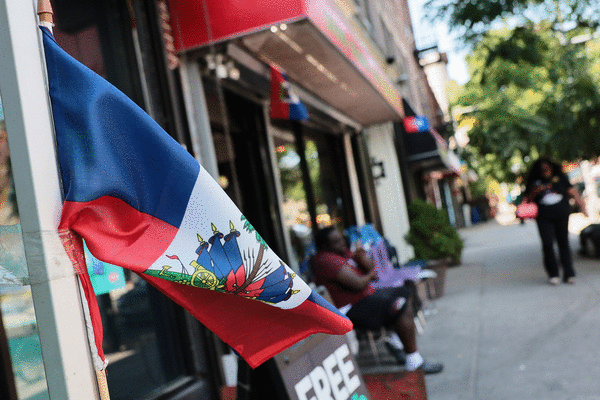
NEW YORK — Fear of mass deportation has gripped New York City’s Haitian community after the Trump administration announced that federal Temporary Protected Status for thousands of immigrants expired this week following a Supreme Court ruling.
The city’s hospitals, staffed by many TPS holders, and Haitian businesses may already be feeling the rippling effects, as people stay home, dreading what may come next.
The decision affecting TPS, which the Supreme Court voted 6-3 along ideological lines to revoke, impacts more than 300,000 Haitians and roughly 3,000 Syrians nationwide, rendering them undocumented and no longer authorized to work in the U.S.
The Department of Homeland Security announced that the TPS expiration date was Monday, but lower district courts had yet to issue final orders on whether the program will end, NPR reported Thursday. It wasn’t immediately clear if the courts reached a decision Friday.
On the streets of Brooklyn’s Little Haiti, DHS’ announcement had a quieting effect, as fears of federal immigration raids swept the community, locals told the Daily News.
“People are worried. Usually, the street outside is not so empty. We stepped out [Wednesday] morning, and we were, like, ‘Wow, it’s very empty,’” said a woman who works for a local advocacy group that offers social services to Haitian immigrants. “We’re waiting. We’re just waiting.”
One man, who came to Brooklyn from Haiti in 2001 and has U.S. citizenship, said the federal government will be sending TPS holders back to live on the streets amid constant gang violence.
“It’s not safe. Everybody knows that. [The government] knows that too. Gangs, they kill a lot of people. They’ll kill you,” he said. “When you send them back, they live in the streets. If you’re not living in your house, then the gangs take the house.”
The 62-year-old man, who wished to remain anonymous, said the fear on Nostrand Avenue near Clarendon Road, where he stopped to speak to a Daily News reporter on Wednesday afternoon, was palpable.
“Before you see a lot of people sitting down, playing music and everything, but now they’re not doing that,” he said. “It’s empty, it’s quiet. Only legal people sit down. You don’t see a lot of vendors in the street anymore.”
A DHS spokesperson refused to comment on whether Immigration and Customs Enforcement raids were being planned, saying the department “does not discuss ongoing or future operations.”
“Temporary Protected Status is exactly that—temporary. For too long, TPS has been allowed to function as a de facto amnesty program despite Congress never intending it to be permanent,” DHS said in its statement. “What we would say now is it’s closing time, which means you don’t have to go home, but you can’t stay here. The good news is it’s not too late to get a $2,600 check and a free flight home.”
A Little Haiti resident, whose older sister immigrated from Haiti two years ago on TPS, said the move didn’t come as a surprise.
“With this administration, I don’t expect anything to go right or go in the right direction. We’re not shocked,” Danny, 40, said.
“It was an opportunity,” he said of TPS. “A lot of people came and were able to help their families back home. My sister has been able to send money to her grandkids. It’s just that you came here, in life you made some progress, and now you’ll go back down.”
He said his 46-year-old sister has found relief from the dangers of their home country, living in Brooklyn and working with elderly patients at a hospital.
“She became relieved. There’s no gunshots, nobody’s grabbing your phone walking down the street. It’s just a sense of security, and she’s at ease,” he said. “Out there, there’s people always shooting, people are running. That’s normal. I went a couple years ago, and the country was on fire.”
“The only way they’re going back is by force. It’s a war zone out there. The gangs took over. There’s no stability, no sanitation, no work. It’s just a bad situation,” he added.
Nancy Hagans, the president of the New York State Nurses Association, said that thousands of TPS holders worked as nurses, nursing assistants, and home health aides, and that the federal government’s move threatens to create major staffing shortages in city hospitals and nursing homes.
“Who will be there to care for our patients? Who is going to be there to care for our loved ones that are home and cannot care for themselves? For our loved ones who are in a nursing home? What is the plan from the government when they remove these workers?” asked Hagans, a Haitian immigrant who works as an ICU nurse at Maimonides Medical Center in Borough Park, Brooklyn.
“Coworkers, colleagues are very sad. We’re very upset because we know what it’s gonna be like. We’re gonna be short,” said Hagans, who is in the country legally. “Two, three days you may get someone to come in and do an extra shift here and there, but in the long run it’s going to hurt. We don’t know (who will replace them). The employers themselves, I’m sure, they don’t know.”
Hagans said Haitians returning to their home country from America are viewed as wealthy and vulnerable, and are often targeted by thieves and bandits.
“These people that they want to send back to Haiti, they’re sending them to die,” said Hagans. “It’s a funeral. We are in mourning. My mother, who’s 89 years old, has not been able to speak. She’s crying because she knows what’s going to happen.”
The ruling may also be choking local businesses that rely on Haitian customers, like Golden Blue Bar & Restaurant, a Haitian eatery on Flatbush Avenue near Clarendon Road, which was dead quiet on Wednesday afternoon.
“It’s been very slow. I just texted one of my workers like, ‘Hey, if it’s empty, I only need one person today. People aren’t coming in,'” said Amantha Chery, 28, whose Haitian immigrant parents own the establishment.
“It’s been really tough. I feel like they’re all scared. Their working papers are getting stopped, so they don’t have money to go out. They’re all saving their money and trying to figure out what to do next. It’s sad,” Chery added.
Stephanie Delia, the incoming president of the Haitian American Lawyers Association of New York, told NY1 that TPS holders should prepare now for possible deportations.
“When I say prepare, I mean, specifically think of four areas: your children, your money, your legal documents, and an emergency plan,” Delia said.
Mayor Zohran Mamdani said the city would stand with its immigrant communities, and urged anyone with questions to call the Mayor’s Office of Immigrant Affairs (MOIA) free Immigration Legal Support Hotline at (800) 354-0365.
“More than 3 million of the people who call this city home are immigrants,” Mamdani said. “No matter where you were born, no matter how far you had to travel to get here, you are a New Yorker.”
©2026 New York Daily News. Visit nydailynews.com. Distributed by Tribune Content Agency, LLC.





Comments