With work permits expired, Haitians await federal judge's order for formal end of TPS
Published in News & Features
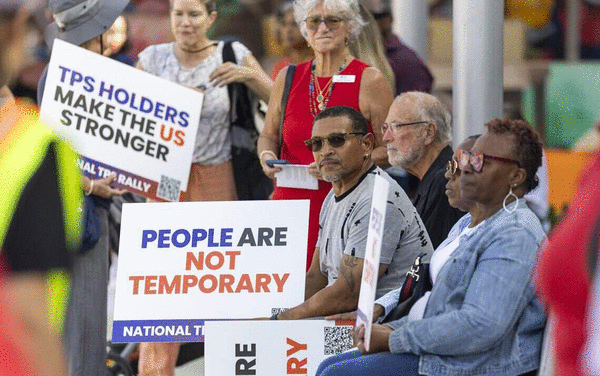
The clock is ticking on the end of Temporary Protected Status for hundreds of thousands of Haitian immigrants in the United States, meaning that it’s only a matter of time before the Trump administration can begin escalating their deportations to Haiti.
Technically, the administration’s policy ending TPS for Haitian and some Syrian immigrants will take effect when a federal judge in Washington, D.C., lifts her stay that put that decision on hold. U.S. District Judge Ana C. Reyes must lift her stay when she receives an official order from the Supreme Court, which overturned her in a major 6-3 ruling siding with the government on June 25.
The judge is awaiting the Supreme Court order, or mandate, which was sent on Monday to the federal appeals court in Washington before being forwarded to her. Whenever Reyes lifts her stay, most likely this week, about 350,000 Haitian immigrants with TPS in Florida and other states will lose their protection against deportation.
Haiti was first designated for TPS in 2010 after the country’s devastating earthquake killed more than 300,000 people and displaced 1.5 million others. In the years since, worsening conditions — including political instability, gang violence and recurring humanitarian crises — led to the repeated extensions and redesignation of the humanitarian program.
Dread over the impending end of TPS has been hanging over the Haitian community in South Florida, where many fear Immigration and Customs Enforcement raids are imminent.
On Monday, the Department of Homeland Security acted as if TPS had already ended when the Supreme Court issued its mandate to the lower courts. With TPS work authorizations expired, the agency issued a post on X telling Haitians that their “free trial of America has ended.”
“Your Temporary Protected Status protections have expired,” the DHS post said. “Enforcement will be carried out. You can wait for DHS to deport you or you leave now by visiting DHS.Gov/CBPHOME.”
The message was followed by two choices in boxes: “Leave Now” or “Wait for Deportation.”
Lawyers for the Haitian immigrants who filed the initial complaint against the Trump administration in the federal court in Washington said they were “still evaluating the effects of the Supreme Court’s ruling” and would inform Reyes by July 31 about filing an amended lawsuit. In February, Reyes paused the administration’s decision ending TPS for the Haitian immigrants, setting the stage for the high court’s ruling overturning both her and a federal appeals court as it concluded that the executive branch’s policymaking was not subject to judicial review.
However, the justices left open a narrow front for the Haitian immigrants to continue challenging the administration’s decision based on their initial claim that canceling TPS was based on racial discrimination in violation of the Equal Protection Clause of the Constitution.
But even as the Haitian immigrants’ TPS case moves through the federal court in Washington, many of them could still be deported by ICE to Haiti, a country collapsing from deadly gang violence, political chaos and extreme poverty and hunger.
Some advocates for the Haitian immigrants have been quietly lobbying the Trump administration to provide deportation protections to Haiti through a program known as Deferred Enforced Deportation.
During his first presidential term, President Trump issued deferred deportation to thousands of Liberians living in the U.S. after he terminated the West African nation’s TPS designation. The president later extended the wind-down period by a year.
In 2019 Congress enacted the Liberian Refugee Immigration Fairness, which allowed eligible Liberians who had been continuously present in the U.S. since November 20, 2014, to adjust their status to lawful permanent residents.
©2026 Miami Herald. Visit at miamiherald.com. Distributed by Tribune Content Agency, LLC.





Comments