Court monitor cites laundry list of healthcare failings at major California ICE detention center
Published in News & Features
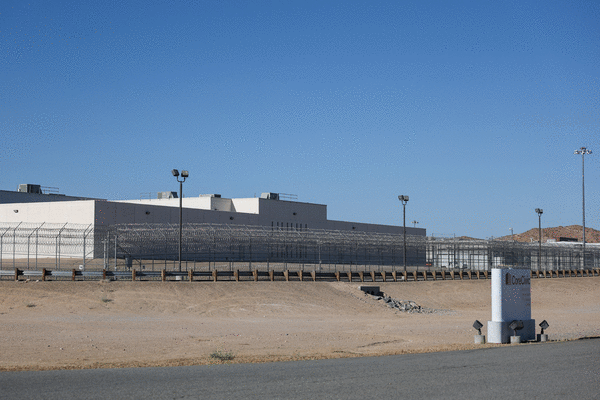
LOS ANGELES — The largest immigration detention center in California "lacks a reliable system to consistently provide adequate health care, placing individuals at serious risk of both immediate and long-term harm," according to a report issued this week by a court-appointed monitor.
In his report, Dr. Muthusamy Anandkumar, a physician with extensive experience as a medical monitor in immigration detention facilities, state prisons and county jails, cited "a recurring pattern of delayed identification of patient needs, delayed or missed assessments, delayed or inadequate treatment, missed or delayed medication administration, and gaps in follow-up care" at the California City Detention Facility in the Mojave Desert.
According to the report, Anandkumar interviewed more than a dozen staff and 40 patients, conducted a three-day site inspection and reviewed 141 patient medical records and thousands of pages of documents produced by Immigration and Customs Enforcement and CoreCivic, the private prison company operating the facility.
"This pattern indicates broader problems in the facility's health care delivery system rather than occasional lapses in care," Anandkumar said in his report.
U.S. District Judge Maxine M. Chesney appointed Anandkumar to ensure compliance with her February order that ICE provide "constitutionally adequate healthcare" at the detention center.
Chesney's ruling stemmed from a class-action lawsuit filed last year by several advocacy nonprofits and law firms — the Prison Law Office, the American Civil Liberties Union, the California Collaborative for Immigrant Justice and Keker, Van Nest & Peters — which alleged inhumane conditions at the detention center, including inadequate food, water and medical care.
Tess Borden, a lawyer with the Prison Law Office, said it was the first time a court had appointed an independent, neutral party to review the full scope of healthcare provided at an ICE detention center.
"The system failures that [Anandkumar] points to are not just endemic of the system at California City, but the system of immigration detention nationally," Borden said.
Similar complaints have been raised by detainees at detention centers across the country. Earlier this month, a federal judge ordered the government to immediately overhaul conditions at the Adelanto ICE Processing Center and instructed the immigration agency to provide access to a qualified, independent third-party monitor who would focus on the systems for medical care and disability accommodations.
The Department of Homeland Security did not immediately respond to a request for comment. A former agency spokesperson previously called Chesney's order "unnecessary and superfluous given DHS's medical policy goes above and beyond."
"All detainees are provided with proper meals, water, medical treatment, and have opportunities to communicate with their family members and lawyers," the spokesperson said in February. "Ensuring the safety, security, and well-being of individuals in our custody is a top priority at ICE. ICE has higher detention standards than most U.S. prisons that hold actual U.S. citizens."
The former prison turned detention center has faced a growing number of complaints since it opened in August, as the Trump administration pushed to expand detention capacity nationwide.
In his report, Anandkumar said staff reported that, when the facility opened, "it was intended to house individuals in good health."
"In practice, however, the facility received a large volume of patients, including patients with complex medical conditions, and the medical team was not adequately prepared to manage this population," he said.
Anandkumar said the facility "does not appear to have adequate staffing, stable on-site management, sufficient clinical and operational oversight, or an effective quality assurance process to identify and promptly address care-related problems."
"These elements are necessary to manage the health care needs of this patient population," he said.
Fernando Viera Reyes, a plaintiff in the lawsuit who is currently being held at the detention facility, said in a statement that for months he couldn't move, sleep or even use the bathroom without being in extreme pain. Despite that, he said, it took five months for California City to get him a biopsy.
He has now been diagnosed with metastatic prostate cancer, he said.
"By the time I received my official diagnosis, the cancer had spread all over my body. If my ability to get cancer treatment is in the hands of this same staff, I'm scared I'll be left without the healthcare I need," he said. "It feels like we're being treated like we don't have any value, but we're all human beings, and we deserve lifesaving treatment just like anyone else."
©2026 Los Angeles Times. Visit at latimes.com. Distributed by Tribune Content Agency, LLC.






Comments