St. Paul wants no more homeless encampments by winter. Many question the plan
Published in News & Features
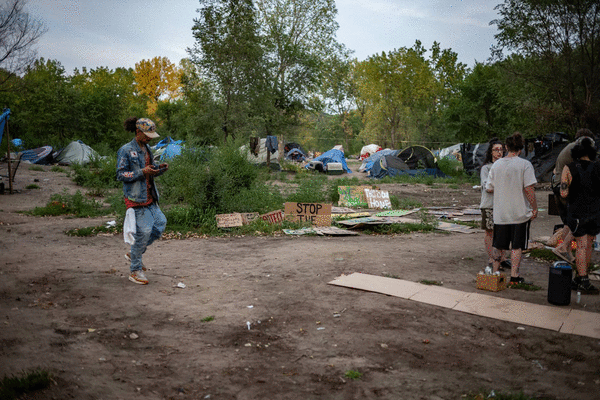
ST. PAUL, Minn. — Outside St. Paul’s largest homeless encampment in an out-of-the-way East Side park near the river, a small army of outreach workers, case managers and social workers were set up behind a bank of laptops under white pop-up tents.
The encampment’s residents lined up to plug back into Ramsey County welfare systems and try to figure out their next moves.
The Pig’s Eye Park encampment, established in January 2025 and home to more than 100 unsheltered people, will be closed on Aug. 5, with just under a month’s notice from the city. It’s the city’s first major closure of homeless camps in more than a year, drawing fresh criticism and outcry from activists. It is also the start of a shift in the city’s approach to prevent future encampments.
On a quiet summer morning, residents paced dusty paths between tents, tended to small fires and swatted away the flies that swarmed every molecule of food.
From one yurt, a resident who introduced himself as Wolf echoed the sentiment of many of the residents of this and other St. Paul encampments, as well as the many volunteers and activists who work with them: Why now, when the camp has been established for well more than a year? And can shelter really be found for everyone when the camp is cleared?
City leaders cite a growing number of emergency calls — more than 850 in the past year from three established encampments in St. Paul. Pig’s Eye Park is the largest, where St. Paul estimates 120 people are staying, but residents guess the population is closer to 300. Unlike some previous large encampments that were predominantly single men, there are many families with children at Pig’s Eye.
In a break from the last several years of policy, St. Paul will aim to prevent encampments of more than a few tents forming. The Pig’s Eye Park camp formed with the city’s tacit consent in 2025, in the hours after the city cleared an encampment in the nearby Bruce Vento Nature Sanctuary. Now, St. Paul aims to clear the other two established encampments before the winter sets in.
The shift comes as the city of Minneapolis takes a harsher tack toward drug sales and use, and as St. Paul Mayor Kaohly Her tries to find a new approach to homelessness as she nears her eighth month in office.
“We do not want to have any more established encampments moving forward,” Assistant Mayor Cedric Baker said at a public meeting Wednesday.
Ramsey County does not have enough emergency shelter beds to accommodate everyone now living in an encampment, but the shelters are not as critically full as those in Hennepin County.
“If someone is looking for a shelter bed most nights there is one,” County Manager Ling Becker said. But those openings are typically in the single digits.
St. Paul sent $1 million to the county this week to open another 49 beds in the Dorothy Day shelter in downtown, earmarked for encampment residents, and the county is finding providers to bring more emergency beds and longer-term solutions online.
But there still seems to be more people than beds.
Dozens of furious activists and several residents of encampments came to City Hall on Tuesday to underline this point, and to tell the City Council that the destabilization of closing the camp will hurt residents. They cited research showing strong correlations between encampment sweeps and increased rates of overdose, and wondered how outreach workers will be able to keep track of clients if they scatter.
At the camp, some are already finding housing. A woman who declined to be named said she and her three children had moved into an apartment after a few weeks in the camp. On Thursday, she was packing up her fiancé’s belongings for his move into another apartment.
Wolf has found an apartment too, he said, after a period of unsheltered homelessness that began when he lost his job during the pandemic. He will bring his things there when he gets the keys, he said. But he plans to sleep in the encampment until he knows his neighbors are taken care of.
Many others are still waiting to hear if Ramsey County will be able to find a place for them to stay.
Some activists and service providers are calling for a two-year moratorium on closures to allow more time for people to find shelter, but Baker is skeptical a longer timeline will produce any new solutions. Little changed in the number of emergency shelter beds and available supportive housing for people exiting homelessness in the year-and-a-half since the city’s last large encampment closed.
Council Member Cheniqua Johnson’s Ward 7 includes the encampment, as well as neighbors increasingly frustrated with the panhandling, feces and needles in parks and streets. She thinks St. Paul has grown too comfortable with the less-visible camp in Pig’s Eye, with the encampment’s squalid conditions out of sight and out of mind.
Service providers fear those who choose to stay outside will disappear, putting them further from those trying to help them, and at greater risk of overdoses and other harms.
Even if there was adequate space, many of the people living in camps fear shelter life.
“I hear so many stories about shelters,” said encampment resident Justin Ford. “Violence, people stealing your stuff.”
For now, Ford lives at another encampment on the East Side with his 2-year-old gray-and-white pit bull, Switch, who greets visitors with a gentle headbutt.
Ford is not sure where he and Switch will go when his encampment is cleared. The Ramsey County social-services armada had not yet appeared at his camp.
For smaller service providers, the plan has seemed sudden and jumbled.
“There are so many people who want to help, but they’ve been completely boxed out,” said Justin Lewandowski of Open Hands Midway, a nonprofit that provides meals and supplies.
Lewandowski said he wondered if clearing the encampments might set back efforts to revitalize St. Paul’s struggling business districts. Without a home base like Pig’s Eye, Lewandowski said he thought people from the encampment would gravitate to places near shelters and day programs.
“People are going to go downtown or to the Midway,” he said, “where they have resources.”
©2026 The Minnesota Star Tribune. Visit startribune.com. Distributed by Tribune Content Agency, LLC






Comments