The chef feeding Venezuela's earthquake survivors -- and listening to their grief
Published in News & Features
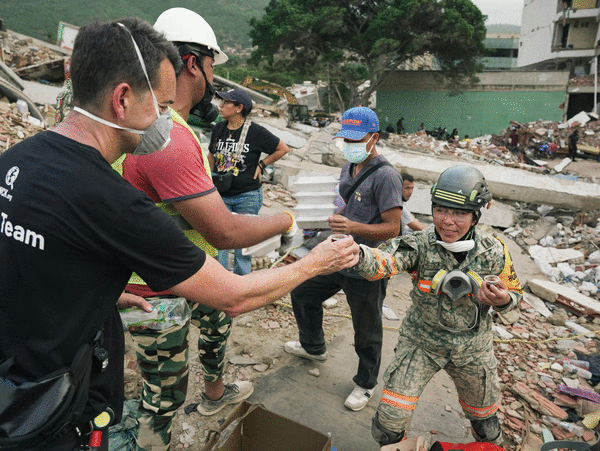
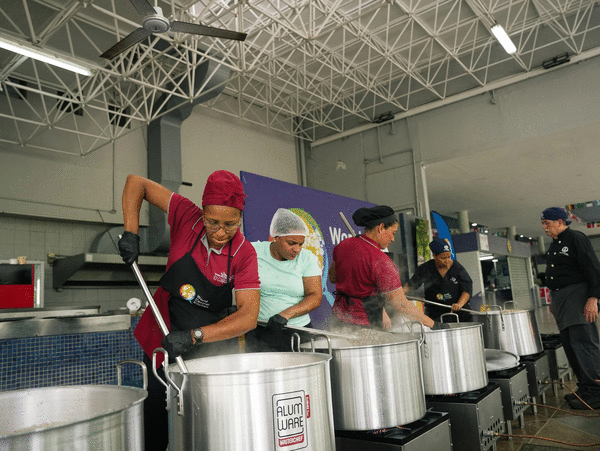
While preparing thousands of meals for people affected by the earthquakes in Venezuela, as well as for rescuers and relatives of those still missing, chef Olivier de Belleroche also listens to the stories of those who refuse to give up the search.
One mother told him she only wanted to recover “a little piece” of her son so she could give him a proper burial. Another woman said she had spent several days waiting to find the remains of her brother and his family because she had promised her mother she would not return without them.
“It brings tears to your eyes and gives you goosebumps, honestly,” said the director of disaster response at World Central Kitchen (WCK) in an interview with el Nuevo Herald from Venezuela.
De Belleroche has been in the South American country since late June, after twin earthquakes measuring 7.2 and 7.5 devastated Venezuela, leaving more than 5,000 people dead and more than 17,000 displaced.
With the first shipments of food arriving and a network of restaurants already mobilized in Caracas and La Guaira to prepare thousands of meals each day, he launched WCK’s emergency response operation.
The operation is based at Club Puerto Azul in La Guaira, the area hardest hit by the earthquakes, whose staff opened its facilities and made its workforce and equipment available to the organization.
“We built a kitchen in record time. Right now, we are preparing 35,000 meals, which is a lot. Of those, 13,000 are sandwiches, cold meals, and the remaining 22,000 are hot meals,” he said.
WCK has served more than one million freshly prepared meals to families, emergency crews, volunteers and frontline workers in the weeks since the devastating earthquakes.
“One million meals is more than a milestone—it represents thousands of acts of solidarity by the people who made this response possible. From the local restaurants that opened their kitchens and the volunteers who served the meals to the community leaders who helped us reach families,” de Belleroche said.
From the earthquake alert to arriving on the ground
The chef has responded to natural disasters caused by typhoons, hurricanes, floods, wildfires, volcanic eruptions and earthquakes, as well as humanitarian crises in conflict zones such as Gaza and Ukraine.
So when the alert for the twin earthquakes went off on June 24 at midnight, Madrid time, and he saw the magnitude of the disaster, he immediately knew WCK would most likely be deployed to Venezuela.
He primarily works in Europe, Asia and Africa, but because he holds a Spanish passport, it was decided he would travel to Venezuela, where he could enter the country more quickly.
That same night, WCK began mobilizing volunteers in Caracas who had participated in previous emergency responses. They headed into the field to gather information from La Guaira, the area hardest hit by the earthquakes.
A first team of 10 people traveled to Bogotá, Colombia, some from Europe and others from Latin America, including Miami-based Venezuelan American chef Carlos García.
The team also included Venezuelan national David Mota, another member of the organization with extensive emergency response experience, including operations following the hurricane that devastated Acapulco.
From there, they flew to Valencia, Venezuela, before traveling by road to Caracas and La Guaira.
With more food supplies available and a network of local restaurants already mobilized, the team was able to quickly expand its response across Venezuela.
For de Belleroche, one of the organization’s greatest strengths is its ability to mobilize without the bureaucratic hurdles that often delay emergency operations.
“We stand out because we are among the first to be on the front lines, since we are a nongovernmental organization,” he said.
He said the organization is funded entirely through private donations, which allows it to make decisions more quickly and deploy to affected areas in the earliest stages of a crisis.
The strategy is not to impose a menu
In La Guaira, de Belleroche and the WCK team began working with local restaurants from the earliest days of the emergency. Rather than imposing a menu, the organization’s strategy is to rely on people who understand the tastes and needs of each community.
He explained that when WCK arrives in a disaster zone, the first step is to reach out to restaurants that have previously partnered with the organization and then expand the network with new partners capable of meeting its production, food safety and quality standards.
“We don’t impose the food, we learn from local chefs. The goal is for the community to help its own community,” he said.
Venezuelan chefs decide what to prepare based on local tastes, while the organization provides its operational systems to increase production capacity and ensure nutritional standards.
The operation eventually grew to include about 60 restaurants, as well as catering companies, a culinary university, cooking schools, food trucks and food vendor associations, most of them based in Caracas.
In La Guaira, where many businesses remained closed after the earthquakes, the organization relied heavily on meals prepared in Caracas and transported to the disaster zone.
Getting the meals to the affected communities became one of the biggest logistical challenges. Road closures, checkpoints and travel restrictions caused delays that, in some cases, forced the organization to cancel deliveries because the food could no longer be delivered safely.
Listening to earthquake victims
For de Belleroche, WCK’s work goes beyond preparing and distributing meals. At food distribution sites, the team also became a source of comfort for people searching for missing relatives, offering them someone willing to listen.
“There are many people waiting for their loved ones who may not even want food. They simply want someone to listen to their story, why they are there, and who they are waiting for,” he told el Nuevo Herald.
For him, one of the most important parts of disaster response is standing alongside people as they endure uncertainty and grief.
At one of the distribution sites, where hot and cold meals were served throughout the day, de Belleroche witnessed one of those stories.
A woman approached and asked if she could skip the line. She wasn’t seeking food for herself, but for the 20 people helping search for her son and other relatives trapped beneath the rubble.
“I don’t have time to stay here. I have to get back to them,” she said.
The volunteers listened to her story and found a solution. They gave her a special reusable cloth bag that the team reserves for people who regularly return to pick up meals for groups of family members or rescue workers.
She was able to take the meals without waiting in line.
According to de Belleroche, before leaving she thanked the team, especially for feeding the rescuers, and said she would not leave until her son was found.
“The only thing she wanted was a small piece of her son—whatever she could recover—so he could rest in peace,” de Belleroche recalled.
Stories like hers were repeated over and over among those who remained in the affected areas: families who had spent weeks searching for loved ones and people who refused to return home without answers.
“Almost everyone who tells you their story ends up crying,” he said.
©2026 Miami Herald. Visit at miamiherald.com. Distributed by Tribune Content Agency, LLC.






Comments