Senate Republicans reject bid to extend Haiti TPS despite calls from Miami-Dade leaders
Published in News & Features
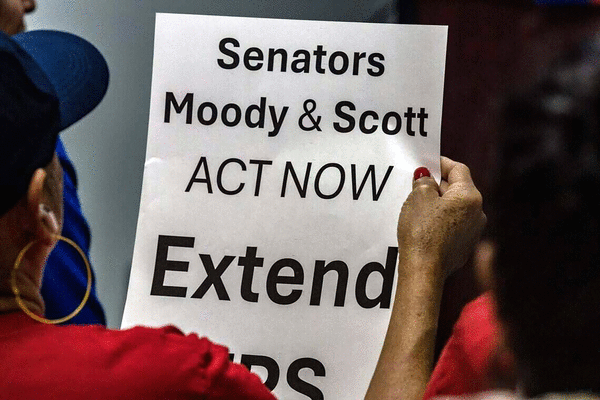
Senate Republicans on Wednesday blocked Democrats’ attempt to extend temporary protected status for Haitians, rejecting legislation that would have allowed hundreds of thousands of Haitians to remain in the United States without fear of deportation until at least the next U.S. presidential election.
In April, House Democrats, with the support of a handful of Republicans, passed legislation extending temporary protections for Haitian immigrants by three years. The bill was sponsored by Reps. Ayanna Pressley of Massachusetts and Laura Gillen of New York, both Democrats, and advanced to a vote after supporters successfully used a bipartisan discharge petition to get the bill out of committee.
Massachusetts Democratic Sen. Ed Markey and Delaware Democratic Sen. Lisa Blunt Rochester later introduced companion legislation in the Senate. Their effort to pass the measure Wednesday before Haitians’ TPS expires on Friday was blocked by Missouri Republican Eric Schmitt. The senator accused Democrats of trying to make TPS permanent.
“America is not a global refugee camp. America is not a get-rich scheme for the Third World. America is our home, and when house guests become squatters, you don’t delay enforcement. You call the sheriff and you send them home. That’s exactly what we must do here today,” Schmitt said.
Plea for support
Hours before the Senate debate, local elected officials in South Florida joined union, faith and business leaders and immigration advocates in urging senators to approve the bill. They specifically called on Florida Sens. Rick Scott and Ashley Moody, both Republicans, as well as Secretary of State Marco Rubio, who previously represented Florida in the Senate.
“All the organizations on this have reached out to senators,” said Paul Christian Namphy, political director of the Family Action Network Movement. “It’s radio silence, and this is unacceptable.”
Miami-Dade County Mayor Daniella Levine Cava said her office had also tried to reach the lawmakers without success. Ending TPS, she said, would place 350,000 Haitians at risk of detention and deportation to a country in turmoil.
South Florida is home to one of the largest Haitian communities in the U.S. It’s estimated that 90,500 Haitians here have TPS, which allows people from countries facing armed conflict or natural disasters to live and work temporarily in the U.S. TPS holders contribute about $5.8 billion annually into the U.S. economy and pay roughly $1.5 billion in taxes, Levine Cava and other leaders said.
“This is our lifeline,” Levine Cava said.
Haitians' contributions to the U.S., the mayor highlighted, date back to America’s fight for independence, when soldiers from the French colony of Saint-Domingue, present-day Haiti, fought in the Battle of Savannah in 1779. More recently, they have helped transform South Florida by “opening businesses, creating jobs, taking care of our elders, our seniors, our children, building our homes, strengthening our neighborhoods, enriching our culture.
“They are a critical, indispensable part of our entire economy,” Levine Cava added. “And right now, this community, this economy, faces an existential threat because of the ending of TPS.”
The issue, Cava and Miami-Dade County Commissioner Marleine Bastien said, has been framed solely as immigration policy, when it is also about the workforce and economics.
“This is not the Haitian immigration problem. This becomes every family’s, every citizen’s problem. The same is true for construction, hospitality, manufacturing, education, transportation, retail, and business services,” said Bastien. “Our economy is already facing labor shortages.
“Ending TPS doesn’t save American money,” she added. “Ending TPS costs America money.”
Since the Supreme Court last month allowed the Trump administration to move forward with ending TPS protections, the longtime Haitian community advocate said her phone has not stopped ringing. She has received calls from both TPS holders and businesses who employ Haitians, asking what should they do. Father Reginald Jean-Mary of Notre Dame Catholic Church in Little Haiti said he’s never seen such suffering and fear in the community.
Behind the statistics are families facing agonizing decisions about their homes, their vehicles and even their U.S.-born children.
“Imagine spending 20 years building a career as a doctor and nurse, a business owner, homeowner, raising your children,” said Bastien, only to end up one day in a nation where “your life, the lives of your loved ones might be in danger. Imagine that.”
County Commissioner Oliver Gilbert III and State Sen. Shevrin Jones, both Democrats running for Florida’s 24th Congressional District seat, didn’t mince words about the Trump administration’s decision.
“They’re dressing up their prejudice as policy,” Jones said. “The real question is, what will we do? We have United States senators who represent Florida who support sending nations back. They don’t actually represent Florida.”
Jones told the story of a young woman who has spent 21 years in Florida under TPS with her family. “You know what her question was: What am I going back to? Who am I going back to? It’s a death sentence.”
“What type of America is that? What type of Miami is that? The individuals who we come to them on campaign time ask for the Haitian vote, but we can’t stand up and ask when they ask us for the support,” he said. “The same group of people back in 1776, when they fought for this freedom, now are asking us to fight with them. It’s not a strong ask. It’s a simple ask. It’s an American ask.”
Jones said if House Democrats were able to get Republicans to support bipartisan legislation to ensure that the people who’ve been there for the U.S. didn’t have to leave, then he could not see why the same couldn’t happen in the Senate.
But Senate Republicans objected, with Schmitt arguing that voters had endorsed President Donald Trump’s mass deportation platform, including his promise to end TPS for Haitians.
Senate Minority Leader Chuck Schumer of New York accused the president of trying to force Haitians back into “dangerous conditions” they fled in Haiti.
“Let’s be clear: Revoking Haitians’ Temporary Protected Status will not only hurt them; it hurts our entire country,” he said. “In New York, you can’t go into a hospital, a nursing home, or a clinic without seeing scores of dedicated healthcare professionals who are fiercely proud of their Haitian heritage.
“That’s true in cities and towns throughout the country,” Schumer added. “We’ve heard warnings that if Trump expels our Haitian TPS holders, it will strain our health system, create a gap in caregiving workforce that will be difficult to fill.”
The Supreme Court, Markey said, failed a moral test by allowing the president to end the humanitarian program. Protecting the vulnerable is not a political choice but “a moral duty,” he said.
“Haiti continues to confront overlapping crises, political instability, widespread violence, and a humanitarian emergency that has strained every single facet of daily life,” said Markey who visited Haiti after Hurricane Matthew in 2016 and led efforts to get the United Nations to apologize after its troops introduced cholera in the wake of the 2010 earthquake. “Sadly, Haiti is still hurting. Haiti’s security crisis is eroding the promise and future of an entire nation.”
Markey and supporters of extending the protections noted on Wednesday that armed groups control large swaths of Haiti’s capital. Kidnappings, targeted violence and road blockades have made it difficult for people to reach hospitals, attend school and access basic services.
Instead of meeting Haiti’s catastrophe with compassion, the administration instead has chosen to compound the trauma, the lawmakers argued.
“It is clear that Haitian TPS holders cannot return home safely, and yet, and yet, the State Department currently advises American citizens against traveling to Haiti because of the dangers and instability, and that’s utter hypocrisy,” Markey said.
Lawmakers vow to keep fighting
During her remarks on the Senate floor, Blunt Rochester described beneficiaries in her state including a woman named Marie, who came to the state at the age of 12 and went on to become one first Haitian certified real estate agent in the state.
“She received a deportation letter last April. Everyone in her family received the letter, including her one-year-old niece,” Blunt Rochester said.
Another constituent and her family fled to Delaware after a gang war broke out in Haiti following the assassination of President Jovene Moise in 2021. She and her family also received a deportation letter that has left them “depressed and scared” and sent into a tailspin as they face a devastating choice.
“Do you stay here illegally? They don’t want to do that. Do you try to figure it out and go back to a country with danger and chaos with a small child, or do you flee?” the congresswoman said.
The administration’s policy, the congresswoman said, “is driven by cruelty and xenophobia, and it has real consequences.”
Maryland Democrat Chris Van Hollen said despite Wednesday’s block by Republicans they will not give up. But he acknowledged the impact of the move.
“Now TPS holders face imminent loss of their legal status and of their work authorizations. We should not be forcing anybody back into a situation of imminent harm, especially people who have been here and working legally and playing by all of the rules,” he said.
“The Temporary Protective Status Program is now having the protective status part of it ripped out by our colleagues.”
_____
©2026 Miami Herald. Visit miamiherald.com. Distributed by Tribune Content Agency, LLC.






Comments