Israel withdraws troops from parts of Lebanon in test of truce
Published in News & Features
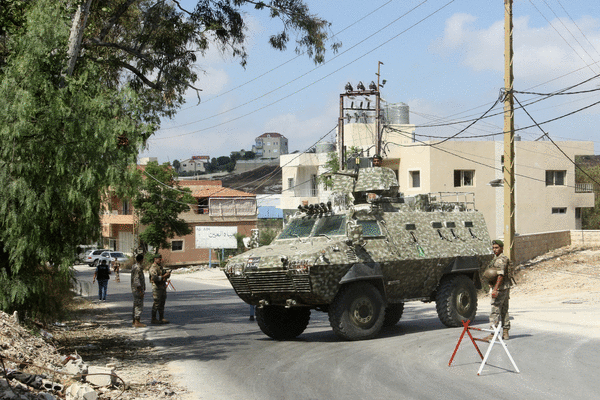
Israeli troops have withdrawn from parts of southern Lebanon under a U.S.-mediated ceasefire agreement, which aims to keep Iran-backed Hezbollah away from the Israeli border and end nearly five months of conflict.
The move comes after Lebanese President Joseph Aoun traveled to Washington for a meeting with U.S. President Donald Trump on Tuesday. It will be the first between leaders of the two countries for almost 20 years, with both seeking to rein in Hezbollah and establish peace after two rounds of intense fighting between the militant group and Israel.
The U.S. on Monday announced the activation of so-called pilot zones in southern Lebanon, which are designed to enable the Lebanese army to replace Israeli troops in occupied areas.
The idea is that Lebanon will establish military authority over Hezbollah, meaning Israel will no longer see the need to station troops across the border.
The latest round of fighting between Israel and Hezbollah began after the U.S. and Israel went to war against Iran at the end of February. Hezbollah, in solidarity with its patron, attacked Israel, which responded by sending tens of thousands of troops across the border. Israel’s attacks have killed thousands of people and displaced more than a million, according to the Lebanese government.
The Lebanese Armed Forces said its units entered Zawtar Al Gharbeye, one of the three initial pilot zones, after Israel withdrew from the town. It urged residents not to return until it’s deemed safe to do so. Hours later, the army said Israeli troops opened fire in the area and warned that such attacks could undermine the operation.
Israeli-issued maps show Zawtar Al Gharbeye as straddling the occupation zone’s northern edge. The Lebanese army said it already entered Froun and Srifa, beyond its boundary, in coordination with the Military Coordination Group for Lebanon, a framework that includes the U.S. and Israel.
The three towns are among more than 150 municipalities south of the Litani River, the focus of Israel’s occupation and military strikes against Hezbollah.
Under a deal signed last month between Lebanon and Israel in Washington, the two agreed on a plan to end the conflict and ultimately reach a peace settlement. The two countries have been in a technical state of war for decades.
Israel has said it needed to maintain control over the buffer zone — and prevent displaced Lebanese from returning there — as long as Hezbollah, which is deemed a terrorist group by the U.S., continues to pose a threat.
The pilot zones are a test of Lebanon’s capacity to keep Hezbollah out and to implement a decades-old undertaking by the Lebanese government to dismantle non-state armed groups. Hezbollah, whose once-formidable arsenal and political clout have been degraded by more than two years of fighting with Israel, decries the U.S.-backed plan as a national betrayal.
Aoun, trying to navigate a sensitive political environment in his home country, has insisted that Israel must withdraw from Lebanese territory and requested financial aid for the Lebanese army to carry out its duties.
Israeli Prime Minister Benjamin Netanyahu, who’s up for reelection in October, has described the troop moves in southern Lebanon as redeployments rather than withdrawals.
The IDF said it will “adjust its force posture” in one of the zones but that troops remained poised to respond to any threats.
—With assistance from Dan Williams.
©2026 Bloomberg L.P. Visit bloomberg.com. Distributed by Tribune Content Agency, LLC.





Comments