Wildfire smoke could leave northern Illinois by Friday afternoon as pollutant levels drop
Published in News & Features




CHICAGO — The National Weather Service expects wildfire smoke to leave northern Illinois sometime Friday afternoon.
Zachary Yack, meteorologist for the National Weather Service, said there’s potential for some smoke to later drift back into sections of northeastern Illinois, northern Illinois and northwest Indiana as Friday turns into the weekend. Conditions probably won’t be as bad as they were Thursday and Friday morning, he added.
Though conditions are slowly improving, the Chicago Park District announced Friday morning that Chicago beaches and pools will remain closed for a second day in a row, and that all day camps will be held indoors. The park district also said Osaka Garden, and both the Garfield Park Conservatory and Lincoln Park Conservatory will remain closed for the day.
Yack said he expects some scattered storms and showers Friday afternoon and Saturday. While rain often improves visibility, he said its impact on air quality is less certain.
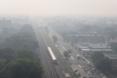
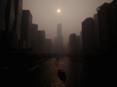
Smog covered portions of northern Illinois all of Thursday and Friday morning as smoke drifted in from wildfires in Canada and Minnesota. By late Thursday afternoon, Chicago had overtaken Detroit, Minneapolis and Toronto as the most polluted major city in the world, according to Swiss air quality company IQAir. Chicago moved to second behind Detroit on Friday morning.
Hazardous concentrations of the pollutant PM2.5 in the North Shore suburbs dropped from above 900 Thursday night to 465 Friday morning, according to AirNow, a website that combines data from county, state and federal air quality agencies nationwide. In Chicago, levels of PM2.5 fell from 669 Thursday night to 334 Friday morning.
Any rating above 300 represents a “health warning of emergency conditions,” according to AirNow.
Fine particles known as PM2.5, which can be emitted by factories, power plants, diesel and gasoline vehicles, residential fireplaces and wildfires, were the main drivers of elevated air quality. PM2.5 can harm human health and sometimes be deadly. Initially, fine particulate matter may cause a burning sensation in the eyes and nose. But because of its small size, it can settle deep in the lungs and cross into the bloodstream.
As climate change intensifies, concerns grow about air quality events that disrupt daily life becoming the norm. Scientists say climate change from human activities is making conditions like drought more common, thus increasing the size, frequency and severity of wildfires. Wind patterns also add a layer of unpredictability to the reach of bad air from intensifying, longer-lasting wildfires.
Temperatures Friday were expected to reach near 91, according to the weather service. Scattered showers and thunderstorms were possible this afternoon after 1 p.m. Saturday, the temperature was also expected to be near 91, with a slight chance of showers and thunderstorms between 11 a.m. and 2 p.m. Officials warned winds could gust up to 20 mph on Saturday.
On Sunday, officials expected a mostly sunny day, with a high near 81.
____
©2026 Chicago Tribune. Visit at chicagotribune.com. Distributed by Tribune Content Agency, LLC.






Comments