White House helipad to stop copter from burning lawn, Navy says
Published in News & Features
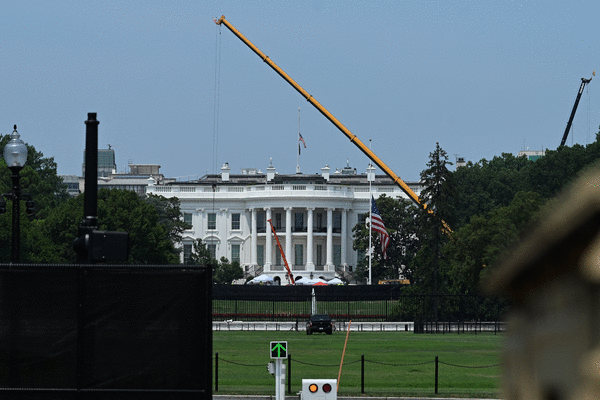
WASHINGTON — The landing pad under construction on the White House South Lawn will allow the new Lockheed Martin Corp. VH-92 helicopter designed to carry the president to meet a key unmet performance requirement — not damaging the grass, the U.S. Navy said.
The Navy in a Thursday statement stopped short of explicitly saying Lockheed failed to meet that demand. Still, the service said it is confident the pad will prevent “damage to the landing site” and “maintain safe obstacle clearance during all phases of approach, landing, take-off, and departure from the South Lawn.”
The White House did not respond to a request for comment.
Lockheed completed delivery of the Sikorsky Aircraft helicopters in 2024 for use as the new Marine One. But President Donald Trump and his predecessor, Joe Biden, had been forced to use older helicopters when traveling to and from the White House because the new model’s exhaust burned the lawn.
Trump confirmed earlier this month that a stone helipad was being built on the South Lawn to accommodate the newer helicopters. The older model landed directly on the grass and used temporary landing plates to protect the surface.
While the helipad is under construction, Trump has departed on Marine One from the Ellipse, a park just south of the White House.
The scorching issue is just one problem dogging the fleet of presidential aircraft. Amid years of delays at Boeing Co. for delivering a new Air Force One model, Trump turned to a luxury 747-8 gifted by Qatar to serve as a stopgap.
The Marine Corps, which operates the 23-aircraft, $5 billion helicopter program, is ensuring the HMX-1 squadron, which carries VIPs, “is appropriately resourced to fly all required missions in support of the president across a wide range of operating areas, including the White House South Lawn,” said the statement.
The Navy said that the contractor, and not the U.S. government, funded “aircraft modifications related to Landing Zone suitability.”
Lockheed’s Sikorsky unit in a statement defended the new helicopter as a “recognizable asset known around the globe for safety, security and reliability” and said it “delivers increased performance and reduced maintenance costs and time over the current fleet of presidential helicopters.”
The intractable problem, first identified in 2018, involved the helicopter’s spinning rotors and engine exhaust that damaged the grass where it lands. The helicopter is powered by a General Electric Co. engine.
Lockheed told Bloomberg News in April 2024 that it believed it had found a fix and would start testing it soon.
“We have been working in close collaboration with our customer and have an agreed upon landing zone solution with testing planned to validate and ensure the aircraft meets that specific operational requirement,” it said.
©2026 Bloomberg L.P. Visit bloomberg.com. Distributed by Tribune Content Agency, LLC.





Comments